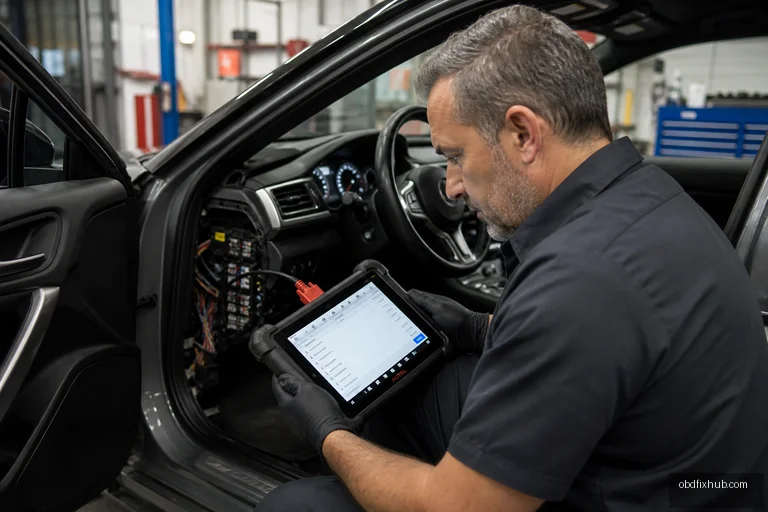
P00FF Body Control Module Requested MIL Illumination means the Body Control Module (BCM) has asked another control module to turn on the Malfunction Indicator Lamp (MIL), commonly called the check engine light. The code is usually a communication or reporting code—not the original fault itself—so replacing the BCM or simply clearing P00FF often fails to solve the problem.
What Does P00FF Mean?
The BCM manages many body-related systems, including lighting, door locks, security functions, wipers, interior electronics, and vehicle-network communication. When it detects a condition that should be reported to the driver, it can send a request over the CAN network for the MIL to illuminate.
In practical terms, P00FF is often a “follow-the-clue” code. The BCM may be reporting a fault stored in its memory, relaying a request from another module, or indicating that a networked controller has asked for the warning lamp. The precise definition and diagnostic procedure can vary by manufacturer, model year, and software version.
Is P00FF a Serious Code?
P00FF should not be judged by the code alone. The vehicle may drive normally, but the underlying problem could involve a safety or reliability system such as electronic stability control, airbag communication, immobilizer operation, or charging-system voltage.
If the check engine light is flashing, the vehicle is misfiring, it has lost power, or multiple warning lamps appeared at once, stop driving except to move the vehicle to a safe location. A steady MIL with normal drivability is usually less urgent, but it still deserves a complete scan rather than a quick code reset.
Common Causes of P00FF Body Control Module Requested MIL Illumination
- Another stored diagnostic trouble code: The BCM may be requesting MIL illumination because it detected a fault in a body, chassis, security, or communication system.
- Low battery voltage: A weak battery, poor ground, or failing alternator can cause several modules to reset or lose communication at the same time.
- CAN-bus communication problems: Open circuits, shorted wires, corrosion, water intrusion, or a failing network module can interrupt messages between the BCM and other controllers.
- BCM software or configuration errors: A failed programming event, incorrect vehicle configuration, or outdated calibration can trigger a request that is not resolved by replacing hardware.
- Blown fuse or poor power supply: BCM power and ground circuits must be checked under load; a fuse that looks intact does not prove the circuit is healthy.
- Water damage or connector corrosion: Moisture around the kick panel, fuse box, door harness, or windshield area can create intermittent electrical faults.
- Internal BCM failure: This is possible, but it should be considered only after power, ground, network wiring, software, and related codes have been verified.
Symptoms You May Notice
Symptoms depend on the fault that caused the BCM to request the MIL. Some vehicles show only a check engine light, while others develop several electrical complaints at the same time.
- Check engine light or another warning lamp illuminated
- Intermittent power-lock, window, wiper, or exterior-light operation
- Security or immobilizer warnings
- Battery drain after the vehicle is parked
- Modules disappearing during a diagnostic scan
- Hard starting, no-start conditions, or delayed ignition authorization
- Traction control, ABS, airbag, or instrument-cluster communication warnings
A useful diagnostic clue is timing. If P00FF appeared immediately after a dead battery, jump-start, battery replacement, aftermarket remote starter installation, or water leak, begin with voltage and network checks before condemning the BCM.
How to Diagnose P00FF Correctly
- Perform a complete vehicle scan. Use a scan tool capable of accessing the BCM, ABS, airbag, security, instrument cluster, and other modules. A basic code reader may show P00FF but hide the code that explains it.
- Record every code before clearing anything. Note whether each code is current, history, or intermittent. Communication codes that appear in several modules are especially important.
- Check battery and charging voltage. With the engine off, a healthy fully charged battery is typically near 12.6 volts. With the engine running, charging voltage is commonly around 13.5–14.8 volts, although smart-charging systems vary. Test during cranking as well; excessive voltage drop can create misleading module faults.
- Inspect BCM power, grounds, and connectors. Look for loose terminals, overheated fuse-box connections, green corrosion, and moisture. Voltage-drop testing is more reliable than simply checking continuity with a multimeter.
- Evaluate CAN communication. Check whether modules communicate consistently and follow the manufacturer’s resistance and waveform specifications. Do not probe network wires randomly with a test light; incorrect testing can damage communication circuits.
- Use manufacturer-specific service information. Look for technical service bulletins, software updates, configuration procedures, and known water-entry points for the exact vehicle.
How to Fix P00FF
The repair is determined by the underlying code, not by P00FF alone. A weak battery may require replacement and battery-management registration. A corroded connector may need terminal repair and water-leak correction. A CAN-bus fault requires locating the damaged circuit or module, while a software problem may require dealer-level programming.
If the BCM itself has failed, installation is rarely plug-and-play. Many vehicles require configuration, key or immobilizer synchronization, option coding, and sometimes a security relearn. A used BCM can work in certain applications, but compatibility, mileage data, component security, and programming requirements must be confirmed before purchase.
What Not to Do
- Do not replace the BCM solely because P00FF is present.
- Do not clear the code before recording all module-specific faults and freeze-frame data.
- Do not install a higher-rated fuse to stop repeated fuse failure.
- Do not ignore battery-voltage problems after a jump-start or battery replacement.
- Do not assume a generic OBD scanner has accessed every control module.
Can You Drive With P00FF?
Short-distance driving may be reasonable when the MIL is steady, the vehicle starts and drives normally, and no safety warning is present. Arrange diagnosis promptly if body electronics are malfunctioning, the battery is going flat, or multiple modules report communication errors.
Have the vehicle towed or stop driving if the MIL flashes, the engine runs severely rough, steering or braking assistance changes, the vehicle enters limp mode, or the immobilizer prevents reliable starting. Those symptoms suggest a fault more urgent than the reporting code itself.
Bottom Line
P00FF is best understood as a BCM-related request to illuminate the malfunction indicator lamp, not as a complete diagnosis. The fastest reliable repair is a full-module scan followed by battery, power, ground, CAN-network, connector, and software checks. Find and repair the original fault first; only then should BCM replacement be considered.
Frequently Asked Questions
Can a bad battery cause P00FF?
Yes. Low voltage during starting or charging instability can make several modules reset and generate communication or BCM-related requests. Test the battery under load and verify alternator output before replacing electronic modules.
Does P00FF mean the BCM is bad?
No. The code indicates that the BCM requested MIL illumination or is associated with that request. The actual cause may be another module, a network fault, low voltage, wiring damage, software, or the BCM itself.
Will clearing P00FF fix the check engine light?
It may turn the lamp off temporarily, but it will return if the underlying condition remains. A complete scan of all modules is necessary before clearing the code.
Can a generic OBD2 scanner diagnose P00FF?
It may display the code, but many generic scanners cannot read BCM, ABS, airbag, security, or manufacturer-specific data. A professional or manufacturer-capable scan tool is normally required for accurate diagnosis.
Should I replace the BCM with a used unit?
Only after confirming the original BCM is defective and verifying exact compatibility. Used units may require programming, configuration, immobilizer matching, or security relearn procedures before the vehicle will operate correctly.




