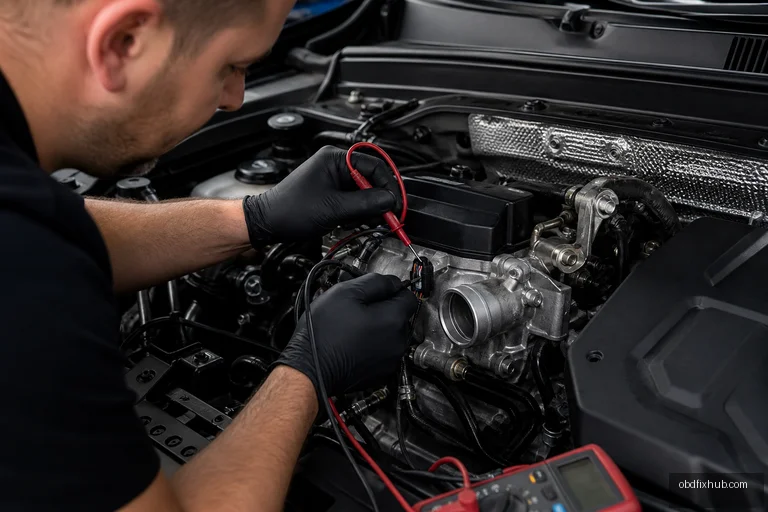
U02AF Lost Communication With Turbocharger Inlet Valve Sensor means the engine control module has stopped receiving valid data from the turbocharger inlet valve sensor or its control circuit. It does not automatically mean the turbocharger itself has failed. In many real-world cases, the fault is caused by a damaged connector, poor power or ground, wiring near the turbo heat shield, or a CAN/LIN network problem.
This is a communication-related diagnostic trouble code, so replacing the turbocharger before testing the electrical system is one of the most expensive mistakes you can make. The correct repair starts with identifying the vehicle manufacturer’s exact component name and checking whether the sensor, actuator, or valve has its own network connection.
What Does U02AF Mean?
U02AF is a network communication code. The powertrain control module, or PCM, expects messages from the turbocharger inlet valve sensor, but those messages are missing, invalid, or arriving outside the expected timing window. Depending on the manufacturer, the component may be described as a turbocharger inlet valve, compressor inlet valve, turbocharger air control valve, or turbocharger inlet pressure sensor.
That wording difference matters. Some vehicles use a simple pressure sensor with a conventional voltage signal, while others use an electronically controlled valve or smart actuator that communicates over CAN or LIN. Always confirm the factory service information for the specific year, engine, and VIN before applying a generic wiring diagram.
Common Symptoms of U02AF
The symptoms depend on whether the vehicle can substitute a default value or has placed the turbocharger system into a protective strategy. A diesel engine may limit boost to protect the engine and emissions system, while a gasoline engine may show reduced acceleration without immediately entering limp mode.
- Check Engine Light or reduced-power warning
- Weak acceleration, especially under load
- Reduced or inconsistent turbocharger boost
- Limp-home mode or a fixed low-power strategy
- Delayed throttle response
- Surging, hesitation, or uneven boost delivery
- Higher fuel consumption
- Additional CAN communication or actuator codes
A useful practical clue is the timing of the symptom. If power disappears immediately after driving through heavy rain, suspect water intrusion or a connector problem. If the fault appears only after the engine becomes hot, inspect wiring routed close to the turbocharger, exhaust manifold, or diesel particulate filter.
Why Does U02AF Set?
1. Damaged wiring or terminals
Turbocharger components live in a harsh environment. Heat, vibration, oil mist, and repeated movement can harden insulation or pull terminals partially out of a connector. A wire may look intact while its copper strands are broken inside the insulation, creating an intermittent open circuit that is difficult to find with a visual inspection alone.
2. Poor power or ground
An electronic inlet valve or sensor may lose communication when its supply voltage drops during cranking or when its ground develops excessive resistance. Battery condition, engine-to-body ground straps, and shared fuse circuits should be checked before condemning the sensor.
3. Corrosion or water intrusion
Connectors near the front of the engine, intake ducting, or turbocharger can collect water and road salt. Green discoloration, swollen seals, pushed-back terminals, and moisture inside the connector are strong evidence of a connection fault. Spraying contact cleaner without correcting a damaged terminal usually provides only a temporary improvement.
4. Failed sensor, valve, or actuator
The inlet valve sensor may have an internal electronics failure, or the complete actuator may stop transmitting on the vehicle network. Internal failure is more likely when power, ground, wiring continuity, and network signals are correct but the component remains absent from the scan tool’s data list.
5. CAN or LIN network fault
A shorted network wire, incorrect termination resistance, another failed module, or a blown shared fuse can prevent communication. If several unrelated modules report U-codes at the same time, do not focus only on the turbocharger. The root cause may be a network power supply or a single module pulling the bus down.
6. Software or calibration issue
Some manufacturers release software updates for communication dropouts, actuator plausibility errors, or incorrect wake-up behavior. If the wiring is sound and the code returns immediately after a verified component replacement, check technical service bulletins and PCM or actuator update procedures.
How to Diagnose U02AF Correctly
A professional diagnosis should reproduce the fault rather than simply erase the code. The following sequence avoids unnecessary turbocharger and actuator replacement.
- Record all codes and freeze-frame data. Note engine speed, battery voltage, coolant temperature, boost pressure, and whether the code is current, pending, or stored. Other U-codes often reveal a common power or network problem.
- Confirm the component identity. Use the manufacturer’s wiring diagram to determine whether U02AF refers to a pressure sensor, inlet valve position sensor, electronic valve, or complete actuator assembly.
- Inspect the harness physically. Follow the wiring from the component toward the main harness. Look for melted loom, contact with a bracket, oil contamination, stretched wires, and repairs made with household connectors.
- Check fuses, voltage, and ground under load. A circuit can show battery voltage with no load and still fail when the actuator operates. A voltage-drop test is more useful than a simple continuity beep.
- Test the communication circuit. On CAN-equipped systems, a scan tool may show the actuator disappearing from the network. Network resistance checks must be performed with the correct modules powered down and only according to the service procedure. LIN circuits require a different test strategy and should not be diagnosed like CAN.
- Use live data and an actuator test. Command the inlet valve through the scan tool while watching position, pressure, and communication status. A command that changes but produces no feedback points toward the actuator, sensor, or mechanical linkage.
- Verify the repair with a road test. Clear the code, allow the vehicle to complete its self-check, and test it under the conditions shown in the freeze frame. A stationary idle test may not reproduce a fault that occurs only during boost or vibration.
U02AF Repair: What Usually Fixes It?
The repair depends on the failed part of the circuit. Common fixes include repairing heat-damaged wiring, replacing corroded terminals, restoring a missing ground, sealing a connector against water, replacing the inlet valve sensor or actuator, and updating the relevant control module software.
After replacing an electronic turbocharger valve or actuator, many vehicles require calibration, initialization, or a learned-position procedure. Skipping that step can leave the original code cleared but cause a new position or plausibility code. Some systems also require an intake-air, turbocharger, or EGR adaptation reset after the repair.
Do not force the valve by hand unless the service manual permits it. Internal gears and position sensors can be damaged easily, and a valve that is mechanically stuck because of carbon or oil deposits may need cleaning or replacement according to the manufacturer’s instructions.
Can You Drive With U02AF?
Short-distance driving may be possible if the engine runs normally and the warning is not accompanied by severe power loss, smoke, overheating, or abnormal turbocharger noise. However, continued driving with incorrect boost control can increase emissions, reduce fuel economy, and place extra stress on the turbocharger or engine.
Stop driving and arrange professional diagnosis if the vehicle enters severe limp mode, produces blue or heavy black smoke, shows an oil-pressure warning, or makes a siren-like turbocharger noise. Those symptoms suggest a problem beyond a simple communication fault.
Estimated Repair Cost
Costs vary considerably by vehicle. A loose terminal or damaged wire may be a relatively small electrical repair, while replacing and programming a complete turbocharger actuator can be substantially more expensive. A turbocharger should not be included in the estimate until mechanical boost testing and the complete electrical diagnosis prove that it has failed.
When requesting an estimate, ask whether it includes connector repair, actuator calibration, software updates, and a post-repair road test. These details explain why two quotes for the same U02AF code can differ significantly.
Final Takeaway
U02AF indicates lost communication with the turbocharger inlet valve sensor or related actuator; it is not proof that the turbocharger must be replaced. Begin with the exact factory component definition, then test power, ground, wiring, connector condition, and CAN or LIN communication before replacing parts. If the code returns, a technician should verify the repair under real operating conditions and complete any required actuator calibration.
Frequently Asked Questions
Is U02AF caused by a bad turbocharger?
Usually, no. U02AF is primarily a communication fault, so wiring, terminals, power supply, grounding, or the electronic inlet valve should be tested first. A mechanically failed turbocharger may create related boost codes, but it does not automatically explain a lost communication code.
Can a weak battery cause U02AF?
Yes. Low cranking voltage or unstable system voltage can interrupt communication with an electronic actuator. Battery voltage should be tested during starting, and charging voltage should be checked with the engine running and electrical loads applied.
Will clearing U02AF fix the problem?
Clearing the code only removes the stored fault until the control module runs its communication check again. If the wiring or component fault remains, U02AF will return, often during the same temperature, vibration, or boost conditions.
Do I need to replace the turbocharger actuator after seeing U02AF?
Not necessarily. The actuator should be replaced only after its power, ground, network communication, wiring, and mechanical movement have been verified. On some vehicles, a replacement actuator also requires programming or position calibration.
Can a basic OBD scanner diagnose U02AF?
A basic scanner may display the code but often cannot access actuator data, network status, or calibration functions. A manufacturer-capable scan tool and a wiring diagram are normally needed for an accurate diagnosis.




