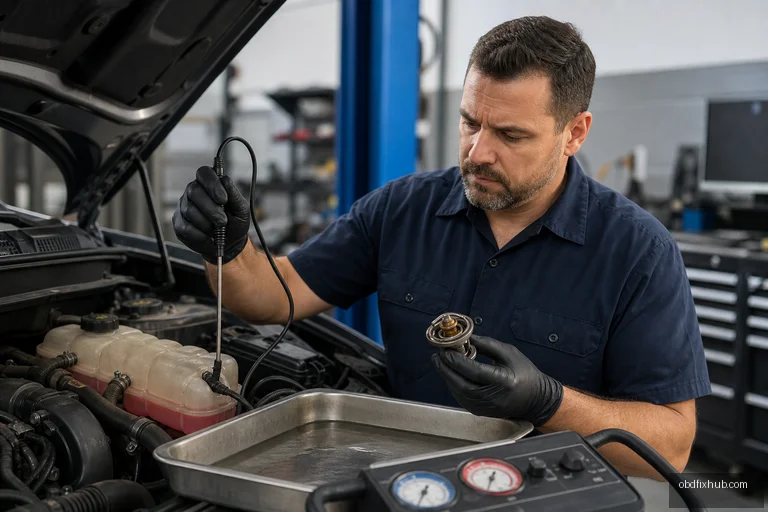
If your vehicle stores the code P0128 Coolant Thermostat Below Regulating Temperature, the engine is not reaching its expected operating temperature quickly enough. In most cases, the thermostat is stuck partially or fully open, but a low coolant level, inaccurate coolant temperature sensor, wiring fault, or cooling fan problem can produce the same code. The vehicle may still drive normally, so proper testing matters before replacing parts.
What Does P0128 Mean?
P0128 is a generic OBD-II trouble code that means the engine coolant temperature has remained below the temperature the engine computer expects during a defined driving period. The powertrain control module, or PCM, compares coolant temperature with factors such as intake air temperature, engine run time, vehicle speed, and calculated engine load.
The exact threshold varies by manufacturer, but many engines normally operate around 180–220°F (82–104°C). A vehicle can set P0128 when the coolant temperature rises too slowly, never reaches the calibrated target, or drops unexpectedly during steady driving. This is why the code does not automatically prove that the thermostat is defective.
P0128 Coolant Thermostat Below Regulating Temperature: Common Causes
- Thermostat stuck open: This is the most common cause. Coolant circulates through the radiator before the engine is warm, delaying normal operating temperature.
- Low coolant level: Insufficient coolant can prevent the temperature sensor from reading the engine accurately and may create air pockets around the sensor.
- Faulty engine coolant temperature sensor: A sensor that reports a temperature colder than reality can trigger P0128 even when the thermostat works correctly.
- Damaged wiring or corroded connectors: Intermittent resistance in the coolant temperature sensor circuit can create implausible temperature readings.
- Cooling fan running continuously: A failed fan relay, shorted control circuit, or incorrect fan command can overcool the engine, especially in cold weather.
- Incorrect thermostat or poor installation: A thermostat with the wrong temperature rating, installed backward, or fitted without the required seal can cause slow warm-up.
- Recent cooling-system service: Air trapped after a radiator, water pump, hose, or coolant replacement may interfere with temperature measurement and circulation.
Symptoms of the P0128 Code
Some drivers notice only the check engine light. Others experience several practical symptoms because an engine that runs too cool cannot maintain its intended fuel, ignition, and emissions strategy.
- Check engine light illuminated
- Cabin heater produces lukewarm air, particularly at idle
- Temperature gauge stays below its usual position
- Reduced fuel economy
- Longer warm-up time after a cold start
- Higher emissions or failure of an emissions inspection
- Automatic transmission shift behavior that feels different on some vehicles
- Engine performance that feels slightly sluggish during warm-up
A temperature gauge sitting near the normal mark does not completely rule out P0128. Dashboard gauges are often heavily damped and may show normal even when the scan data is below the PCM threshold.
How to Diagnose P0128 Correctly
Replacing the thermostat is often successful, but a quick scan-tool check can prevent an unnecessary repair. I recommend diagnosing the code in this order.
1. Check the coolant level and condition
With the engine completely cold, inspect the reservoir and radiator if the vehicle design allows access. Do not remove a radiator cap from a hot engine. Look for visible leaks around the thermostat housing, water pump, radiator, hoses, and heater-core connections. A low level or repeated loss of coolant must be repaired before evaluating the code.
2. Compare scan data with the real engine temperature
Using a scan tool, check the engine coolant temperature after the vehicle has sat overnight. The reading should be reasonably close to the outdoor temperature and the intake air temperature. If the scan tool shows -40°F, an implausibly high value, or a reading that does not change during warm-up, suspect the sensor or its circuit.
3. Watch the warm-up pattern
Start the engine cold and monitor coolant temperature while driving normally. A healthy engine should show a steady rise, then stabilize near its regulated temperature. If the reading climbs slowly and falls noticeably at highway speed or when the heater is used, a thermostat stuck open is highly likely.
4. Check the radiator hose carefully
On many vehicles, the upper radiator hose should remain relatively cool during initial warm-up and become hot when the thermostat opens. If it warms gradually from the first few minutes after startup, coolant may be flowing through the radiator too early. Use caution around moving belts, fans, and hot components; an infrared thermometer is safer than relying on touch.
5. Verify fan operation and electrical data
Confirm that the electric cooling fan is not running continuously when the engine is cold unless the vehicle manufacturer specifies that behavior. Inspect fan relays, sensor connectors, and wiring for corrosion, damaged insulation, or coolant contamination. Compare the coolant temperature signal with manufacturer specifications rather than relying only on the dashboard gauge.
How to Fix P0128
The correct repair depends on the test results. If the thermostat is stuck open or has the wrong rating, replace it with a quality part that matches the vehicle application. Install a new gasket or seal, clean the mating surfaces, and follow the manufacturer’s torque specification. A thermostat that is installed incorrectly can leak or fail to regulate temperature even when it is new.
After thermostat replacement, refill the cooling system with the specified coolant mixture and bleed all trapped air according to the service procedure. Some vehicles require a dedicated bleeder screw, a vacuum filling tool, or a specific heater and idle sequence. Simply topping up the reservoir may leave air in the system.
If the coolant temperature sensor is inaccurate, replace the sensor and inspect its connector at the same time. If the sensor data is correct, test the wiring from the sensor to the PCM for continuity, short circuits, and unwanted resistance. A cooling fan that runs constantly may require a relay, control module, wiring, or command diagnosis rather than a thermostat.
Can You Drive With P0128?
Short-distance driving is usually possible if the coolant level is correct, there is no leak, the temperature gauge is not overheating, and the engine is otherwise running normally. However, prolonged driving with a cold-running engine can reduce fuel economy, increase deposits and emissions, and prevent the vehicle from completing emissions monitor tests.
Stop driving and investigate immediately if the temperature rises above normal, the coolant warning light appears, steam is visible, the heater suddenly goes cold, or coolant is disappearing. P0128 itself usually indicates an engine that runs too cool, but the underlying cooling-system fault can still become serious.
What Happens After the Repair?
Clear the code only after the repair and check for leaks. Then allow the vehicle to complete a normal drive cycle that includes a cold start, city driving, and steady-speed operation. If P0128 returns, review live coolant-temperature data instead of installing another thermostat; repeated failures often point to a sensor, wiring, air pocket, fan-control issue, or an incorrect replacement part.
Key Takeaway
P0128 means the engine is not reaching its expected operating temperature within the required time. A thermostat stuck open is the leading suspect, but coolant level, air in the system, the coolant temperature sensor, wiring, and cooling-fan operation must also be checked. Diagnose the temperature data first, use the correct thermostat and coolant, bleed the system properly, and verify the repair with a complete drive cycle.
Frequently Asked Questions
Is P0128 always caused by a bad thermostat?
No. A stuck-open thermostat is common, but low coolant, a faulty coolant temperature sensor, wiring damage, trapped air, or a fan that runs continuously can also set P0128.
Can low coolant cause the P0128 code?
Yes. Low coolant can create air around the temperature sensor and prevent accurate readings. Check for leaks and correct the coolant level only when the engine is cold.
How long can I drive with P0128?
Limited driving is often possible when the engine is not overheating and the coolant level is stable. Arrange a diagnosis soon because extended cold operation can affect economy, emissions, and engine performance.
Will replacing the thermostat clear P0128?
It may, if the thermostat is the actual cause. The cooling system must also be filled and bled correctly, and the code should be verified with a scan tool after a complete warm-up drive.
Why does my car have P0128 but the temperature gauge looks normal?
Many dashboard gauges hide small temperature changes. The PCM uses precise sensor data and may detect a slow warm-up or low operating temperature that the gauge does not visibly show.




