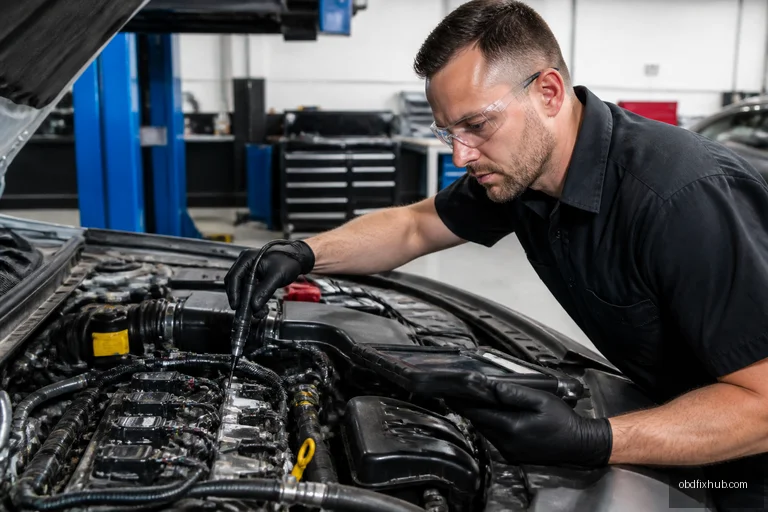
P0263 Cylinder 1 Contribution/Balance means the engine control module has detected that cylinder 1 is contributing noticeably more or less power than the other cylinders. The usual causes are a restricted or faulty fuel injector, injector wiring problems, poor compression, valve-train damage, or an air and fuel imbalance. Do not replace the injector automatically: a proper diagnosis must separate a fuel-delivery fault from a mechanical engine problem.
What Does P0263 Cylinder 1 Contribution/Balance Mean?
The PCM or ECM monitors crankshaft speed and, on many engines, injector correction or cylinder-balance data. When cylinder 1 produces a different amount of power from the remaining cylinders, the computer stores P0263. It is essentially telling you that one cylinder is not pulling its share of the load.
This code is common on diesel engines with electronically controlled common-rail injectors, but it can also appear on gasoline engines with individual fuel injectors. The exact test strategy varies by manufacturer. On some vehicles, P0263 is triggered by crankshaft acceleration; on others, it is based heavily on injector compensation values.
Cylinder numbering is not universal. On an inline engine, cylinder 1 is usually at the front of the engine, but the front may be defined differently depending on the manufacturer. On a V6 or V8, cylinder 1 is normally identified by the service manual rather than by assuming it is the front cylinder on a particular bank.
Common Symptoms of P0263
The symptoms depend on how far cylinder 1 is out of balance and whether the problem is fuel-related or mechanical. A mildly restricted injector may cause little more than a warning light, while a dead cylinder can make the vehicle unsafe or damage the catalytic converter.
- Check Engine Light or malfunction indicator lamp
- Rough idle, especially when the engine is warm
- Engine hesitation or a noticeable flat spot under acceleration
- Reduced power and poor fuel economy
- Hard starting or extended cranking
- Engine vibration that changes with RPM
- White, gray, or black smoke, depending on the engine and fault
- Diesel injector knock or an unusually sharp combustion sound
- Additional misfire or cylinder contribution codes
A flashing Check Engine Light, severe shaking, or heavy smoke should be treated as an immediate diagnostic issue. Continuing to drive with a gasoline misfire can overheat the catalytic converter, while an over-fueling diesel cylinder can wash oil from the cylinder wall and accelerate engine wear.
Most Likely Causes of P0263
1. Faulty, dirty, or restricted injector
The most obvious cause is an injector that is delivering too little or too much fuel. Deposits, internal wear, a sticking pintle, poor atomization, or an injector with excessive return flow can all reduce cylinder contribution. On common-rail diesels, the injector may still click electrically and yet fail mechanically.
2. Injector wiring or connector damage
Heat, oil contamination, vibration, and engine movement can damage the injector harness. A loose terminal may pass a basic continuity test but fail when the harness is flexed or when the injector is pulsed at operating temperature. Look closely for rubbed-through insulation, spread terminals, corrosion, and oil inside the connector.
3. Low compression or mechanical damage
Burned valves, worn piston rings, a damaged piston, a failed head gasket, or incorrect valve timing can make cylinder 1 weak even when the injector is perfect. Low compression is especially likely when the code is accompanied by hard starting, crankcase blow-by, a persistent misfire, or a noticeable difference in compression between cylinders.
4. Valve-train or camshaft problems
A worn cam lobe, collapsed lifter, bent pushrod, or valve that is not opening correctly can reduce air entering or leaving cylinder 1. This type of fault is often missed when diagnosis stops after an injector test. A visual inspection under the valve cover may be necessary on engines with known rocker-arm or lifter failures.
5. Air, fuel-pressure, or control problems
A restricted fuel filter, low supply pressure, unstable rail pressure, an intake leak, or an exhaust restriction can affect cylinder balance. These problems usually influence more than one cylinder, but the weakest cylinder may trigger the code first. Other stored codes, live fuel-pressure data, and freeze-frame information help reveal that pattern.
How to Diagnose P0263 Correctly
- Scan all modules and record the freeze-frame data. Note engine temperature, RPM, load, fuel pressure, battery voltage, and any accompanying misfire, rail-pressure, or injector circuit codes. Do not clear the code before saving this information.
- Confirm the complaint. Check whether the engine is rough at idle, under load, or only during cold start. A problem that disappears at higher RPM points toward a different cause than a cylinder that remains weak throughout the operating range.
- Inspect the cylinder 1 injector circuit. Check connector fit, terminal tension, power supply, driver wiring, and harness routing. A scope test is more useful than relying only on resistance, particularly with high-speed diesel injector circuits.
- Review cylinder-balance and injector-correction data. Treat correction values as clues, not proof. A large positive correction may indicate that the computer is adding fuel because the cylinder is weak, but it does not prove the injector itself is defective.
- Perform an injector test. Depending on the vehicle, this may include an injector cut-out test, return-flow test, pressure-drop test, or bench test. On some engines, swapping injectors between cylinders can confirm the diagnosis, but the injector must be coded or calibrated afterward if the manufacturer requires it.
- Test compression and valve operation. Use a compression test, relative compression test, or leak-down test. If compression is low, listen for air escaping through the intake, exhaust, crankcase, or cooling system to identify the mechanical fault.
- Verify fuel pressure and air flow. Compare commanded and actual rail pressure, inspect the fuel filter, and check for intake or exhaust restrictions. A fuel-pressure problem that affects the entire rail should not be treated as a single bad injector without further testing.
One practical diagnostic shortcut is to compare the engine while cold and fully warm. An injector with an internal leak may produce excessive correction when hot, whereas a compression or valve problem may become more obvious as the engine warms and oil viscosity changes. This comparison is not a substitute for testing, but it can help determine which test to perform next.
P0263 Repair: What Usually Fixes It?
The repair depends on the confirmed cause. A contaminated injector may sometimes respond to approved fuel-system cleaning, but a worn or leaking injector generally needs replacement or professional rebuilding. Do not rely on pouring cleaner into the tank when the injector has failed a return-flow or bench test.
- Repair or replace damaged injector wiring and connectors.
- Replace, code, or program the injector according to the manufacturer’s procedure.
- Replace a restricted fuel filter and correct low fuel-supply pressure.
- Repair burned valves, worn cam components, lifters, or compression-related engine damage.
- Correct intake leaks, exhaust restrictions, or fuel-rail pressure faults.
- Clear the codes and complete a road test while monitoring cylinder-balance data.
On many diesel engines, injector replacement is not the final step. The new injector may require an identification code to be entered into the ECM, and some systems need an injector quantity-learning or pilot-injection relearn procedure. Skipping that step can leave the engine rough and make a successful repair appear unsuccessful.
Can You Drive With P0263?
Short, gentle driving to a repair facility may be possible if the engine runs smoothly and the warning light is steady. Avoid towing, hard acceleration, and long trips until the fault is diagnosed. Stop driving and arrange recovery if the light flashes, the engine is shaking severely, oil level rises, smoke is heavy, or fuel pressure becomes unstable.
Summary: The Right Way to Fix P0263
P0263 identifies an imbalance in the power contribution of cylinder 1; it does not identify a specific failed part. Start with the stored data and injector circuit, then use balance testing, fuel-pressure checks, and compression or leak-down testing to separate an injector problem from an engine-mechanical fault. A measured diagnosis prevents unnecessary injector replacement and helps avoid expensive damage caused by continued misfire or over-fueling.
Frequently Asked Questions
Is P0263 the same as a cylinder 1 misfire code?
Not exactly. A misfire code, such as P0301, indicates that combustion is failing or inconsistent. P0263 indicates that cylinder 1 is contributing differently from the other cylinders. The two codes can appear together, but either one may also occur alone.
Does P0263 always mean the injector is bad?
No. The injector is a common cause, but wiring faults, low compression, valve-train damage, fuel-pressure problems, and air restrictions can create the same imbalance. Injector correction data should always be confirmed with a circuit, flow, or mechanical test.
Can low compression cause P0263?
Yes. A burned valve, worn piston, damaged cylinder, or valve-timing problem can make cylinder 1 produce less power. If injector testing does not identify a fault, a compression or leak-down test is the next logical step.
Where is cylinder 1 located?
It depends on the engine design and manufacturer. Consult the service information for the exact vehicle rather than assuming cylinder 1 is always at the front or on a particular bank.
Will clearing P0263 fix the problem?
Clearing the code only resets the stored fault. If the imbalance remains, the ECM will usually set P0263 again after the required drive cycle or monitoring conditions are met.




