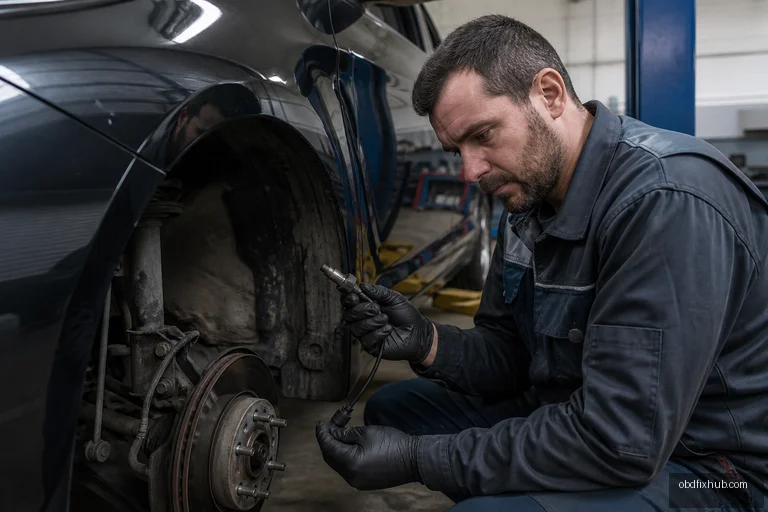
P0297 Vehicle Overspeed Condition means the powertrain control module (PCM) has detected a vehicle speed above the limit programmed into its calibration. It does not automatically prove that the vehicle was actually driven too fast. A faulty vehicle speed sensor, incorrect tire size, ABS wheel-speed signal, wiring problem, or communication error can all trigger P0297.
This is an informational diagnostic code, but it should not be ignored. The PCM may reduce engine power, limit transmission operation, or store additional speed-sensor and communication codes until the problem is corrected.
What Does P0297 Mean?
P0297 is a generic OBD-II powertrain code defined as Vehicle Overspeed Condition. The PCM compares vehicle-speed information with a manufacturer-defined maximum threshold. If the reported speed remains above that threshold or reaches an implausible value, it records the code.
The exact threshold and strategy vary by manufacturer. Some vehicles use the transmission output speed sensor, while others calculate vehicle speed from ABS wheel-speed sensors or a dedicated vehicle speed sensor (VSS). Because of that variation, a manufacturer-specific service manual is more useful than a generic code description alone.
Common Symptoms of P0297
The symptoms depend on whether the vehicle really experienced an overspeed event or received a false speed signal. In many cases, the driver notices a warning light before any serious drivability problem appears.
- Check Engine Light or service warning message
- Reduced engine power or a limp-home mode
- Transmission stuck in one gear or delayed shifting
- Speedometer reading that jumps, drops, or becomes inaccurate
- ABS, traction-control, or stability-control warning lights
- Cruise control becoming unavailable
- Unexpected engine braking or unusual transmission behavior
- Stored communication or wheel-speed sensor trouble codes
A useful real-world clue is the combination of warning lights. P0297 with ABS and traction-control codes usually points toward a wheel-speed or network problem. P0297 by itself, especially after a tire change or performance modification, deserves a different line of investigation.
Most Likely Causes of P0297 Vehicle Overspeed Condition
1. Faulty vehicle speed sensor
A failing VSS or transmission output speed sensor can generate intermittent spikes rather than a stable speed signal. Metal debris on a magnetic sensor, internal sensor damage, or a poor connector can produce a false overspeed reading. The sensor may work normally at low speed and fail only when vibration or temperature increases.
2. ABS wheel-speed sensor or tone-ring problem
Many modern vehicles derive vehicle speed from individual wheel sensors. A damaged reluctor ring, excessive wheel-bearing play, corrosion under the sensor mounting surface, or a sensor cable stretched during suspension work can create an implausible wheel-speed value.
If one wheel suddenly reports 150 mph while the other three show 40 mph, the PCM may interpret that data as an overspeed condition. This is why reading only the engine computer can miss the real fault; the ABS module should also be scanned.
3. Incorrect tire or wheel size
Installing tires with a substantially different rolling circumference changes the relationship between wheel rotation and road speed. A minor size difference normally will not create P0297 by itself, but an incorrectly programmed tire-size calibration can cause speed calculations to become unreliable, particularly after an axle, transmission, or body-control-module replacement.
4. Damaged wiring, connectors, or poor grounds
Speed signals are vulnerable to open circuits, short circuits, water intrusion, and electromagnetic interference. Inspect wiring near the transmission, wheel hubs, suspension components, and exhaust system. A harness that is pulled tight at full steering lock may work during a road test and fail when the wheel is turned.
5. CAN-bus or module communication fault
The PCM may receive vehicle-speed data from the ABS, transmission, or body control module over the CAN network. A network interruption, low battery voltage, faulty module, or poor ground can make the PCM receive corrupted or implausible speed information.
6. Actual overspeed event or incorrect calibration
In some applications, P0297 can be set after a genuine high-speed event. It may also appear after a non-factory engine or transmission calibration has been installed. Do not assume a software issue until sensor data, tire size, and freeze-frame information have been checked.
How to Diagnose P0297 Correctly
Replacing the speed sensor immediately is a common mistake. The first step is to determine whether the PCM saw a genuine speed value or an electrical signal that only looked like overspeed.
- Record all stored codes. Scan the PCM, ABS, transmission, and body modules if the scan tool supports them. Note whether P0297 is current, pending, or history.
- Save freeze-frame data. Record vehicle speed, engine rpm, gear, throttle position, battery voltage, and road conditions when the code set.
- Compare scan-tool speed with the dashboard. During a controlled road test, compare indicated speed, GPS speed, and live data. Use a safe, legal location and never reproduce an overspeed condition on public roads.
- Check individual wheel-speed data. At low speed, all four wheel readings should remain close. A single signal that drops out or spikes identifies the side requiring inspection.
- Inspect the physical components. Look for damaged tone rings, loose wheel bearings, sensor debris, corrosion, damaged connectors, and wiring that has rubbed against a tire or suspension part.
- Test the circuit. Use the vehicle wiring diagram to check reference voltage, ground quality, signal continuity, and short circuits. Do not probe sensitive CAN wires with an unsuitable test light.
- Verify programming and tire configuration. Confirm the tire size, final-drive ratio, module programming, and replacement-part calibration match the vehicle.
On a professional diagnosis, graphing live wheel-speed data is often more revealing than watching a numerical PID. A brief spike may disappear from the screen but remain obvious on a graph. If the problem occurs only over bumps, perform a careful wiggle test while monitoring the signal.
How to Fix P0297
The correct repair depends on the failed input, not the code name. Common repairs include replacing a defective VSS, repairing damaged wiring, cleaning or replacing an ABS sensor, installing a damaged tone ring, correcting wheel-bearing play, or repairing a CAN-bus power or ground fault.
Aftermarket wheels and tires should be checked against the manufacturer’s approved size range. If a module was replaced, it may require configuration, relearning, or software programming with factory-level equipment. Clearing the code without completing that procedure can make the fault return immediately.
After repairs, clear the codes and perform a complete road test under normal conditions. Confirm that the speedometer is stable, all wheel-speed values agree, the transmission shifts normally, and no ABS or traction-control warnings return. A code that returns only after several miles may indicate an intermittent harness or bearing issue rather than a permanently failed sensor.
Can You Drive With P0297?
Short, careful driving may be possible if the speedometer is accurate and the vehicle has no loss of power, harsh shifting, ABS warning, or stability-control problem. However, avoid unnecessary driving if the speed reading is wrong or multiple chassis warning lights are active. The vehicle may not know its true speed, and safety systems such as ABS, traction control, and cruise control may be disabled.
If the engine is in limp mode, the transmission is stuck, or the car suddenly reports an extreme speed, have it diagnosed rather than continuing to drive. Towing is the safer choice when braking or stability-control functions are affected.
Key Takeaway
P0297 does not necessarily mean the driver exceeded the speed limit. It means the PCM received a vehicle-speed value above its programmed limit or judged the speed signal to be implausible. Start with a complete module scan and freeze-frame data, compare live speed readings, inspect wheel-speed and VSS circuits, and verify tire and module calibration before replacing parts.
Frequently Asked Questions
Can a bad wheel speed sensor cause P0297?
Yes. On vehicles that calculate road speed through ABS wheel sensors, one sensor producing an unrealistic spike can trigger P0297. ABS, traction-control, or stability-control codes often appear at the same time.
Is P0297 caused by driving too fast?
Sometimes, but not always. The code can result from a genuine overspeed event, yet a faulty sensor, damaged tone ring, wiring fault, or corrupted network signal can create the same condition.
Will changing tires fix P0297?
Changing to the correct tire size may solve the problem if the vehicle has an incorrect rolling circumference or calibration. It will not repair a defective speed sensor, damaged wiring, or ABS tone ring.
Can I clear P0297 with an OBD scanner?
You can clear the stored code, but it will return if the underlying speed signal remains incorrect. Always record the freeze-frame data and diagnose the cause before erasing it.
Does P0297 affect the transmission?
It can. Transmission shift timing depends on accurate vehicle-speed information, so the vehicle may shift harshly, stay in one gear, or enter fail-safe mode until the fault is repaired.




