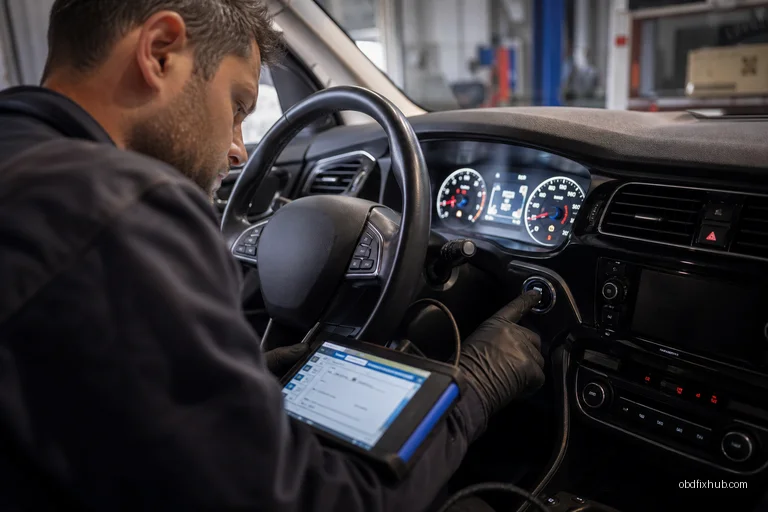
P05BC Stop-Start Mode Switch Circuit/Open means the engine control module has detected a missing or electrically invalid signal from the vehicle’s automatic stop-start mode switch circuit. The usual causes are a failed switch, damaged wiring, a loose connector, corrosion, or low system voltage—not automatically a bad starter or engine computer. This guide explains what the code means, how to diagnose it without replacing parts blindly, and when the fault is actually caused by another system.
What Does the P05BC Code Mean?
P05BC is a generic OBD-II diagnostic trouble code related to the stop-start mode switch input. The exact switch design varies by manufacturer. It may be a dashboard button, a console switch, a steering-column control, or part of a larger switch assembly monitored by the body control module and powertrain control module.
The word open is important. It usually means the control module cannot see the expected electrical path or voltage signal. That can happen because a wire is broken, a terminal has backed out, a connector is wet, or the switch contacts no longer change state when pressed. It does not necessarily mean the button is physically stuck in the open position.
Some vehicles use a simple switch-to-ground circuit, while others send the request over a LIN or CAN network. For that reason, the correct voltage test and pin locations must come from the vehicle’s wiring diagram. A generic internet pinout can easily lead to a short circuit or a false diagnosis.
Common Symptoms of P05BC
The most obvious symptom is that automatic engine stop-start no longer operates. The vehicle will normally continue idling at traffic lights, even when the battery, engine temperature, and other conditions appear suitable.
- Check Engine Light or service warning message
- Stop-start unavailable, disabled, or temporarily unavailable message
- The stop-start indicator does not illuminate when the button is pressed
- The system works intermittently, especially after rain, vibration, or interior repairs
- Other body-control or communication codes stored at the same time
- Battery or charging warnings caused by a weak 12-volt battery
P05BC normally does not prevent the vehicle from starting or driving. However, the stop-start system is deliberately disabled because the module cannot trust the driver’s mode request. If the vehicle also has crank, charging, transmission, or communication symptoms, those faults need separate attention.
Most Likely Causes of P05BC
- Defective stop-start switch: Internal contacts can wear out, particularly when the switch is pressed frequently or contaminated with spilled liquid.
- Open or damaged wiring: Look for broken wires near the center console, dashboard trim, steering-column harness, or areas recently disturbed during accessory installation.
- Loose or corroded connector: A terminal may be pushed backward inside the plug and look connected while making no electrical contact.
- Low battery voltage: Stop-start systems are highly sensitive to battery state of charge. A weak AGM or EFB battery can create multiple misleading codes.
- Incorrect battery replacement: Some vehicles require battery registration or coding. Installing the wrong battery type can keep the system disabled.
- Fuse or power supply problem: A blown fuse may affect the switch circuit or several related cabin functions.
- Network or control-module fault: On vehicles using data communication rather than a direct switch circuit, a body module, LIN bus, or CAN wiring fault may be involved.
How to Diagnose P05BC Properly
A professional diagnosis begins with a complete scan, not with replacing the dashboard switch. Record every code in every module before clearing anything. Save freeze-frame data, battery voltage, ignition status, and the conditions under which P05BC was set.
1. Check the battery and charging system first
With the engine off after the vehicle has rested, a healthy 12-volt battery is commonly near 12.6 volts, although temperature and battery condition affect the reading. During cranking, voltage should not collapse excessively. With the engine running, charging voltage should also be checked according to the vehicle’s smart-charging strategy; a fixed voltage assumption is not suitable for every modern car.
If the battery is weak, test or replace it with the correct AGM or EFB specification and perform the required battery registration. Clear the code, drive through several normal stop-start conditions, and rescan. A battery problem can imitate a switch fault, but it will not repair a genuinely open wire.
2. Inspect the switch and harness
Operate the button while watching the switch status on a scan tool, if the vehicle supports live data. The parameter should change consistently between enabled and disabled. If the scan tool shows no change, inspect the switch connector, terminals, fuse, and wiring before condemning the control module.
Gently move the harness while monitoring the data. If the switch status changes when the harness is flexed, there is probably a broken conductor or poor terminal tension. Do not use a test light on a data-network circuit unless the service procedure specifically permits it; a digital multimeter and wiring diagram are safer choices.
3. Compare the circuit with manufacturer specifications
Disconnect the battery or modules only when the service information instructs you to do so. Measure continuity, resistance, and short-to-ground or short-to-power conditions using the specified connector pins. A circuit that appears continuous on the bench can still fail under load, so a voltage-drop test is valuable when corrosion or a high-resistance connection is suspected.
4. Check for software and related faults
Review technical service bulletins for the exact year, engine, and transmission. Some manufacturers have updated control-module software for stop-start logic or switch-status errors. Do not program a module simply because P05BC is present; verify power, ground, network integrity, and the manufacturer’s diagnostic routine first.
What Does “DTCs in This ECU” Mean?
When a scan tool displays DTCs in this ECU, it means diagnostic trouble codes stored in the electronic control unit currently being viewed. ECU stands for Electronic Control Unit. The screen may refer to the engine ECU, body control module, transmission module, or another controller, depending on the menu you selected.
It does not mean that every fault in the vehicle is stored in that one module. For example, the engine ECU may report P05BC while the body module stores a switch or communication code that explains why the engine ECU set it. Always perform a full-system scan when a code involves a networked feature such as stop-start.
What Are Vehicle DTC Codes?
DTC means Diagnostic Trouble Code. These standardized or manufacturer-specific codes tell a scan tool that a module detected a condition outside its expected electrical or operating range. The first character identifies the area: P for powertrain, B for body, C for chassis, and U for network communication.
The remaining characters provide more detail, but the code is a starting point rather than a parts order. P05BC identifies the monitored function and fault type; it does not prove that the switch itself is defective. Testing the circuit and checking related codes is what turns a code into a reliable repair decision.
What Are Secondary DTC Codes?
Secondary DTCs are additional codes recorded alongside the main or primary fault. They may be a consequence of the original problem rather than independent failures. For example, a low battery can set voltage, communication, and stop-start codes during the same start event.
Technicians usually prioritize power-supply, ground, battery, and communication codes before chasing a downstream switch code. Clear all codes only after recording them, repair the confirmed root cause, then perform a road test and rescan. If a secondary code returns by itself, it may require its own diagnosis.
How Is P05BC Fixed?
The repair depends on the test result. A failed switch requires replacement of the switch or the relevant switch assembly. A damaged wire should be repaired with the correct automotive splice, insulation, and terminal treatment—not twisted together and covered with household tape.
Corroded terminals may require terminal replacement rather than spray cleaner alone. If the battery is weak, install the correct specification and register it when required. A module replacement or software update should be considered only after the circuit, power, grounds, and communication lines have been proven good.
Can You Still Drive With P05BC?
In many cases, yes. The vehicle generally remains driveable because the system fails in a safe mode and leaves the engine running. Drive cautiously and arrange a diagnosis soon if the code is accompanied by a battery warning, multiple communication faults, stalling, hard starting, or other warning lights.
Final Takeaway
P05BC points to a problem with the stop-start mode switch signal, but the root cause may be a switch, wiring, connector, battery, fuse, network, or software issue. Start with a full scan and battery test, then verify the switch signal and wiring with the correct service information. If you do not have live-data access or a wiring diagram, a qualified technician can often locate the fault faster than repeated parts replacement.
Frequently Asked Questions
Is P05BC caused by a bad car battery?
It can be, especially when the battery has low state of charge or the wrong type was installed. Test the battery and charging system before replacing the stop-start switch, but confirm the switch circuit if the code returns with a healthy battery.
Does P05BC mean the starter motor is bad?
No. P05BC concerns the stop-start mode switch circuit. The starter may never be commanded because the system is disabled, but that does not prove the starter is defective.
Will clearing P05BC fix the stop-start system?
Clearing the code may turn off the warning temporarily, but it will not repair an open circuit, failed switch, weak battery, or communication fault. The code will return when the module reruns its monitor.
Why does my scan tool show several secondary DTCs?
Multiple codes can be triggered by one low-voltage event, a shared ground, or a network interruption. Save the codes first, then diagnose the power and communication-related faults before replacing individual components.




