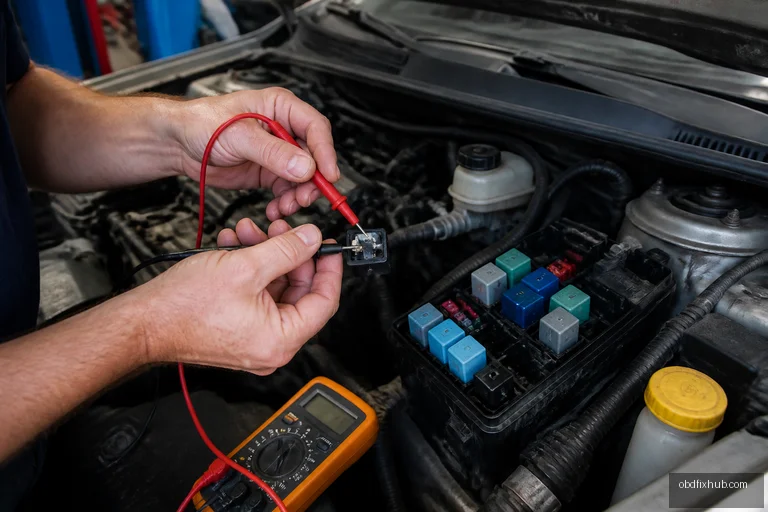
P0645 means the vehicle’s engine or powertrain control module has detected a problem in the A/C clutch relay control circuit. The fault may be caused by a blown fuse, failed relay, damaged wiring, poor ground, an A/C clutch coil problem, or a control-module issue. The code does not automatically prove that the compressor itself is bad, so replacing the compressor first is often an expensive mistake.
What Is Code P0645?
OBD-II trouble code P0645 is defined as A/C Clutch Relay Control Circuit. The vehicle computer uses this circuit to command the relay that supplies power to the air-conditioning compressor clutch. When the command and the electrical feedback do not match the expected voltage, the module stores P0645.
The exact circuit design differs by manufacturer. Some vehicles have the PCM control the relay directly, while others route the command through an A/C amplifier, body control module, or integrated power module. For that reason, the factory wiring diagram for the specific year, engine, and model matters more than a generic internet pinout.
P0645 Symptoms You May Notice
The most obvious symptom is an air conditioner that blows warm air, but the fault can appear in less obvious ways. In many vehicles, the computer disables compressor operation as a protective measure when it cannot control the relay reliably.
- A/C compressor clutch does not engage.
- Warm air from the vents, even when the A/C button is illuminated.
- Intermittent cooling that works after hitting a bump or moving the wiring harness.
- A/C clutch engages briefly and then drops out.
- Check Engine Light or service-engine warning.
- Cooling fans may behave abnormally, depending on the vehicle’s control strategy.
- Other communication, voltage, or power-distribution codes stored at the same time.
If the clutch clicks on but the air remains warm, P0645 may not be the only problem. Low refrigerant, a restricted expansion valve, a faulty pressure sensor, or a mechanically damaged compressor can produce a similar complaint after the relay circuit is repaired.
Common Causes of the P0645 A/C Clutch Relay Control Circuit
- Failed A/C clutch relay: The relay contacts may be burned, stuck open, or internally corroded.
- Blown fuse: A shorted clutch coil or damaged harness can repeatedly open the A/C fuse.
- Open or shorted control wire: Wires near the compressor, radiator fan, battery tray, and fuse box are exposed to heat, vibration, and moisture.
- Defective compressor clutch coil: An open coil will prevent the clutch from engaging; a shorted coil can damage the relay or fuse.
- Bad ground or power feed: Voltage may be present at one test point but collapse under load because of corrosion or a loose connection.
- Faulty pressure sensor or A/C request signal: These faults can prevent normal relay activation and may accompany P0645.
- Control-module or fuse-box fault: This is less common and should be considered only after the wiring, relay, fuse, and clutch have passed testing.
How to Diagnose P0645 Without Guessing
A professional diagnosis starts with the circuit, not with refrigerant replacement. Record every stored and pending code first, because a low-voltage or communication code may explain why the A/C relay command is missing.
- Confirm the complaint. Check whether the A/C request is recognized by the scan tool and whether the compressor clutch actually engages.
- Inspect the fuse and relay. Look for overheated terminals, water intrusion, loose pins, and melted plastic. If the relay is interchangeable with another identical relay, a temporary swap can be useful, but confirm that the replacement has the same part number and pin configuration.
- Check power and ground under load. Do not rely only on a visual inspection or a no-load voltage reading. A test light or voltage-drop test can reveal a connection that fails when current flows.
- Test the clutch coil. With the connector disconnected and the vehicle-specific specifications available, measure coil resistance. An open circuit indicates a broken coil; an unusually low reading suggests an internal short. Never apply battery power blindly if the clutch is controlled by a variable or protected circuit.
- Test the relay control side. Using a wiring diagram, verify the relay’s battery feed, output to the clutch, ignition or module supply, and control ground or control voltage. The expected reading depends on whether the module switches the ground or the power side.
- Inspect the harness while testing. Gently move the wiring near the compressor and fuse box. If the signal changes, look for rubbed insulation, stretched wires, oil contamination, or terminals pushed back inside the connector.
A useful field clue is a relay that clicks but does not deliver voltage to the clutch. That usually points to burned relay contacts, a poor socket connection, or an open output wire. A relay that never clicks requires checking the command side, module inputs, pressure-sensor data, and system voltage before condemning the relay itself.
What Happens When the A/C Clutch Relay Goes Bad?
When the A/C clutch relay fails open, the compressor clutch receives no power and the A/C normally stops cooling. If the relay contacts stick closed, the clutch may remain engaged when it should be off, which can overload the compressor or create abnormal belt noise. A relay with high internal resistance may work intermittently and become hot enough to discolor the fuse-box terminal.
Do not ignore a relay that repeatedly fails. A new relay may appear to fix the issue temporarily, but a shorted clutch coil or damaged wire can destroy the replacement within minutes or days.
Where Is the A/C Clutch Relay Located?
The A/C clutch relay is commonly located in the under-hood fuse and relay box, usually near the battery, air-intake assembly, or fender. Some vehicles place the relay inside an integrated power module; others use a solid-state driver rather than a removable relay. The fuse-box cover may show an A/C, HVAC, MG CLT, COMP, or A/C CLUTCH label, but labels vary widely.
Use the owner’s manual and factory service information to identify the correct relay position. On certain vehicles, the relay is built into the fuse-box assembly and is not serviceable separately. Pulling random relays can disable fuel, engine-management, or safety systems, so identify the circuit before removing anything.
Can You Bypass the A/C Clutch Relay?
Bypassing the relay is not a proper repair and should not be used as a permanent solution. Jumpering the relay socket can send power to the compressor without the normal protection provided by the PCM, pressure switches, temperature logic, and fuse strategy. It can cause compressor damage, belt failure, wiring overheating, or an unexpected loss of engine power.
A technician may use a fused test lead briefly during diagnosis, but only after identifying the correct load terminals and confirming that the compressor is safe to energize. Never bridge terminals with a random piece of wire, and never bypass the system if the refrigerant charge, pressure readings, or clutch coil condition is unknown.
P0645 Repair Options and Typical Cost Factors
The correct repair depends on the failed part. A fuse or relay may be inexpensive, while harness repairs require more labor because the damaged section must be traced and protected from exhaust heat or moving components. A compressor clutch coil may be serviceable separately on some models but may require compressor replacement on others.
- Replace the correct fuse or relay after finding the reason it failed.
- Repair corroded terminals and damaged wiring rather than simply adding a new connector.
- Replace the A/C clutch coil or compressor when testing proves it is defective.
- Repair pressure-sensor, control-module, or fuse-box faults only after the primary circuit has been verified.
After the repair, clear the code, operate the A/C through several on/off cycles, monitor clutch command and pressure data, and perform a road test. If P0645 returns immediately, the circuit still has an electrical fault; if the code stays gone but cooling remains poor, investigate the refrigeration system separately.
Key Takeaway
P0645 identifies a fault in the A/C clutch relay control circuit, not necessarily a failed compressor. Start with the fuse, relay, wiring, clutch-coil resistance, power, and ground, then use scan-tool data and the manufacturer’s wiring diagram to confirm the failed component. Avoid bypassing the relay except for a controlled diagnostic test, and repair the cause rather than repeatedly replacing the relay.
Frequently Asked Questions
What is code P0645?
P0645 is an OBD-II code for an electrical fault in the A/C clutch relay control circuit. It can involve the relay, fuse, wiring, clutch coil, control module, or related A/C inputs.
What happens when the A/C clutch relay goes bad?
The compressor clutch may not engage, causing warm air from the vents. If the relay sticks closed, the clutch can remain engaged and potentially damage the compressor or drive system.
How do I bypass the A/C clutch relay?
Do not bypass it as a repair. A qualified technician may use a properly fused jumper briefly for diagnosis, but an improvised bypass can overheat wiring, damage the compressor, or defeat pressure protection.
Where is the A/C clutch relay located?
It is usually in the under-hood fuse and relay box near the battery, although some vehicles use an integrated power module or solid-state control. Check the vehicle-specific fuse-box diagram before testing.
Can low refrigerant cause P0645?
Low refrigerant usually prevents compressor operation through the pressure-sensor or pressure-switch logic, but it is not the direct definition of P0645. Check for related pressure codes and verify the relay circuit before adding refrigerant.




