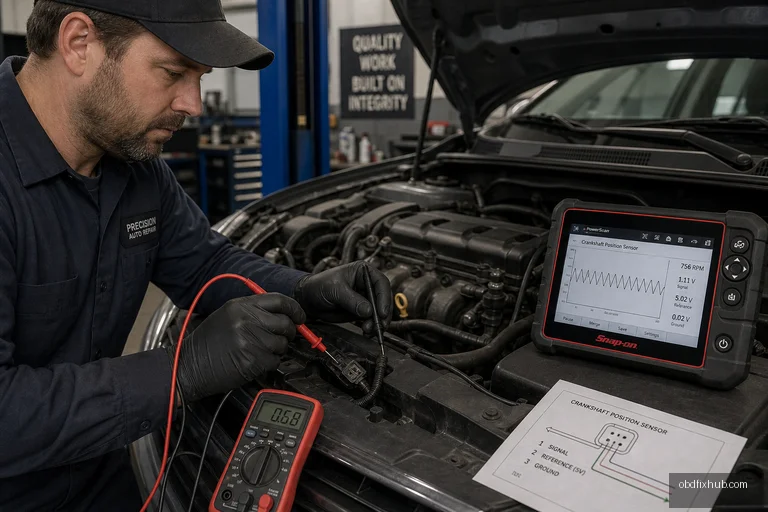
P0725 Engine Speed Input Circuit means the transmission control system is not receiving a reliable engine RPM signal from the engine speed input circuit. In practice, the fault is commonly linked to a crankshaft position sensor, damaged wiring, poor electrical connections, or a communication problem between the engine and transmission modules. Do not replace the sensor automatically: the fastest diagnosis starts by checking whether the scan tool sees engine RPM while the engine is cranking.
What Does P0725 Mean?
Diagnostic trouble code P0725 is a generic powertrain code related to the engine speed input signal used by the transmission control module (TCM) or powertrain control module (PCM). The module needs accurate RPM information to select gears, control shift timing, manage torque converter lockup, and coordinate fuel and ignition strategies.
Although the code description says “engine speed input circuit,” the exact design varies by vehicle. Some vehicles obtain RPM directly from the crankshaft position sensor (CKP), while others receive a calculated signal from the PCM over the CAN network. The manufacturer’s wiring diagram and service information are therefore essential before testing individual wires.
P0725 Symptoms You May Notice
The symptoms depend on whether the RPM signal is completely missing, intermittent, or merely implausible. A vehicle with a brief signal drop may drive almost normally, while a complete failure can prevent the engine from starting.
- Check Engine Light or transmission warning light
- Hard starting, extended cranking, or a no-start condition
- Engine stalling when slowing down or coming to a stop
- Harsh, delayed, or incorrect automatic transmission shifts
- Transmission stuck in one gear or failsafe mode
- Inoperative tachometer or an RPM reading that suddenly drops to zero
- Poor acceleration, reduced fuel economy, or limited-power operation
A useful real-world clue is the tachometer during cranking. If it remains at zero and the scan tool also reports zero RPM, the PCM may not be receiving a crankshaft speed signal. If the tachometer works but the transmission still logs P0725, suspect signal quality, module communication, wiring, or a transmission-control-side issue instead of assuming the crank sensor has failed.
Common Causes of P0725
- Defective crankshaft position sensor or engine speed sensor
- Damaged, stretched, oil-soaked, or corroded sensor wiring
- Loose terminals, backed-out pins, or poor connector contact
- Incorrect sensor air gap, damaged reluctor wheel, or excessive mechanical play
- Low battery voltage or unstable charging-system output
- Missing sensor power supply, ground, or reference voltage
- CAN communication faults between the PCM and TCM
- Faulty PCM or TCM, although module failure is less common than circuit faults
- Related crankshaft or camshaft sensor codes, such as P0335 or P0340
Water intrusion is an especially common cause on vehicles where the crank sensor connector sits low on the engine or near the transmission bellhousing. A connector can look clean externally while its terminals are loose enough to create an intermittent open circuit under vibration.
How to Diagnose P0725 Correctly
1. Scan all modules, not only the engine computer
Begin with a complete vehicle scan and record every stored, pending, and history code. Check freeze-frame data, including engine RPM, battery voltage, vehicle speed, and transmission gear when P0725 was set. A related low-voltage or communication code may be more important than P0725 itself.
2. Check live RPM while cranking
Connect a professional scan tool and monitor engine speed while cranking for five to ten seconds. Most systems should display a stable cranking RPM value, often around 150 to 300 RPM, although the correct range varies. A steady zero usually points toward a missing CKP signal, sensor power or ground problem, or a circuit fault.
If the scan tool shows an implausible value, such as a sudden jump from 200 RPM to several thousand RPM during cranking, suspect electrical interference, a poor sensor signal, damaged reluctor teeth, or a wiring fault. Do not rely on the dashboard tachometer alone because it may use a filtered or substitute signal.
3. Inspect the circuit before replacing parts
Follow the sensor harness from the connector to the PCM or transmission harness. Look for rubbing against brackets, melted insulation near the exhaust, oil contamination, and repairs made with household connectors or twisted wires. Gently tug each terminal; a wire can be crimped externally while broken inside the insulation.
Verify battery voltage, engine grounds, and sensor supply voltage. Low system voltage during cranking can create misleading sensor and communication codes, so measure battery voltage under load rather than checking only a parked battery. Clean and tighten the battery terminals and engine-to-body ground strap if voltage drop is excessive.
4. Use a wiring diagram and oscilloscope when needed
Resistance testing alone does not prove that a crankshaft sensor works. A magnetic sensor may show acceptable resistance but produce a weak waveform, while a Hall-effect sensor may have correct resistance readings that reveal nothing useful. An oscilloscope can show whether the signal has consistent amplitude, frequency, and clean transitions during cranking.
Compare the sensor waveform with a known-good reference or the manufacturer’s pattern. If the sensor produces a clean signal at its connector but the PCM does not receive it, the harness or terminal connection is the likely fault. If the signal is missing directly at the sensor, inspect the sensor, reluctor wheel, air gap, and mechanical timing.
How to Fix P0725
The correct repair depends on the test results. Common fixes include replacing a failed crankshaft position sensor, repairing an open or shorted wire, restoring a damaged ground, tightening connector terminals, or repairing CAN communication wiring. After the repair, clear the code and perform a complete road test while monitoring engine RPM and transmission operation.
- Replace the sensor only after confirming the power, ground, wiring, and signal requirements.
- Route repaired wiring away from ignition coils, alternators, exhaust components, and sharp brackets.
- Use sealed automotive splices and heat-shrink protection in areas exposed to moisture.
- Check for manufacturer software updates if the circuit tests correctly but the code returns.
- Inspect the reluctor or tone wheel if a new sensor produces an inconsistent waveform.
After clearing P0725, the vehicle may need a relearn procedure for the crankshaft position sensor or transmission adaptations. Follow the manufacturer’s procedure; simply erasing the code does not confirm that the repair is complete.
Can You Drive With P0725?
Short-distance driving may be possible if the engine runs normally and the transmission shifts properly, but continued driving is risky. A failing RPM signal can cause sudden stalling, harsh shifts, or a transmission limp mode. Avoid driving in heavy traffic or at highway speed when the tachometer drops unexpectedly, the engine stalls, or the transmission is locked in one gear.
P0725 Repair Cost Considerations
Repair cost varies widely by vehicle and access to the sensor. A simple sensor replacement may be relatively affordable, while a harness repair behind the engine or a network fault between modules can require several hours of diagnosis. Before authorizing an expensive PCM or TCM, insist on test results showing that the sensor waveform, wiring continuity, power supplies, grounds, and communication circuits are correct.
Final Takeaway
P0725 is not a parts-replacement diagnosis; it is a signal-quality and circuit problem. Start with a full scan, observe live RPM during cranking, verify power and grounds, inspect the harness carefully, and use an oscilloscope when the fault is intermittent. These steps prevent unnecessary sensor and transmission-module replacements and lead to a reliable repair.
Frequently Asked Questions
Is P0725 caused by a bad crankshaft position sensor?
It can be, but not always. Damaged wiring, poor connector tension, low voltage, reluctor damage, and PCM-to-TCM communication faults can produce the same code. Test the circuit and live RPM before replacing the sensor.
Will P0725 prevent my car from starting?
Yes, if the engine computer does not receive a usable crankshaft speed signal, it may disable fuel injection or ignition. Some vehicles will still start if the signal is intermittent, but they may stall unexpectedly.
Can a weak battery trigger P0725?
Yes. Low cranking voltage can distort sensor signals or interrupt module communication. Check battery voltage while cranking and inspect the main battery and engine ground connections.
Is it safe to drive with the P0725 code?
Only with caution if the vehicle runs and shifts normally. Do not continue driving if it stalls, loses the tachometer signal, shifts harshly, or enters limp mode, because the fault can worsen without warning.
What should be checked first for P0725?
Scan all modules, review related codes and freeze-frame data, then monitor engine RPM while cranking. This simple observation often separates a missing crank signal from a transmission communication or wiring problem.




