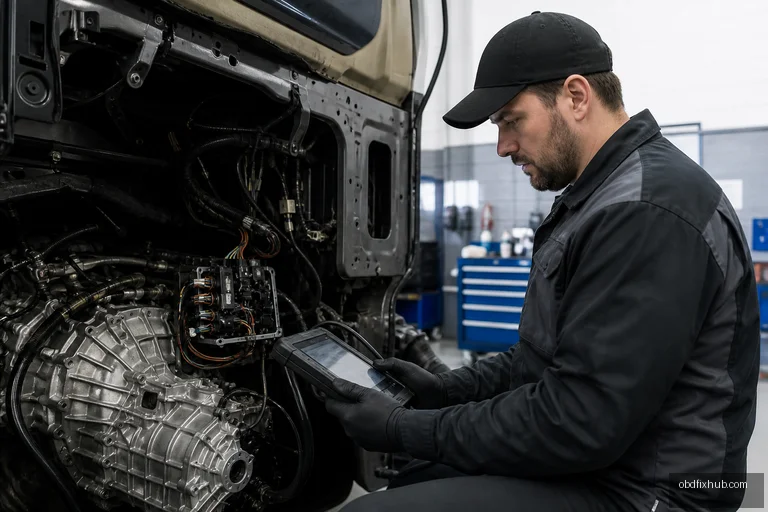
P077E transmission fluid temperature sensor correlation means the transmission control module has detected an implausible or inconsistent temperature signal. In practical terms, the temperature reported by one transmission fluid temperature sensor does not agree with another sensor, a calculated value, or the expected temperature change. The fault may be caused by a failing sensor, damaged wiring, contaminated transmission fluid, a connector problem, or—less commonly—a control module issue.
This is a diagnostic trouble code that should not be diagnosed by replacing the sensor immediately. A technician needs to compare live temperature data, inspect the harness, and confirm that the transmission is reaching a believable operating temperature.
What Does the P077E Code Mean?
P077E is an OBD-II transmission code associated with a transmission fluid temperature sensor signal that is intermittent, implausible, or out of correlation. The exact wording varies by manufacturer. Some vehicles may define it specifically as a transmission fluid temperature sensor “B” circuit problem, while others describe it as a temperature sensor correlation fault.
That distinction matters. OBD code definitions are not completely universal beyond the standardized code structure, so the factory service information for the particular vehicle should be used before testing terminals or ordering parts. A professional scan tool may also display a more accurate manufacturer-specific description than a basic code reader.
Why Temperature Correlation Matters
The transmission control module uses fluid temperature to adjust shift timing, line pressure, torque-converter operation, and protection strategies. On some transmissions, two temperature sensors are compared. On others, the module compares a sensor reading with transmission input speed, output speed, engine coolant temperature, or a calculated warm-up model.
For example, a cold transmission sitting overnight should show a fluid temperature close to ambient temperature. If one sensor reports 20°C while another reports 140°C before the engine starts, the module recognizes that the values cannot both be correct and may set P077E.
Common Symptoms of P077E
The symptoms depend on whether the signal is merely intermittent or permanently incorrect. Some vehicles drive normally at first, while others enter a protective operating strategy as soon as the code is detected.
- Illuminated Check Engine or transmission warning light
- Harsh, delayed, or erratic gear changes
- Transmission stuck in one gear or limp mode
- Torque-converter clutch not engaging correctly
- Reduced fuel economy
- Transmission overheating warning
- Incorrect temperature shown on a scan tool
- Intermittent symptoms after driving over bumps or when the transmission is hot
A particularly useful clue is a temperature value that suddenly jumps from a realistic number to an extreme reading, such as -40°C or more than 150°C. Those values often indicate an open circuit, short circuit, poor connection, or failed thermistor rather than an actual fluid temperature change.
Most Common Causes of the P077E Code
- Failed transmission fluid temperature sensor: The sensor may develop an internal open circuit or drift out of calibration when hot.
- Damaged internal transmission harness: Wiring inside the valve body or transmission pan can rub, break, or become saturated with fluid.
- Corroded or loose connector: Fluid intrusion, road salt, and poor terminal tension can interrupt the low-voltage sensor circuit.
- Incorrect or degraded transmission fluid: The wrong fluid, severe overheating, or heavy contamination can affect sensor operation and hydraulic performance.
- Valve body or mechatronic fault: On electronically controlled transmissions, the temperature sensor may be integrated into a conductor plate or valve-body assembly.
- Power or ground problem: A shared sensor reference, ground, or transmission control power supply can create misleading temperature data.
- Transmission control module software issue: A calibration error is less common but possible, particularly if a technical service bulletin applies.
How to Diagnose P077E Correctly
1. Check all codes and freeze-frame data
Do not diagnose P077E in isolation. Record related codes, vehicle speed, engine coolant temperature, transmission temperature, gear command, and battery voltage from the moment the code was stored. A low-voltage event or a second sensor code can change the entire diagnostic direction.
2. Compare cold-start temperatures
After the vehicle has been parked for several hours, compare transmission fluid temperature with engine coolant temperature and ambient temperature. The readings do not need to be identical, but they should be reasonably close. A large difference before driving is a strong indication of a sensor or circuit fault.
3. Watch the data while moving the harness
Use a scan tool to graph the temperature signal during a road test. The reading should rise gradually as the transmission warms. If it drops suddenly when the harness is moved, the transmission is shifted, or the vehicle crosses a bump, inspect the connector and internal wiring for an intermittent open.
4. Inspect the connector and transmission pan
Look for bent terminals, pushed-back pins, green corrosion, fluid inside the connector, and wiring that is pinched against the case. If the pan is removed, check for excessive metal debris or burnt-smelling fluid. A temperature sensor problem accompanied by significant debris may be a symptom of internal transmission wear, not an isolated electrical failure.
5. Test resistance against the factory specification
Most transmission temperature sensors are thermistors whose resistance changes with temperature. Measure resistance only after identifying the correct sensor terminals and specification. Never apply arbitrary battery voltage to a thermistor circuit; doing so can damage the control module.
Resistance should also be checked at more than one temperature if the fault is intermittent. A sensor can test normally at room temperature and fail only after the transmission reaches operating temperature. This is one reason a quick driveway resistance test often produces a false “sensor is good” conclusion.
How to Fix P077E
The correct repair depends on what the testing proves. Common repairs include replacing an external temperature sensor, repairing damaged wiring, restoring terminal tension, replacing a transmission internal harness, or replacing a conductor plate or mechatronic assembly when the sensor is integrated into it.
- Repair or replace damaged sensor wiring using sealed automotive splices.
- Clean corroded terminals only when the terminals can still hold proper tension; badly damaged terminals should be replaced.
- Replace the transmission fluid and filter if the fluid is contaminated and the manufacturer’s service procedure permits it.
- Replace the sensor or integrated sensor assembly according to the factory procedure.
- Perform any required transmission adaptive reset or temperature sensor calibration with a capable scan tool.
- Clear the code and complete the specified drive cycle before confirming the repair.
Be cautious with a simple fluid flush. If the transmission is already slipping, overheating, or producing metal debris, servicing the fluid alone will not correct the underlying failure. Conversely, replacing a valve body or transmission based only on P077E is equally inappropriate without proving a mechanical fault.
Can You Drive With P077E?
Short, gentle driving may be possible if the transmission shifts normally and no overheating warning is present. However, extended driving is risky because the control module may use a default temperature value and apply incorrect shift or pressure strategies. Stop driving and arrange a repair if the vehicle is stuck in one gear, shifts violently, smells burnt, or displays a transmission temperature warning.
Practical Repair Tip From Real-World Diagnosis
When P077E appears only after rain, washing, or a long drive, technicians should prioritize connector and harness testing before condemning the sensor. Heat can expand a weak terminal connection, while moisture can temporarily bridge or interrupt a low-voltage circuit. Reproducing the fault with a heat gun, controlled harness movement, or a monitored road test is often more effective than replacing parts based on a single static resistance measurement.
Summary: The Best Next Step
P077E points to a transmission fluid temperature signal that does not make sense to the control module. Start with the exact manufacturer definition, scan data, and cold-start temperature comparison. Then inspect the connector and harness, test the sensor at different temperatures, and only replace components after the electrical fault has been proven.
If the transmission is shifting harshly or entering limp mode, have it diagnosed promptly. Correctly repairing the circuit early can prevent unnecessary transmission damage and avoid an expensive parts-first repair.
Frequently Asked Questions About P077E
Is P077E always caused by a bad transmission temperature sensor?
No. Wiring damage, poor terminal contact, fluid intrusion, a shared sensor-ground fault, or a control module issue can produce the same code. The sensor should be tested rather than replaced automatically.
Can low transmission fluid cause P077E?
Low fluid can cause overheating and abnormal transmission operation, but it does not always create a temperature correlation code directly. Check the fluid level using the manufacturer’s exact temperature and procedure, then inspect for leaks and electrical faults.
Will changing the transmission fluid clear P077E?
Only if contaminated or incorrect fluid caused the abnormal condition—and even then, the code may require a scan-tool reset and drive cycle. Fluid service will not repair an open circuit, corroded connector, or failed sensor.
How serious is the P077E code?
Its severity ranges from minor intermittent data loss to a fault that causes harsh shifting and limp mode. Treat it as important, especially if the transmission warning light, overheating message, or abnormal shifting is present.
Can a basic OBD scanner diagnose P077E?
A basic scanner can retrieve the code, but transmission temperature correlation faults usually require live data, freeze-frame information, circuit testing, and sometimes bidirectional controls. A manufacturer-capable scan tool provides much more reliable diagnosis.




