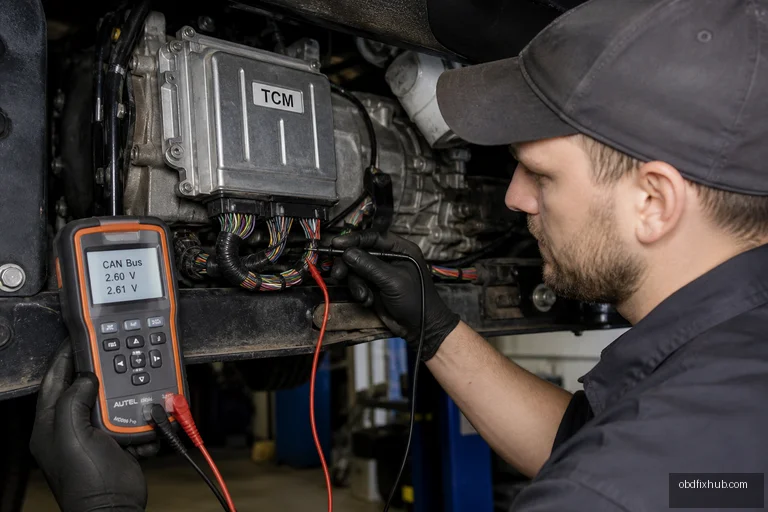
P0863 TCM Communication Circuit means the vehicle has detected a problem exchanging data with the Transmission Control Module (TCM). In most cases, the fault is caused by low system voltage, damaged CAN-bus wiring, a poor ground, water intrusion, or a communication network problem—not automatically a failed TCM. Accurate diagnosis requires scanning every control module and testing the network before replacing expensive parts.
What Does the P0863 Code Mean?
P0863 is an OBD-II diagnostic trouble code associated with the TCM communication circuit. The TCM manages transmission functions such as shift timing, line pressure, torque-converter clutch operation, and gear selection. It must constantly exchange information with the engine control module, ABS module, body control module, and other systems over the vehicle’s communication network.
On most modern vehicles, this communication occurs through the Controller Area Network, commonly called CAN bus. When the expected messages from the TCM are missing, corrupted, delayed, or outside the permitted voltage range, the vehicle may store P0863. The exact wording and diagnostic strategy can vary by manufacturer, so the factory service information for the specific year, make, engine, and transmission remains important.
P0863 Symptoms You May Notice
A vehicle can store P0863 with very few noticeable symptoms, especially when the communication failure is intermittent. In more severe cases, the transmission enters a protective or “limp-home” mode to prevent further damage.
- Transmission warning light, check engine light, or a flashing gear indicator
- Harsh, delayed, or unpredictable shifts
- Transmission stuck in one gear, often second, third, or reverse
- Failure to shift into drive or reverse
- Loss of manual shift or sport mode functions
- Intermittent no-start condition on vehicles that require TCM authorization
- Multiple unrelated communication codes stored in other modules
- Speedometer, ABS, cruise control, or stability-control malfunctions
One useful diagnostic clue is the pattern of the codes. If P0863 appears alongside U0101, U0001, U0121, or several low-voltage codes, the problem is more likely to involve the power supply, ground, CAN wiring, or network rather than the transmission’s mechanical components.
Common Causes of P0863 TCM Communication Circuit
1. Weak battery or unstable charging voltage
A low battery can produce a surprising number of false communication faults. During cranking, voltage may drop low enough for the TCM to reset, while an overcharging alternator can damage or disrupt sensitive electronic modules. Check battery condition and charging voltage before condemning a communication circuit.
2. Damaged CAN-bus wiring
The CAN network generally uses twisted CAN-High and CAN-Low wires. A short to power, short to ground, open circuit, crushed harness, poor splice, or excessive corrosion can prevent the TCM from communicating. Harness damage is common near the transmission, battery tray, fuse box, exhaust heat shields, and areas exposed to road salt.
3. Poor power or ground connection
The TCM may have power at one pin but still fail under load because of a corroded fuse, loose connector terminal, damaged relay, or weak ground strap. A visual inspection alone is not enough. Voltage-drop testing while the circuit is loaded often reveals resistance that a simple continuity test misses.
4. Water intrusion or connector corrosion
Moisture can enter a TCM connector through a damaged seal, blocked drain, windshield leak, transmission-fluid leak, or pressure-washed engine bay. Look for green corrosion, swollen terminals, white residue, pushed-back pins, and water marks around the module and its harness.
5. Failed TCM or another module on the network
A defective TCM can stop transmitting and set P0863, but another module that is shorting the CAN network can create the same symptom. This is why replacing the TCM based only on the code is a common and expensive mistake. The network must be tested first.
6. Incorrect programming or aftermarket electrical equipment
A recently replaced TCM may require software configuration, immobilizer pairing, or calibration. Remote starters, alarm systems, trailer wiring, tracking devices, and poorly installed audio equipment can also interfere with CAN communication if they tap into the wrong circuits.
How to Diagnose P0863 Correctly
A professional diagnosis should identify whether the TCM is missing power, unable to transmit, or being isolated by a fault elsewhere on the network. The following sequence is more reliable than clearing the code and immediately installing a module.
- Record every stored code and freeze-frame detail. Use a scan tool capable of communicating with all modules, not only the engine computer. Note whether P0863 is current, history, or intermittent.
- Check battery and charging voltage. A healthy battery should normally measure about 12.4–12.7 volts with the engine off. Charging voltage is commonly near 13.5–14.8 volts, although specifications vary. Watch voltage during cranking as well.
- Inspect TCM fuses, relays, grounds, and connectors. Test both sides of each fuse with the circuit powered. Check for voltage drop between the TCM ground and battery negative while the circuit is operating.
- Verify TCM power under load. A test light or suitable load can expose a circuit that shows battery voltage with a digital meter but cannot supply current through a corroded connection.
- Test CAN resistance with the vehicle asleep. On many networks, approximately 60 ohms between CAN-High and CAN-Low indicates two 120-ohm terminating resistors in parallel. A reading near 120 ohms, very low resistance, or an open circuit requires further investigation. Always follow the manufacturer’s procedure before testing.
- Check CAN voltage and waveform. With the network active, CAN-High and CAN-Low should switch in a controlled differential pattern. A lab scope can reveal a shorted line, excessive electrical noise, missing termination, or a module that is holding the network dominant.
- Separate the network if necessary. If one module is pulling down the bus, technicians may disconnect modules one at a time according to the wiring diagram to locate the source. Never unplug modules randomly on vehicles with safety or immobilizer systems.
- Confirm software and configuration. If a TCM was replaced or the vehicle recently received programming, verify that the correct part number, calibration, coding, and security relearn procedures were completed.
How to Fix P0863
The repair depends on the test result. A weak battery should be charged or replaced, and the charging system should be corrected if it is overcharging. Damaged CAN wiring must be repaired with the correct wire type, proper twists, sealed connections, and routing that protects it from heat and vibration.
Corroded terminals should not simply be sprayed and reconnected. The connector must be inspected for loss of terminal tension, then repaired or replaced as specified. Clean and secure all relevant grounds, including transmission grounds and engine-to-body straps.
If the TCM has correct power, ground, network connections, and termination but does not communicate, module failure becomes more likely. Even then, confirm whether the module needs programming, initialization, or replacement with a VIN-compatible unit. A used TCM may require specialist cloning or reconfiguration before the vehicle will operate normally.
Can You Drive With P0863?
Driving is risky when the transmission is stuck in one gear, shifting violently, slipping, or refusing to select drive or reverse. Continued operation can increase transmission heat and mechanical stress. If the vehicle shifts normally and the code is intermittent, a short trip to a repair facility may be possible, but avoid heavy traffic, towing, and long-distance driving until the communication fault is diagnosed.
A Practical Diagnostic Tip Many People Miss
Check whether P0863 appears immediately after a battery replacement, jump-start, engine-bay wash, transmission repair, or aftermarket accessory installation. The timing often points directly to the cause. Also compare the scan tool’s ability to communicate with the TCM: if the scan tool cannot enter the TCM at all while other modules respond, focus first on TCM power, ground, connector integrity, and CAN wiring rather than internal transmission failure.
Summary: The Right Way to Handle P0863
P0863 identifies a TCM communication problem, not a guaranteed transmission or TCM failure. Start with battery voltage, scan all modules, inspect power and grounds, and test the CAN network before replacing parts. A structured diagnosis prevents unnecessary module replacement and helps distinguish a simple wiring repair from a genuine programming or TCM fault.
Next step: Have the vehicle scanned with a full-system diagnostic tool and request the actual voltage, ground, resistance, and network test results—not just a recommendation to replace the TCM.
Frequently Asked Questions
Is P0863 caused by a bad transmission?
Usually not directly. P0863 is a communication fault, so the primary causes are electrical power, grounds, CAN wiring, connectors, software, or a control module. A mechanical transmission problem may exist separately, but it should not be assumed from this code alone.
Can a low battery trigger P0863?
Yes. Low cranking voltage or unstable alternator output can reset the TCM and interrupt communication. Battery and charging-system tests should be among the first diagnostic checks.
How much does it cost to fix P0863?
Cost varies widely. A loose ground or damaged wire may be relatively inexpensive, while CAN harness repairs, programming, or TCM replacement can cost substantially more. The diagnostic time and required module configuration often account for a significant part of the final bill.
Should I replace the TCM when P0863 is stored?
No. Replace or reprogram the TCM only after confirming its power, ground, connector pins, CAN communication, and network termination. Another module or wiring fault can cause the same code.




