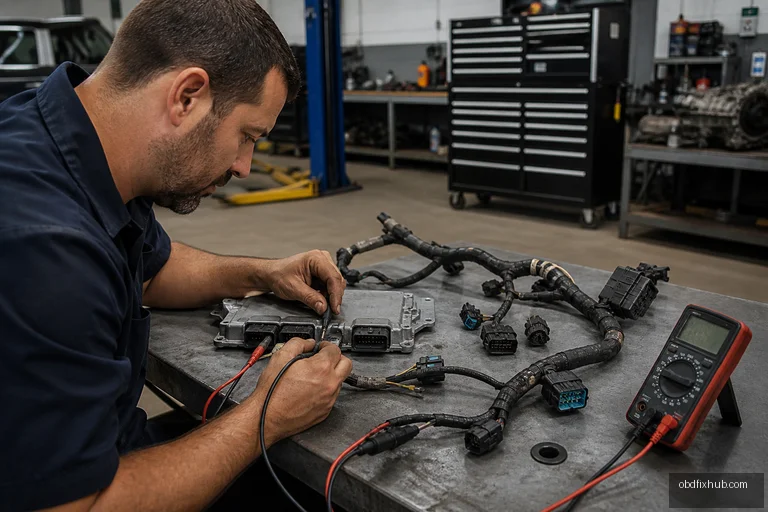
P0880 TCM Power Input Signal means the transmission control module (TCM) is receiving an incorrect, unstable, or missing power input. In practice, the fault is often caused by a weak battery, blown fuse, poor ground, damaged ignition feed, or corroded connector—not by a failed TCM itself. Proper voltage and circuit testing should come before replacing an expensive control module.
What Does P0880 TCM Power Input Signal Mean?
Code P0880 is a generic OBD-II power-input fault for vehicles equipped with an electronically controlled automatic transmission. The TCM needs a clean battery supply, an ignition-switched supply, and reliable grounds to operate solenoids and communicate with other modules. When the voltage it sees falls outside the expected range, disappears intermittently, or does not match the ignition state, it stores P0880.
The exact circuit designation varies by manufacturer. Some vehicles route transmission power through a dedicated fuse and relay, while others integrate the TCM into the powertrain control module (PCM). For that reason, the factory wiring diagram and the vehicle-specific service bulletin are more useful than assuming every P0880 diagnosis follows the same pinout.
P0880 Symptoms You May Notice
A TCM with an unreliable power supply cannot control transmission pressure and shift solenoids consistently. The vehicle may continue driving normally at first, then enter fail-safe mode after a voltage interruption or a restart.
- Check Engine Light or transmission warning light
- Harsh, delayed, or missing gear changes
- Transmission stuck in one gear, often second or third
- Delayed engagement of Drive or Reverse
- Intermittent no-shift condition after starting
- Reduced fuel economy and higher engine speed on the highway
- Several communication or low-voltage codes stored in other modules
- Occasional no-start or crank-but-no-shift symptoms on certain vehicles
A useful clue is timing. If the fault appears immediately after a battery replacement, jump-start, alternator problem, water leak, or engine-bay repair, inspect the power and ground circuits before suspecting an internal transmission problem.
Common Causes of P0880
1. Low system voltage or a failing battery
A weak battery can pull module voltage down during cranking. The engine may still start, but the TCM can reset before communication is established. Check battery voltage after the vehicle has rested and observe voltage during cranking; a severe drop below the vehicle manufacturer’s specification is a significant lead.
2. Blown TCM fuse or faulty relay
A blown fuse may be the result of a shorted harness, a water-damaged connector, or an internally failed component. Replacing the fuse without finding why it opened can cause it to fail again. A relay with burned contacts can also provide partial voltage: enough to test with no load, but not enough to operate the TCM reliably.
3. Damaged power or ignition feed wiring
Harnesses near the battery tray, transmission case, exhaust, and underbody are exposed to heat, vibration, oil, and moisture. A wire may look intact while its copper strands are broken inside the insulation. Intermittent P0880 faults often respond to vibration, steering movement, or engine torque because the damaged section shifts.
4. Poor ground connection
Ground faults are frequently overlooked. Corrosion between a battery ground cable, engine block, body ground, or transmission ground strap can create a voltage drop that appears to the TCM as a power-input problem. A clean-looking bolt does not prove the circuit is good under load.
5. Water intrusion or connector corrosion
Rainwater, spilled fluid, pressure washing, and blocked drains can contaminate a TCM connector or fuse-box junction. Green or white deposits on terminals, swollen seals, and moisture inside the connector should be treated as evidence of a circuit problem, not simply cleaned and ignored.
6. TCM or integrated PCM failure
An internal module fault is possible, especially after reverse-polarity connection, jump-start damage, overvoltage from a failed alternator, or repeated water exposure. It should be considered only after power, ground, communication, and connector tests pass under load.
How to Diagnose P0880 Correctly
Use a scan tool that can access transmission and manufacturer-specific data. A basic code reader may display P0880 but cannot show whether the TCM is online, which voltage parameter is incorrect, or whether other modules lost communication at the same time.
- Record all codes and freeze-frame data. Scan every module, not just the engine computer. Codes such as U0101, low-voltage faults, or multiple module resets can point to a shared power problem.
- Inspect the battery and charging system. Test the battery state of charge, cranking voltage, and alternator output. A charging voltage that is too low or excessively high can create repeated TCM faults.
- Check every related fuse and relay. Test both sides of each fuse with the ignition in the required position. Do not rely only on visual inspection. Confirm that the relay receives a control signal and delivers voltage under load.
- Compare TCM power supply with battery voltage. With the circuit connected, measure voltage at the TCM power terminal and compare it with battery voltage. A significant difference indicates resistance in the fuse, relay, splice, connector, or wiring.
- Perform a voltage-drop test on grounds. Measure between the TCM ground and the battery negative terminal while the circuit is operating. This is more reliable than measuring resistance with the power disconnected.
- Perform a wiggle test. Monitor TCM voltage or communication while gently moving the harness around the battery box, transmission, fuse panel, and connector. If the reading changes, isolate the damaged section instead of replacing parts.
- Inspect for water and terminal tension. A terminal can be clean but loose. Compare its grip with a known-good terminal and repair it using the manufacturer’s approved connector procedure.
How to Fix Code P0880
The correct repair depends on the failed part of the circuit. Replace a blown fuse only after checking for a short. Repair broken wires with properly crimped, sealed connections or the manufacturer-approved harness repair method, and secure the harness away from heat and sharp edges.
Clean corroded grounds and tighten them to the specified torque. Replace a faulty relay, battery, or alternator when testing confirms the component is responsible. If a connector has terminal damage or water intrusion, replacing only the TCM may leave the original fault in place.
If the TCM has correct power and ground during the fault, communicates correctly, and has no internal diagnostic data indicating another issue, module failure becomes more likely. Many replacement TCMs require programming, configuration, immobilizer pairing, or transmission adaptive relearn. A used module may not be plug-and-play.
Can You Drive With P0880?
Short-distance driving may be possible if the transmission shifts normally and the warning light is steady, but it is not risk-free. A vehicle stuck in one gear can overheat the transmission or make acceleration and merging hazardous. Do not continue driving if Reverse or Drive engagement is delayed, the transmission slips, the warning light flashes, or the vehicle enters a severe limp mode.
A Practical Diagnostic Example
One common real-world pattern is a vehicle that develops P0880 after a rainy night and shifts harshly only on the first drive. The battery tests normally, but moisture is found around the under-hood fuse box. A voltage test shows full battery voltage with the connector unplugged, yet the TCM feed drops sharply when connected because corrosion has created high resistance in the terminal. Repairing the terminal and sealing the water entry fixes the code; replacing the TCM would not.
Final Takeaway
P0880 is a power-supply diagnosis, not automatic proof of a bad transmission or TCM. Start with battery and charging voltage, then verify fuses, relay output, loaded power feeds, grounds, connectors, and harness movement. If you want a reliable repair, use the vehicle-specific wiring diagram and confirm the fault under load before authorizing module replacement.
Frequently Asked Questions
Is P0880 a serious code?
It can be serious because the transmission may enter fail-safe mode or lose normal gear control. Have it diagnosed promptly, especially if shifting is harsh, delayed, or limited to one gear.
Can a bad battery cause P0880?
Yes. Low cranking voltage, a weak battery, poor battery terminals, or a failing alternator can interrupt TCM operation and trigger P0880. Battery and charging tests should be early steps in the diagnosis.
Does P0880 mean I need a new TCM?
No. Fuses, relays, grounds, wiring, connectors, and voltage problems are common causes. Replace or program the TCM only after its power and ground supplies remain correct during testing.
Will clearing P0880 fix the transmission?
Clearing the code only erases the stored fault. If the electrical problem remains, P0880 will return and the transmission may again enter limp mode.
Can I diagnose P0880 with a basic code reader?
A basic reader can confirm the code, but a bidirectional or transmission-capable scan tool is preferred. Accurate diagnosis often requires live voltage data, module communication checks, and a wiring diagram.




