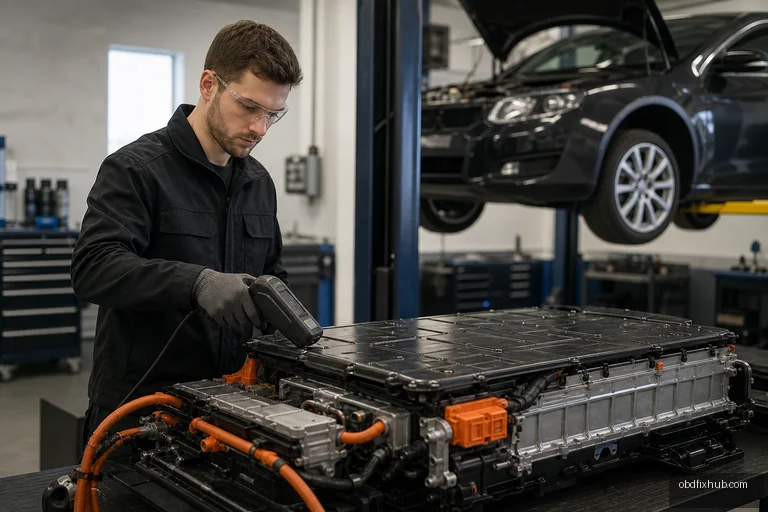
P0A7D Hybrid/EV Battery Pack State of Charge Low means the vehicle’s battery control system has detected that the high-voltage traction battery has less usable charge than expected. The cause may be a genuinely discharged pack, a weak or imbalanced battery module, inaccurate voltage or current data, a charging fault, or a battery management system problem. Do not treat this code like a routine 12-volt battery warning: hybrid and EV battery systems can contain several hundred volts and require qualified diagnostic equipment and safety procedures.
What Does the P0A7D Code Mean?
P0A7D is an OBD-II powertrain fault code associated with a low state of charge in the hybrid or electric vehicle battery pack. The battery energy control module, hybrid control module, or powertrain control module calculates state of charge using pack voltage, battery current, temperature, cell readings, and charging history.
When those values indicate that the battery is below its permitted operating range, the module stores P0A7D. The exact enabling conditions vary by manufacturer. Some vehicles set it after the pack remains undercharged for a defined period, while others trigger it when the calculated state of charge conflicts with individual cell voltages or battery current data.
Common Symptoms of P0A7D
The warning signs depend on whether the battery is simply low or has an underlying hardware fault. A vehicle may still drive normally at first, especially if the internal-combustion engine can provide backup power.
- Check Engine, Hybrid System, EV System, or Service Warning lights
- Reduced electric-only driving range
- Limited regenerative braking
- Reduced acceleration or restricted power output
- The gasoline engine running more often than usual
- Failure to enter EV mode
- Difficulty starting the engine in some hybrid models
- Charging that stops early or refuses to begin
- Cooling fans running loudly near the rear seat or battery area
- A message such as Hybrid System Malfunction or Battery Charge Low
A particularly useful clue is inconsistent behavior. If the state-of-charge display suddenly falls several bars, rises unusually quickly, or changes after a short period of driving, the problem may be battery capacity loss or inaccurate battery monitoring rather than a normal low charge.
Most Likely Causes of P0A7D
1. The high-voltage battery is genuinely undercharged
A hybrid battery can become undercharged after extended storage, repeated short trips, low fuel, a charging interruption, or a fault that prevents the engine from charging the pack. In a plug-in hybrid or EV, a failed charging session, tripped circuit breaker, damaged charge connector, or onboard charger issue can produce the same result.
2. Weak or imbalanced battery modules
High-voltage packs are made from many cells or modules connected in series. A weak module may show acceptable voltage at rest but drop sharply under load. The battery management system then sees one section of the pack reaching its lower limit before the remaining sections, so it reports a low or unreliable state of charge.
This is common in older hybrids with high mileage. A pack that charges quickly but also loses its displayed charge quickly is often showing reduced usable capacity, not a simple charging mistake.
3. Battery current sensor or voltage-sensing problem
The battery control system must know how much current enters and leaves the pack. A faulty current sensor, poor connector contact, damaged sense wire, or incorrect zero-current calibration can make the calculated state of charge inaccurate. Corrosion or water intrusion around the battery monitoring harness deserves close inspection.
4. Battery temperature or cooling problems
Excessive heat can cause the control system to limit charging and discharging. Blocked battery air inlets, a dirty cooling fan, a failed fan motor, or luggage covering the intake may contribute to a low-state-of-charge fault. Temperature sensor errors can also make the module reduce battery availability even when the pack has charge.
5. Charging system, DC-DC converter, or software faults
In a conventional hybrid, the engine-driven generator must replenish the high-voltage battery. In an EV or plug-in hybrid, the onboard charger and high-voltage charging circuit perform that job. A failed inverter, DC-DC converter, charging module, software calibration, or low auxiliary-voltage condition can prevent the pack from reaching its expected charge level.
How to Diagnose P0A7D Correctly
A professional diagnosis starts with more than a basic code reader. The technician should use a scan tool that can access the battery energy control module and retrieve manufacturer-specific subcodes, freeze-frame information, live cell data, and related hybrid system faults.
- Record all codes. P0A7D may be secondary to a charger, inverter, isolation, temperature, or battery imbalance code. Diagnose the companion code first when appropriate.
- Check the 12-volt battery. A weak auxiliary battery can create misleading hybrid faults and interrupt charging or module communication. Test it under load rather than relying only on a resting voltage reading.
- Confirm the charging condition. For a plug-in vehicle, verify the outlet, charge cable, connector lock, charging schedule, and charging status. For a non-plug-in hybrid, confirm that the engine and generator can maintain battery charge.
- Compare live battery data. Look for differences between cell-group voltages, battery current, temperature sensors, commanded charge, and actual charge. A large voltage spread during acceleration or regenerative braking is more significant than a small difference at rest.
- Inspect battery cooling. Check the intake grille, fan operation, ducting, and signs of overheating or contamination. Do not remove a high-voltage battery cover as a DIY inspection.
- Follow the manufacturer’s load and capacity tests. A proper test determines whether the pack can hold energy, not merely whether its open-circuit voltage looks normal.
P0A7D Repair: What Actually Fixes It?
The correct repair depends on the test results. If the battery was only discharged because of a charging interruption, restoring the charging system and completing the manufacturer’s battery initialization or drive cycle may resolve the code. Simply clearing P0A7D without restoring charge usually allows it to return.
If the battery pack has a failed module, technicians may recommend a module-level repair, a professionally remanufactured pack, or a new replacement pack. Module replacement can be less expensive, but it is not automatically the best long-term solution: mismatched capacity between old and replacement modules can lead to another imbalance.
Other repairs may include replacing a battery cooling fan, repairing a sense-wire connector, correcting a current-sensor issue, updating control-module software, repairing the onboard charger, or replacing a failed inverter or DC-DC converter. The diagnostic evidence should determine the part, not the code alone.
Can You Drive With P0A7D?
Short-distance driving may be possible when the vehicle has normal power, no overheating warning, and no red hybrid or EV safety message. However, continued driving can leave the vehicle unable to start, reduce power unexpectedly, or worsen a failing battery pack. Stop driving and arrange professional assistance if the vehicle shows severe power limitation, a high-voltage warning, burning odor, smoke, battery overheating, or repeated charging failure.
Never disconnect orange high-voltage cables, bridge battery terminals, or probe pack connectors with a standard multimeter. High-voltage battery diagnosis requires insulated equipment, service-plug procedures, personal protective equipment, and manufacturer-specific training.
How to Prevent the Code From Returning
- Keep the battery cooling intake clear of bags, dust, pet hair, and seat covers.
- Use the correct charging equipment and investigate interrupted charging sessions.
- Do not leave a plug-in vehicle at an extremely low charge for long periods.
- Maintain the 12-volt battery and charging system.
- Have unusual state-of-charge swings diagnosed before the vehicle becomes undriveable.
- Follow the manufacturer’s software update and battery inspection recommendations.
Key Takeaway
P0A7D is a warning that the hybrid or EV battery pack is not providing the expected state of charge. The practical fix may be as simple as correcting a charging problem, but it can also indicate battery degradation, cell imbalance, sensor failure, cooling trouble, or a high-voltage control-system fault. Retrieve all related codes, verify the 12-volt system, review live battery data, and have high-voltage testing performed by a properly equipped technician before replacing the battery pack.
Frequently Asked Questions
Can a weak 12-volt battery cause P0A7D?
Yes. A weak 12-volt battery can interrupt module communication or charging control and create misleading hybrid fault codes. It should be tested first, although replacing it will not repair a genuinely weak high-voltage battery.
Will clearing P0A7D fix the problem?
No. Clearing the code only removes the stored fault temporarily. If the battery remains undercharged or the control module detects an imbalance or sensor error, P0A7D will return.
How much does a P0A7D repair cost?
Cost varies widely. A 12-volt battery, cooling fan, connector, or software update may be relatively affordable, while a high-voltage battery replacement can be considerably more expensive. A battery capacity and imbalance test is essential before approving major repairs.
Is P0A7D the same on every hybrid and EV?
The basic meaning is similar, but the setting conditions, related subcodes, battery design, and repair procedure vary by make and model. Always use the vehicle’s factory service information for final diagnosis.




