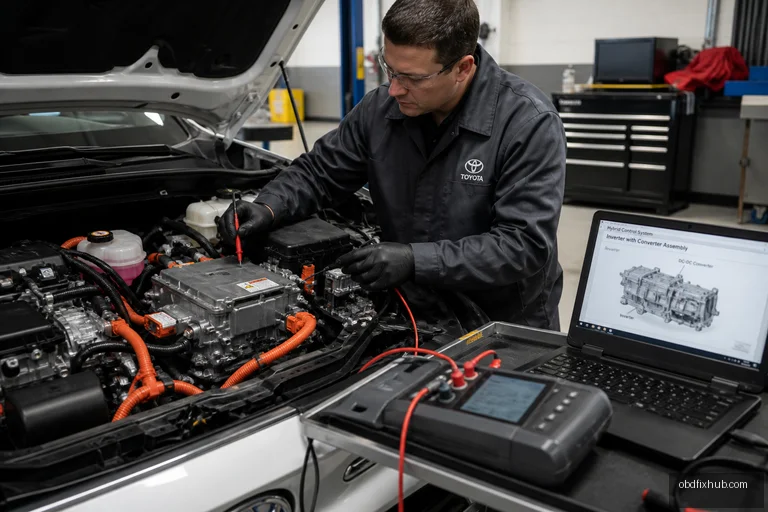
Search intent: Informational. Drivers searching for P0A94 DC/DC Converter Performance usually want to know whether the vehicle is safe to drive, what caused the warning, and whether the converter or inverter must be replaced. P0A94 means the hybrid vehicle’s DC/DC conversion system is not operating within the expected performance range. In practical terms, the high-voltage hybrid battery may not be supplying the correct charging output to the 12-volt electrical system, so the vehicle can develop charging, starting, warning-light, and shutdown problems.
This is not a code that should be diagnosed by replacing the 12-volt battery alone. The correct repair depends on the vehicle make, model, diagnostic subcode, freeze-frame data, wiring condition, cooling system, and measured converter output.
What Does P0A94 DC/DC Converter Performance Mean?
A hybrid vehicle uses a high-voltage battery to power the electric drive motors. Because the vehicle’s conventional accessories and control modules operate on low voltage, the DC/DC converter reduces high-voltage battery power to a regulated 12-volt supply. It performs a role similar to an alternator in a gasoline vehicle, although it is built into or closely associated with the hybrid inverter/converter assembly.
When the powertrain control module detects that the converter output, input, current, temperature, or control response does not match the expected value, it stores P0A94. On Toyota and Lexus vehicles, an additional information code, often called an INF or subcode, can be especially important. The main P0A94 code identifies the system; the subcode often points the technician toward the specific circuit or operating condition.
Common Symptoms of P0A94
Symptoms vary according to whether the converter is producing low output, intermittent output, or no output at all. A vehicle may initially drive normally because the high-voltage system is still functioning, but the 12-volt battery can gradually discharge as the converter fails to maintain it.
- Hybrid system, check engine, or master warning light illumination
- 12-volt battery repeatedly going flat
- “Check Hybrid System” or similar dashboard message
- Hard starting, no READY mode, or a vehicle that shuts down unexpectedly
- Flickering lights, unstable infotainment operation, or multiple unrelated warning codes
- Reduced-power mode or limited electric-assist operation
- Cooling fan operation, unusual inverter noise, or evidence of overheating
A useful field clue is timing. If the vehicle starts after an external 12-volt charge but the code returns shortly after entering READY mode, the converter may not be charging the low-voltage battery. If the problem appears only when the vehicle is hot, thermal protection, restricted cooling, or an internal semiconductor fault becomes more likely.
Most Likely Causes of P0A94
1. Internal DC/DC converter or inverter failure
The converter contains high-power semiconductor components, control circuits, capacitors, and thermal management hardware. Internal failure can cause low output, excessive current, overtemperature detection, or a complete loss of conversion. On some Toyota and Lexus hybrid platforms, the DC/DC converter is integrated into the inverter assembly, so the repair may involve the complete inverter rather than a separate bolt-on module.
2. Weak or damaged 12-volt battery
A failing auxiliary battery can create low-voltage events that confuse control modules and set secondary communication or hybrid codes. It can also make a good converter appear unreliable during startup. However, a new 12-volt battery will not repair P0A94 if the converter itself is defective. The battery should be load-tested and its resting voltage, terminal condition, and history should be documented before condemning expensive hybrid components.
3. High-voltage battery, fuse, or connection problem
The converter needs a stable high-voltage supply. A battery fault, service disconnect issue, blown high-voltage fuse, poor busbar connection, or abnormal battery voltage can prevent normal DC/DC operation. Battery isolation and high-voltage interlock codes should be checked before testing the converter.
4. Cooling system or excessive temperature
The inverter and converter generate substantial heat. Low inverter coolant, air trapped after service, a failed electric coolant pump, blocked radiator, restricted hose, or poor coolant circulation can cause the system to reduce output or shut down to protect itself. A cold vehicle may pass a basic test while the same fault returns after a long drive, which is why temperature data and a road test are often essential.
5. Wiring, ground, or communication fault
Corroded terminals, loose grounds, damaged high-voltage cables, connector contamination, and CAN communication faults can interrupt converter control. Rodent damage and previous accident repairs deserve particular attention. A visual inspection should include the inverter connectors, low-voltage grounds, harness routing, and signs of coolant intrusion or overheating.
How to Diagnose P0A94 Properly
Do not begin with parts replacement. A reliable diagnosis follows the evidence recorded when the fault occurred.
- Record every code and freeze-frame value. Scan all available modules, not just the engine computer. Note battery voltage, vehicle speed, coolant temperature, state of charge, and the P0A94 information code.
- Test the 12-volt system first. Check the battery at rest, during wake-up, and under load. Inspect both terminals and the body and powertrain grounds. A low-voltage event can produce a long list of misleading codes.
- Confirm READY-mode charging behavior. Using a suitable scan tool and the manufacturer’s test procedure, verify whether the low-voltage system receives stable converter output when the vehicle is in READY mode. Do not rely on a single generic voltage specification because charging strategies differ by model.
- Inspect the inverter cooling circuit. Check coolant level, pump operation, circulation in the reservoir where applicable, stored temperature codes, and evidence of overheating. A converter that fails only when hot should not be diagnosed from a cold start alone.
- Check high-voltage supply and interlocks. This requires approved insulated equipment and manufacturer procedures. Look for high-voltage battery, service-plug, fuse, isolation, or interlock codes that could explain the converter’s missing input.
- Use the manufacturer’s subcode test tree. The diagnostic subcode may direct the technician to converter output, internal temperature, current sensing, communication, or a specific power circuit. Without it, P0A94 is often too broad for a confident component-level conclusion.
High-voltage hybrid systems can remain dangerous even when the ignition is switched off. Anyone without hybrid safety training should not remove the service plug, open the inverter, back-probe orange cables, or measure high-voltage circuits with ordinary test equipment.
P0A94 Repair Options
The repair depends on the confirmed cause. A weak auxiliary battery may require replacement and code clearing, while a damaged ground or connector may need cleaning, terminal repair, or harness replacement. If cooling is the problem, the correct fix could be a coolant pump, hose, radiator, bleeding procedure, or repair of a leak.
When internal converter failure is confirmed, options may include a new inverter/converter assembly, a manufacturer-rebuilt unit, or a properly tested remanufactured component. The replacement should match the exact vehicle application and software requirements. Some vehicles require initialization, calibration, or programming after installation; skipping that step can leave the vehicle inoperative even when the hardware is good.
After repair, the technician should clear codes, verify READY-mode operation, monitor converter input and output data, confirm stable 12-volt charging, and perform a controlled road test. A successful repair is not simply the absence of a warning light immediately after clearing codes.
Can You Drive With P0A94?
Driving may be possible for a short distance if the vehicle enters READY mode normally and no red warning, overheating message, or serious drivability symptom is present. Even then, the 12-volt battery may be discharging, and the vehicle could fail to restart after being switched off. If the vehicle will not enter READY mode, repeatedly shuts down, shows an overheating warning, or displays multiple hybrid-system alerts, arrange transport rather than continuing to drive.
Never attempt to solve the problem by repeatedly disconnecting the 12-volt battery. That may temporarily erase symptoms while leaving the underlying converter fault untouched and can remove useful diagnostic information.
Key Takeaway
P0A94 DC/DC Converter Performance indicates a problem with the hybrid system’s low-voltage power conversion, not automatically a bad 12-volt battery. Start with a complete module scan, the manufacturer-specific subcode, 12-volt testing, cooling-system inspection, and safe verification of converter operation. Because the fault involves high-voltage equipment, diagnosis and inverter replacement should be handled by a qualified hybrid technician using the correct service information.
Frequently Asked Questions
Can a bad 12-volt battery cause P0A94?
Yes. A weak or unstable 12-volt battery can trigger P0A94 and related low-voltage codes, especially during startup. The battery must be tested under load, but replacing it does not prove that the DC/DC converter is healthy.
Is P0A94 the same as an inverter failure?
Not always. P0A94 can be caused by an inverter or converter fault, but wiring, cooling, high-voltage supply, communication, and battery problems can produce the same main code. The vehicle’s information subcode and test data are needed before condemning the inverter.
How much does a P0A94 repair cost?
Cost ranges from a relatively minor battery, connector, ground, or coolant repair to a major inverter/converter replacement. Vehicle design, new versus remanufactured parts, programming, and labor rates create large differences.
Can I clear P0A94 and keep driving?
You can clear the code with a compatible scan tool, but that does not repair the fault. If the converter problem remains, the code and warning message will return, and the 12-volt battery may eventually discharge.




