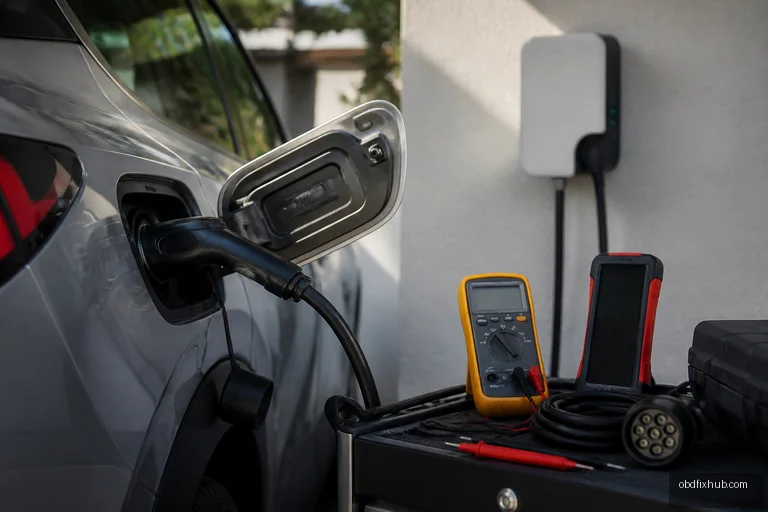
P0D20 Battery Charger Output Voltage Performance means the vehicle has detected that its battery charger is producing a voltage outside the expected range. On most electric vehicles and plug-in hybrids, this refers to the onboard charger and high-voltage charging system—not automatically the ordinary 12V battery. The fault may come from the power source, charging cable, connectors, voltage sensors, software, or the onboard charger itself, so replacing the charger immediately is rarely the best first step.
What Does Code P0D20 Mean?
P0D20 is an OBD-II diagnostic trouble code associated with Battery Charger A Output Voltage Performance. The vehicle’s battery management system or hybrid control module compares commanded charging voltage with the voltage it actually measures. If the difference is too large, unstable, or present for a defined period, it stores the code.
The word performance is important. It does not necessarily mean the charger has completely failed. A weak AC supply, a loose charging connection, a failed voltage sensor, or a communication problem can make a healthy charger appear defective. Exact test limits vary by manufacturer, battery voltage, temperature, and charging strategy.
Common Symptoms of P0D20
Drivers often discover P0D20 when the vehicle refuses to begin charging or stops partway through a charge. The symptoms can appear intermittently, particularly after rain, extreme temperatures, or use of a different charging station.
- Home or public charging will not start.
- The vehicle starts charging and then stops after a few seconds or minutes.
- A battery, hybrid system, or charging-system warning appears on the dashboard.
- Charging takes much longer than normal or is limited to a reduced power level.
- The state-of-charge percentage does not increase despite a charging indication.
- The charging indicator flashes red or shows a connection fault.
- The vehicle enters reduced-power or no-start mode because the high-voltage battery cannot be replenished.
Most Likely Causes of P0D20
1. Unstable input power
An onboard charger cannot deliver correct output if the AC supply is poor. A tripped circuit, undersized extension cord, loose wall outlet, incorrect voltage, or a charging station fault can interrupt the charging process. Testing another known-good charging station is one of the fastest ways to separate a vehicle problem from an infrastructure problem.
2. Damaged charging cable or connector
Heat-damaged terminals, moisture, corrosion, bent pins, or a worn locking mechanism can increase resistance. The charger may then reduce output or shut down for protection. Inspect both the vehicle inlet and the cable plug, but do not probe high-voltage terminals with an ordinary multimeter.
3. Onboard charger failure
The onboard charger converts AC power into the controlled DC output required by the high-voltage battery. Internal power transistors, capacitors, relays, cooling components, or control boards can fail. Some failures are obvious; others occur only when the charger reaches higher current or operating temperature.
4. Sensor, wiring, or communication faults
A voltage sensor that reports an incorrect value can trigger P0D20 even when actual charging voltage is correct. Damaged CAN wiring, poor ground connections, a low 12V supply, or a software mismatch can also prevent the charging module and battery controller from agreeing about output voltage.
5. High-voltage battery or contactor problems
The charger may be working correctly but unable to connect to the battery because a high-voltage contactor does not close, insulation resistance is too low, or the battery management system has disabled charging. In this situation, P0D20 may be a secondary code rather than the original failure.
How to Diagnose P0D20 Safely
High-voltage EV and hybrid systems can cause severe injury or death. Do not remove orange cables, open the onboard charger, or measure battery pack terminals unless you are trained and equipped for high-voltage automotive work. A standard OBD scanner can read codes, but it cannot make internal high-voltage measurements safely.
- Record all codes before clearing anything. Codes for isolation, contactors, charging communication, or low 12V voltage may identify the primary fault.
- Check the 12V battery. A weak 12V battery can prevent contactors and control modules from operating correctly. Test it after the vehicle has been off for several hours; roughly 12.6 volts indicates a full conventional battery, while readings near 12.0 volts indicate substantial discharge.
- Verify the charging source. Confirm the outlet or EVSE has the correct supply, check for overheating, and try a known-good cable or station.
- Inspect the inlet and plug. Look for water, dirt, discoloration, loose terminals, or melted plastic. Do not continue using a connector that becomes unusually hot.
- Review live data. A professional scan tool can compare requested charger voltage, actual charger voltage, AC input status, charge current, battery temperature, contactor state, and charging permission.
- Follow the manufacturer’s service procedure. If input power and low-voltage supplies are correct, a technician may need to test the onboard charger, high-voltage interlock circuit, insulation system, and battery contactors.
A useful diagnostic clue is timing. If charging fails immediately at every station, suspect the vehicle, its inlet, control electronics, or a disabled charging permission. If it works at one station but not another, investigate the outlet, EVSE, cable, or electrical installation before condemning the car’s charger.
Can a 12V Battery Reading Explain P0D20?
Usually, not by itself. P0D20 generally concerns the high-voltage charging system, while a 12V battery test evaluates the vehicle’s accessory electrical system. However, a severely weak 12V battery can cause modules to reset, contactors to fail to close, or charging communication to stop, so it should still be tested early in the diagnosis.
Is 11.7 volts a dead battery?
An 11.7-volt reading on a resting 12V lead-acid battery indicates a very deeply discharged battery, not proof that it is permanently dead. It may recover after a controlled charge, but sulfation or an internal cell failure may prevent it from holding voltage. Charge it with the correct charger, let it rest, then perform a load or conductance test; do not judge its condition immediately after charging.
How Do I Know If My Battery Charger Is Bad?
Do not diagnose a vehicle charger as defective solely because the car does not charge. First prove that the wall supply or EVSE works, the cable is suitable, the 12V system is healthy, and no safety-related code has disabled charging. A charger becomes a strong suspect when the same failure occurs at multiple known-good stations and live data shows correct input power but missing, unstable, or incorrect charger output.
For a standalone 12V charger, connect it to a battery that is not visibly damaged and verify its output according to the charger manufacturer’s instructions. A smart charger may show little or no voltage when it cannot recognize a severely discharged battery. That behavior does not automatically mean the charger is bad; the battery may need a compatible recovery mode or professional testing.
At What Voltage Is a 12V Battery Bad?
Voltage is a useful screening measurement, not a complete battery verdict. With the battery rested and no load applied:
- 12.6–12.8 volts: generally fully charged.
- 12.4 volts: approximately 75% charged.
- 12.2 volts: approximately half charged.
- 12.0 volts: heavily discharged.
- 11.7 volts or lower: severely discharged, possibly damaged.
A battery at 12.6 volts can still fail under load, while one at 12.2 volts may simply need charging. Test after charging and resting, then confirm with a load test or conductance tester.
How Long Does It Take a Battery Tender to Turn Green?
There is no universal time. A healthy, lightly discharged 12V battery may reach the green or maintenance indication in a few hours, while a deeply discharged battery can take overnight or longer. Battery capacity, charger current, temperature, sulfation, and the Tender’s recognition threshold all affect the result.
If the charger never turns green, check polarity, terminal contact, battery voltage, and the charger’s status lights. A battery that repeatedly remains in charging mode or drops voltage soon after the charger is removed may have high internal resistance or a parasitic drain.
Repair Options and What Usually Fixes P0D20
The correct repair depends on the confirmed cause. Possible solutions include repairing the electrical supply, replacing a damaged EV charging cable, cleaning or replacing the charge inlet, repairing low-voltage wiring, updating control-module software, replacing a voltage sensor, or replacing the onboard charger. High-voltage components should be handled only by a qualified EV or hybrid technician.
After the repair, the technician should clear the codes, perform the required charging-system initialization, and complete a full charging test. A short road test alone is not enough; the vehicle should be monitored while it begins and maintains charging under realistic load.
Key Takeaway
P0D20 indicates a mismatch or abnormal condition in battery charger output voltage. Start with the charging source, cable, charge inlet, stored codes, and 12V battery before replacing expensive high-voltage parts. If the fault follows the vehicle across multiple known-good charging stations, have the onboard charger and high-voltage control system tested using the manufacturer’s safety procedure.
Frequently Asked Questions
Can I drive with code P0D20?
Sometimes, but charging may be unavailable and the vehicle could eventually run out of high-voltage battery power. If a red warning, burning smell, heat, isolation warning, or reduced-power message appears, stop using the vehicle and arrange professional diagnosis.
Will disconnecting the 12V battery clear P0D20?
It may temporarily erase some stored information, but it does not repair the underlying problem. The code will return when the vehicle repeats the failed charging test, and disconnecting the battery can create additional initialization issues.
Does P0D20 always mean the onboard charger must be replaced?
No. EVSE faults, connector resistance, low 12V voltage, sensors, communication wiring, contactors, and software can all produce the same code. Replacement should follow test results, not the code description alone.
Can a regular OBD scanner diagnose P0D20?
A basic scanner may display the code, but manufacturer-level data is often needed to view charger commands, actual voltage, contactor status, and charging permission. A hybrid or EV-capable scan tool is usually more appropriate.




