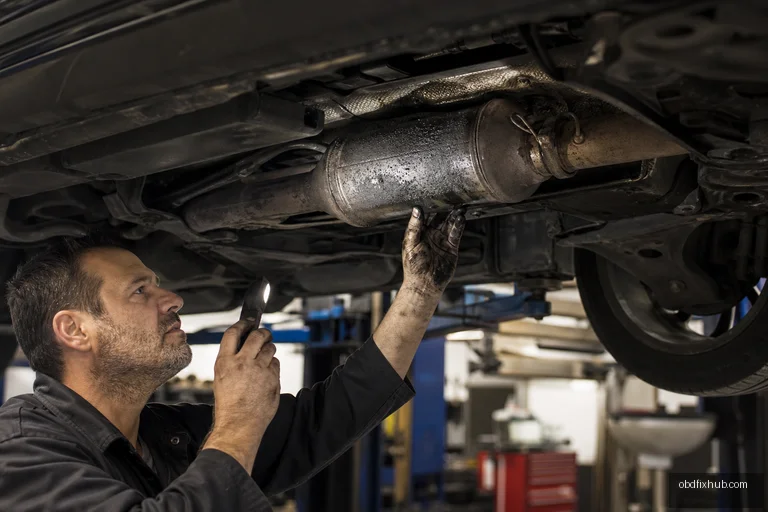
P2002 Diesel Particulate Filter Efficiency Below Threshold: Meaning, Causes, Symptoms & Fix
The P2002 diesel particulate filter efficiency below threshold code means the engine computer has detected that the DPF is not removing enough soot from the exhaust. It does not automatically mean the filter itself must be replaced. A restricted DPF, inaccurate pressure sensor, exhaust leak, failed temperature sensor, or incomplete regeneration can all trigger P2002.
This is an informational troubleshooting search: the most useful response is not a parts list, but a reliable way to identify whether the filter is genuinely failing or whether another component is making it look inefficient.
What Does P2002 Mean?
P2002 is a generic OBD-II powertrain code used by many diesel vehicles. The definition is Diesel Particulate Filter Efficiency Below Threshold, Bank 1. On most four-cylinder and V6 diesel engines, Bank 1 refers to the only cylinder bank or the bank containing cylinder one.
The ECU estimates DPF performance using data from the differential pressure sensor, exhaust gas temperature sensors, calculated soot load, fuel consumption, and regeneration history. When the measured exhaust behavior suggests that too much particulate matter is passing through the filter, the ECU stores P2002 and usually illuminates the check engine light.
Symptoms of a P2002 DPF Fault
Some vehicles show only a warning light at first. Others enter reduced-power mode when the calculated soot load becomes high or the ECU determines that regeneration is no longer safe.
- Check engine light or diesel particulate filter warning
- Reduced engine power, limited turbo boost, or limp mode
- Higher fuel consumption than normal
- Cooling fan running after the engine is switched off
- Frequent active regenerations or unusually hot exhaust smells
- Slow acceleration, especially under load or uphill
- Difficulty completing a regeneration cycle
- Black smoke in cases involving a cracked or melted DPF
A vehicle can still drive normally with an early P2002. That does not make the code harmless. Continued driving with excessive soot loading can raise exhaust backpressure and damage the turbocharger, EGR system, or engine oil through repeated fuel dilution.
Common Causes of P2002
1. A soot-loaded or ash-loaded DPF
Soot is combustible and can normally be removed during regeneration. Ash from engine oil additives is different: it remains in the filter and gradually occupies the filter’s internal volume. A high-mileage DPF may be clean enough to pass a short regeneration but still have insufficient ash capacity, causing the fault to return.
2. Failed or restricted differential pressure sensor
The DPF pressure sensor compares exhaust pressure before and after the filter through two small hoses. A split hose, blocked pressure pipe, melted hose, water contamination, or sensor drift can create an incorrect pressure reading. This is one of the most frequently missed causes because replacing the DPF without checking the sensor leaves the original problem untouched.
3. Exhaust leaks before or around the DPF
A leak near the turbocharger, flex pipe, sensor port, or DPF inlet can alter pressure readings and allow untreated exhaust to escape. Look for dry black soot marks, ticking noises during a cold start, and leaks that become more obvious when the engine is raised to approximately 2,000 rpm.
4. Regeneration is not completing
Short trips, prolonged idling, low coolant temperature, faulty glow plugs, or a failed thermostat can prevent the exhaust from reaching the temperature required for regeneration. A diesel used mainly for urban journeys may repeatedly begin regeneration and then cancel it when the driver stops the engine.
5. Engine problems creating excessive soot
A DPF can be functioning correctly while the engine produces far more soot than it should. Common sources include a sticking EGR valve, leaking injector, dirty intake system, failed boost control, turbocharger fault, or inaccurate MAF sensor. If the root cause is not repaired, even a professionally cleaned filter will load again quickly.
6. Exhaust temperature sensor or software issues
Temperature sensors that report implausible values can stop regeneration or cause the ECU to miscalculate filter efficiency. Some manufacturers also release software updates for improved DPF monitoring. Always check technical service bulletins before condemning an expensive filter.
How to Diagnose P2002 Correctly
Do not begin by clearing the code and taking the vehicle on a long highway drive. A forced regeneration with an unknown cause can overheat a damaged DPF or create a fire risk. A proper diagnosis should be performed in this order.
- Scan all stored and pending codes. Codes for injectors, EGR, boost, temperature sensors, or the pressure sensor may explain the P2002 and should be addressed first.
- Check live data. Compare calculated soot mass, ash load, regeneration status, exhaust temperatures, and differential pressure at idle and under controlled load.
- Inspect the pressure sensor circuit. Remove and examine both pressure hoses. They must be connected to the correct upstream and downstream ports and free from soot or condensation.
- Check for exhaust leaks. Inspect clamps, joints, flex sections, sensor bosses, and the DPF housing before relying on pressure readings.
- Evaluate regeneration conditions. Confirm that coolant temperature reaches normal operating temperature and that the vehicle can achieve the required exhaust temperature.
- Measure restriction independently. A workshop can use a calibrated pressure gauge or manufacturer scan data to determine whether backpressure is genuinely excessive.
- Inspect the filter if needed. A borescope may reveal melting, cracking, or a damaged substrate. A cracked DPF may show acceptable pressure while failing to filter soot effectively.
As a practical example, one common diagnostic pattern is normal-looking engine performance, P2002 returning after several drives, and a differential pressure reading that is too high at idle. If the sensor hoses are clear but pressure remains high, the filter is likely restricted. By contrast, a wildly fluctuating pressure value or a reading that does not change with engine speed points more strongly toward the sensor, wiring, or hoses.
P2002 Repair Options
The correct repair depends on the test results, not simply on the code description.
- Sensor or hose fault: Replace the damaged component, clean or replace blocked lines, and verify the live pressure reading afterward.
- Incomplete regeneration: Repair the thermostat, glow plug, injector, EGR, or temperature sensor causing the regeneration failure, then perform a manufacturer-approved regeneration.
- Soot restriction: A controlled service regeneration may work when the filter is not physically damaged and the soot load remains within safe limits.
- Ash accumulation: Remove the DPF and have it professionally cleaned using equipment that measures before-and-after flow. Chemical sprays poured into the filter rarely address heavy ash loading reliably.
- Cracked, melted, or oil-contaminated filter: Replacement is normally required, followed by repair of the turbocharger, injector, or engine fault that caused the damage.
After repair, the technician should reset learned DPF values only with the correct scan-tool procedure. Some vehicles require a DPF replacement or ash-counter reset; others require a completed regeneration and road-test confirmation. Resetting the counter without cleaning or replacing the filter can make the displayed data misleading.
Can You Drive With P2002?
Short, gentle trips to a repair facility are usually reasonable if the vehicle has normal power, no severe overheating, and no flashing warning light. Avoid towing, hard acceleration, and repeated attempts to force regeneration. Stop driving and arrange professional assistance if the vehicle enters severe limp mode, shows excessive smoke, smells strongly of fuel, or displays a high-temperature or DPF blockage warning.
How to Prevent P2002 From Returning
- Use the manufacturer-approved low-ash diesel engine oil.
- Allow completed regeneration cycles instead of switching the engine off repeatedly.
- Give a healthy diesel occasional sustained road driving, but only after confirming there is no active fault.
- Repair injector, EGR, turbocharger, and boost problems promptly.
- Do not ignore a thermostat that keeps the engine below its normal operating temperature.
- Have pressure sensor hoses inspected whenever the DPF is serviced.
Summary: The Smart Way to Fix P2002
P2002 indicates that the ECU believes the diesel particulate filter is not filtering soot efficiently enough. The filter may be blocked or damaged, but a pressure sensor, hose, exhaust leak, failed regeneration condition, or soot-producing engine fault can create the same code. Diagnose the pressure and temperature data first, repair the underlying cause, and only then choose regeneration, professional cleaning, or DPF replacement.
If P2002 returns soon after a regeneration, treat that recurrence as useful evidence rather than simply clearing the warning again. A qualified diesel technician with manufacturer-level live-data access can usually separate a genuine DPF failure from a misleading sensor reading before expensive parts are installed.
Frequently Asked Questions
Is P2002 always caused by a bad DPF?
No. A faulty differential pressure sensor, blocked sensor hose, exhaust leak, incomplete regeneration, or excessive engine soot can all trigger P2002. Testing these items first can prevent an unnecessary DPF replacement.
Can a DPF cleaner fix P2002?
It may help with a light soot restriction, but it will not remove accumulated ash or repair a cracked filter. Use cleaning products only when they are approved for the vehicle and after checking why the filter loaded up.
How much does a P2002 repair cost?
The cost ranges widely. A pressure hose or sensor may be relatively inexpensive, while professional DPF cleaning or replacement is considerably more costly. Diagnosis should come before pricing a replacement filter.
Will clearing P2002 make it go away?
Clearing the code only erases the stored fault. If the measured efficiency remains below the ECU threshold, the warning will return, often after the next monitoring cycle or regeneration attempt.




