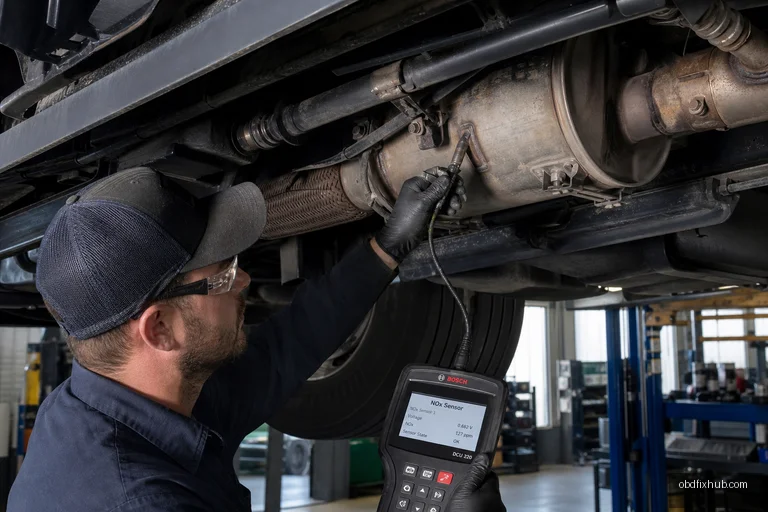
P21B2 means the engine control module detected that the NOx adsorber system took too long to enter closed-loop control. In practical terms, the computer is not receiving believable NOx-control feedback quickly enough after the required operating conditions are met. The fault is usually caused by a contaminated or slow NOx sensor, an exhaust temperature or oxygen-sensor problem, wiring damage, an exhaust leak, incorrect calibration, or a NOx adsorber catalyst that cannot reach operating efficiency.
This is an informational diagnostic code, not a command to replace the NOx sensor immediately. A proper diagnosis must confirm when the fault sets, whether the exhaust reaches the required temperature, and whether the sensor signals respond as expected.
What Does P21B2 Mean?
P21B2 is an OBD-II diagnostic trouble code associated with Excessive Time to Enter Closed-Loop NOx Adsorber Control. The exact wording and test strategy can vary by manufacturer, so the vehicle-specific service information remains the final authority.
“Closed loop” means the engine or aftertreatment controller is actively adjusting NOx-control operation using feedback from sensors. Before closed loop, the module relies mainly on calculated values and predefined tables. Once closed loop begins, it compares expected and measured exhaust conditions and corrects the system accordingly.
A NOx adsorber, also called a lean NOx trap on some applications, stores nitrogen oxides during lean operation and periodically regenerates them during a richer exhaust phase. It depends on accurate temperature, oxygen, NOx, and fueling information. If one input is implausible or the catalyst cannot achieve the expected chemical reaction, closed-loop entry may be delayed.
Common Symptoms of a P21B2 Fault
Some vehicles will show only a check engine light, while others may limit torque or disable certain emissions functions. The symptoms depend on how the manufacturer responds to the failed monitor.
- Check engine light or malfunction indicator lamp
- Reduced engine power or a torque-management warning
- Hesitation during acceleration, especially after warm-up
- Increased fuel consumption or more frequent regeneration events
- Rough operation during NOx adsorber regeneration
- Extended crank time or poor drivability on some diesel applications
- Additional codes for NOx sensors, exhaust temperature, oxygen sensors, EGR, or fuel control
A useful diagnostic clue is whether the problem appears only on short trips. If the vehicle never reaches the required exhaust temperature, the monitor may fail without a hard mechanical fault in the catalyst. Conversely, if the code returns after a long, fully warmed drive, a slow sensor, exhaust leak, or catalyst-efficiency issue becomes more likely.
Most Likely Causes of P21B2
1. A slow or inaccurate NOx sensor
NOx sensors contain an electronic control module and a sensing element exposed to severe heat and contamination. Soot, ash, fuel-related deposits, moisture intrusion, or internal aging can make the sensor respond too slowly. A sensor may still produce a signal, yet fail the response-time test that sets P21B2.
2. Exhaust temperature never reaches the enabling threshold
The NOx adsorber cannot enter its intended control strategy until the exhaust is hot enough. A faulty exhaust gas temperature sensor, thermostat stuck open, excessive idling, restricted airflow, or an engine that runs too cool can prevent the monitor from completing.
3. Exhaust leaks before the relevant sensors
A leak near the turbocharger, exhaust manifold, NOx sensor, or oxygen sensor can draw outside air into the exhaust stream. That changes oxygen concentration and makes calculated NOx behavior appear inconsistent. Small leaks often seal when cold and open as the exhaust system expands, so inspect the system both cold and warm.
4. Damaged wiring, connectors, or sensor power supply
NOx sensors commonly use dedicated power, ground, communication, and heater circuits. Heat-damaged insulation, corroded terminals, poor grounds, and harness chafing can create intermittent faults that are missed by a basic visual inspection. Check connector tension and voltage under load rather than relying only on continuity.
5. Oxygen, fuel-control, or EGR problems
The adsorber relies on the correct exhaust chemistry. A biased oxygen sensor, leaking injector, excessive EGR flow, intake-air problem, or fuel-pressure issue can prevent the system from achieving the rich and lean conditions required for storage and regeneration. In these cases, replacing the NOx sensor alone will not solve P21B2.
6. A degraded NOx adsorber catalyst
After high mileage, repeated overheating, oil consumption, sulfur exposure, or ash accumulation, the catalyst may lose storage capacity. The module may command regeneration correctly but fail to see the expected NOx reduction. A failed catalyst is less common than a sensor or wiring issue, so it should be confirmed with data before replacement.
7. Software or calibration issues
Some manufacturers release updated engine-control or aftertreatment software to correct false monitor failures, sensor interpretation errors, or overly sensitive time thresholds. Check technical service bulletins and calibration updates using the vehicle identification number before condemning expensive components.
How to Diagnose P21B2 Correctly
Use a scan tool that can access manufacturer-specific data and active tests. A basic code reader may display P21B2 but cannot show the enabling conditions or the sensor response needed to identify the root cause.
- Record all codes and freeze-frame data. Note engine temperature, exhaust temperatures, vehicle speed, calculated load, regeneration status, and battery voltage when the code set.
- Determine whether the code is current or historical. Clear codes only after documenting them. If P21B2 returns immediately, look for an electrical or plausibility fault; if it returns only after a drive cycle, focus on operating conditions and catalyst performance.
- Check the enabling conditions. Confirm that coolant temperature, exhaust temperature, vehicle speed, and fuel level meet the manufacturer’s requirements for the monitor.
- Inspect the exhaust for leaks. Pay special attention to joints and sensor bosses upstream of the NOx-control components. A smoke machine or regulated low-pressure test is safer and more reliable than guessing.
- Compare live sensor values. Look for implausible temperature jumps, a fixed NOx reading, delayed response, or disagreement between upstream and downstream readings during a commanded test.
- Test the electrical circuit under load. Verify heater power, grounds, reference supplies, communication lines, and voltage drop at the connector. Heat-related failures may require testing while the harness is warm and gently moved.
- Perform the manufacturer’s regeneration or desulfation procedure only when permitted. A forced routine cannot repair a failed sensor, injector, or catalyst. It can also be unsafe if the exhaust system has a leak or the vehicle is operated near flammable material.
- Check software updates and service bulletins. This step is especially important when the vehicle has no abnormal sensor data and the code returns under otherwise normal conditions.
How to Fix P21B2
The correct repair depends on the failed part, not merely the code description. Common repairs include replacing a confirmed faulty NOx sensor, repairing a heat-damaged harness, correcting an exhaust leak, replacing a failed exhaust temperature sensor, repairing injector or EGR faults, updating the control-module software, or replacing a catalyst that fails a verified efficiency test.
After the repair, clear the code and complete the specified drive cycle. Some systems require a fully warmed engine, steady highway operation, deceleration events, and a regeneration or NOx-control routine before the monitor runs. A stationary idle is rarely enough to validate the repair.
Do not install a used NOx sensor without checking compatibility and calibration requirements. Many sensors have application-specific software or require a relearn procedure. Also avoid repeated forced regenerations when the underlying cause is unknown; excessive heat can damage the turbocharger, wiring, catalyst, or diesel particulate filter.
Can You Drive With P21B2?
Short-distance driving is usually possible if the vehicle runs normally and no red warning, severe power loss, overheating, or unusual exhaust odor is present. However, continued operation can lead to failed emissions testing, reduced fuel economy, additional aftertreatment codes, or a progressively stricter limp mode.
Stop and arrange professional diagnosis if the vehicle shows major power reduction, excessive smoke, abnormal regeneration behavior, engine misfire, or a flashing warning lamp. Those symptoms suggest that P21B2 may be one part of a larger fueling, combustion, or exhaust problem.
Key Takeaway
P21B2 indicates delayed closed-loop NOx adsorber control, but it does not identify one guaranteed failed component. Start with freeze-frame data, operating temperature, exhaust leaks, sensor response, wiring, and related codes. Only after those checks should you consider an expensive NOx catalyst or sensor replacement. A scan tool with active tests and manufacturer-specific data is the fastest route to an accurate repair.
Frequently Asked Questions
Is P21B2 caused by a bad NOx sensor?
It can be, but not always. A low exhaust temperature, air leak, wiring fault, oxygen-sensor problem, software issue, or degraded NOx adsorber can produce the same code. Live-data testing is needed before replacing the sensor.
Will clearing P21B2 fix the problem?
No. Clearing the code only removes the stored fault temporarily. If the monitor still detects delayed closed-loop entry, P21B2 will return after the required drive cycle.
Can an exhaust leak trigger P21B2?
Yes. A leak upstream of the relevant NOx or oxygen sensor can introduce outside air and distort the exhaust readings. Small leaks are particularly important because they may appear only when the system is hot.
Does P21B2 require a forced regeneration?
Not automatically. A regeneration or desulfation routine should be performed only when the service procedure calls for it and the engine, sensors, fuel system, and exhaust are operating correctly. Forced regeneration is not a substitute for diagnosis.
How much does a P21B2 repair cost?
Cost varies widely. A wiring repair or exhaust clamp may be relatively inexpensive, while a genuine NOx sensor or catalyst can be costly. Diagnosis first prevents replacing a high-priced component that is functioning normally.




