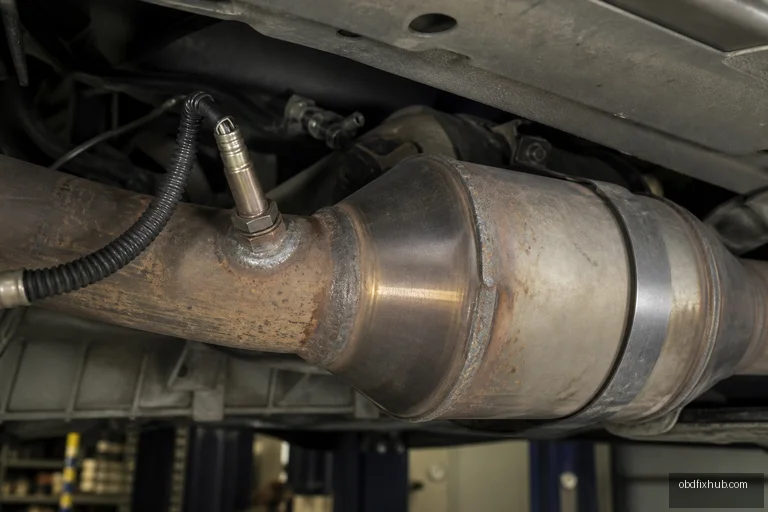
P24AF Particulate Matter Sensor Performance means the engine computer has detected an implausible, unstable, or out-of-range signal from the diesel particulate matter sensor. You may still be able to drive a short distance, but the fault should not be ignored: it can prevent accurate DPF monitoring, trigger a warning light, and eventually cause reduced power or an expensive aftertreatment repair.
This code does not automatically prove that the sensor itself has failed. On vehicles from Ford, Hyundai, and other manufacturers, the same generic OBD description can be caused by damaged wiring, an exhaust leak, excessive soot, a software issue, or a DPF problem. A proper diagnosis tests the complete system rather than replacing the first part that appears on a scan tool.
What Does the P24AF Code Mean?
P24AF is an OBD-II diagnostic trouble code associated with particulate matter sensor performance. The sensor is normally installed in the exhaust system near the diesel particulate filter (DPF). It monitors soot or particulate loading so the engine control module can compare the measured exhaust condition with calculated DPF values.
Unlike a simple open-circuit code, a performance fault means the signal may be present but does not behave as expected. The control module may see a reading that is too high, too low, too slow to change, or inconsistent with exhaust temperature, engine load, differential pressure, and regeneration data.
Ford P24AF meaning
On many Ford diesel applications, P24AF indicates that the particulate matter sensor signal is outside its expected operating range. Ford systems may set the code after a self-test, during a DPF regeneration, or when the sensor reading does not agree with the calculated soot model. Exact test conditions vary by engine, model year, and calibration, so the Ford service information for the specific vehicle is essential.
Hyundai P24AF meaning
In a Hyundai diesel, P24AF generally points to a particulate matter sensor performance problem within the exhaust aftertreatment system. Hyundai may use different sensor designs, connector layouts, and software thresholds than Ford. Therefore, a Hyundai-specific wiring diagram, technical service bulletin, and live-data procedure should be used instead of assuming that a Ford diagnostic routine applies.
Common Causes of P24AF
- Failed particulate matter sensor: The sensing element can become contaminated, age electrically, or fail internally after repeated high-temperature regeneration cycles.
- Damaged wiring or connectors: Exhaust heat can harden insulation, melt conduit, or loosen terminals. Oil, water, and road salt inside the connector can distort the signal.
- Exhaust leaks: A leak before or close to the sensor can draw in outside air and make the sensor reading inconsistent with actual soot flow.
- Excessive soot or ash: A heavily loaded DPF, failed EGR system, injector problem, or incomplete regenerations can overwhelm the sensor and produce implausible data.
- Incorrect installation: A sensor installed in the wrong position, with a damaged mounting boss, or without the required relearn procedure may continue to set P24AF.
- Software or calibration faults: Some vehicles require an ECU update or sensor initialization after replacement, particularly when the original fault appeared after a repair.
- Related exhaust faults: Problems with exhaust temperature sensors, DPF differential pressure sensors, turbocharging, or fuel injection can make the PM signal appear incorrect.
P24AF Symptoms to Watch For
The check engine light is the most common symptom, but the vehicle may not feel different at first. The particulate matter sensor does not directly control normal combustion in the same way as a fuel injector or crankshaft sensor; its fault often begins as an emissions-monitoring problem.
- Check engine or emissions warning light
- DPF warning message or frequent regeneration requests
- Reduced engine power or limp-home mode
- Higher fuel consumption
- Cooling fan operation after shutdown
- Unusual exhaust smell or excessive smoke caused by a related fault
- Additional codes for DPF efficiency, soot loading, exhaust temperature, or differential pressure
A useful diagnostic clue is timing. If P24AF appeared immediately after DPF, exhaust, or sensor work, inspect the connector, harness routing, sensor orientation, and required reset procedure before condemning the new component.
Can You Drive With a Bad Particulate Matter Sensor?
Usually, a short drive to a repair facility is reasonable if the vehicle runs normally and no red warning, severe power loss, overheating, or heavy smoke is present. Avoid treating the fault as harmless, however. If the ECU cannot trust particulate data, it may disable or mismanage DPF regeneration, allowing soot loading to increase.
Stop driving and arrange recovery if the vehicle enters severe limp mode, the DPF warning flashes, exhaust temperatures become abnormal, the engine oil level rises, or the vehicle produces dense smoke. Repeatedly forcing regeneration without finding the cause can damage the DPF, turbocharger, or engine oil.
Can You Clean a Particulate Matter Sensor?
In most cases, the correct repair is not to clean the sensor. The sensing element and its calibration can be damaged by compressed air, wire brushes, brake cleaner, solvents, or physical probing. Some manufacturers permit limited cleaning of a removable protective shield, but that is different from washing or scraping the sensing element.
You can safely inspect the outside of the sensor and check for loose soot, broken mounting hardware, melted wiring, and a contaminated connector. Do not confuse the PM sensor with the DPF differential pressure sensor; they have different functions and cleaning procedures. Always follow the manufacturer’s service instructions before applying any cleaner.
How to Diagnose and Fix P24AF
- Scan all modules and record freeze-frame data. Note engine speed, load, exhaust temperatures, DPF pressure, calculated soot mass, and whether the code is current or pending.
- Check related codes first. An exhaust temperature, DPF pressure, EGR, injector, or turbocharger code may be the root cause rather than a failed PM sensor.
- Inspect the exhaust physically. Look for leaks around the DPF, sensor boss, clamps, flex pipe, and recently repaired joints. Even a small leak can corrupt sensor readings.
- Inspect the harness from the sensor to the main loom. Look for contact with the exhaust, stretched wires, chafing, water intrusion, and terminals pushed backward in the connector.
- Compare live data with operating conditions. A professional scan tool can show whether the PM reading changes logically during warm-up, acceleration, and regeneration.
- Test power, ground, and signal circuits. Voltage and continuity checks must be performed against the vehicle’s wiring diagram. A generic pinout can cause an expensive mistake.
- Replace the sensor only after testing. Use the correct original-equipment specification, install it without twisting the harness, and protect the wiring from exhaust heat.
- Perform the required reset or relearn. Many systems need a PM sensor replacement reset, adaptation, or service regeneration. Clearing the code alone may cause it to return immediately.
- Verify the repair. Clear codes, complete the manufacturer’s drive cycle, and confirm that the monitor runs without the signal becoming implausible again.
A practical workshop example
Consider a diesel van that sets P24AF after a DPF replacement. The sensor is replaced first, but the code returns after two drives. Inspection reveals that the harness was clipped against the new DPF shield and the insulation had melted. Repairing the harness, securing it with the correct heat-resistant retainers, and completing the sensor initialization resolves the fault. This is why a parts-only approach often wastes time and money.
When Professional Diagnosis Is Worth It
P24AF is difficult to diagnose with a basic code reader because the important evidence is often in live data and manufacturer-specific test routines. A diesel specialist can perform an exhaust leak test, inspect regeneration history, test sensor circuits under heat, and determine whether the DPF is actually overloaded.
Do not erase the code before recording freeze-frame data. The stored conditions can show whether the fault occurred during cold start, steady cruising, active regeneration, or a high-load event—information that may disappear after clearing the ECU memory.
Key Takeaway
P24AF means the particulate matter sensor signal is not behaving as the ECU expects; it does not automatically mean the sensor must be replaced. Drive only as far as necessary when the vehicle remains safe, inspect wiring and exhaust leaks carefully, and use vehicle-specific reset procedures after repair. If warning messages, limp mode, smoke, or DPF symptoms are present, arrange diagnosis promptly to prevent a small sensor fault from becoming a DPF or engine repair.
Frequently Asked Questions
What does the Ford code P24AF mean?
On many Ford diesel models, P24AF indicates that the particulate matter sensor signal is outside its expected range or does not agree with other exhaust and DPF data. The exact test criteria depend on the engine and model year.
What does the P24AF fault code mean in a Hyundai vehicle?
In a Hyundai diesel, it generally identifies a particulate matter sensor performance fault. Check the sensor, wiring, exhaust leaks, DPF condition, related codes, and any Hyundai-specific software or relearn requirements.
Can I clean a particulate matter sensor?
Usually not. Cleaning chemicals, compressed air, and physical scraping can damage the calibrated sensing element. Inspect the connector and external wiring, then follow the manufacturer’s instructions before attempting any cleaning.
Can I drive with a bad particulate matter sensor?
A short trip to a repair shop is normally acceptable if there is no severe power loss, flashing warning, overheating, or heavy smoke. Continued driving can interfere with DPF regeneration and increase the risk of a blocked or damaged filter.




