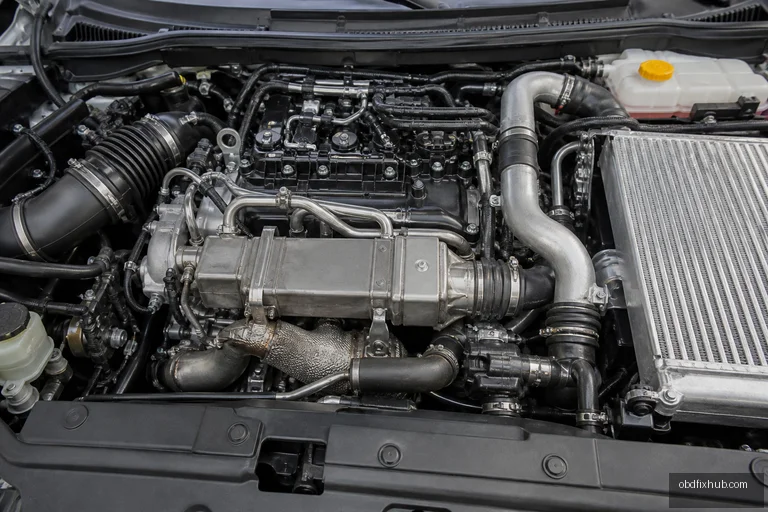
P24F2 EGR temperature and charge-air cooler temperature correlation means the engine control module has detected an implausible relationship between two temperature readings. The code does not automatically prove that the EGR valve or charge-air cooler is defective; it indicates that the measured temperatures do not behave as the control software expects under specific operating conditions.
Because P24F2 can be manufacturer-specific, always verify the exact description for your vehicle using its service information. On many diesel applications, the fault involves an EGR temperature sensor, a charge-air cooler temperature sensor, wiring, airflow, or a software-calculated comparison between those systems.
What Does P24F2 Mean?
The engine control module, or ECM, monitors exhaust gas recirculation temperature and charge-air temperature to confirm that emissions and intake-air systems are operating correctly. It compares sensor signals at startup, during warm-up, under boost, and sometimes during EGR flow tests or diesel particulate filter regeneration.
P24F2 is set when that comparison falls outside the expected range. The sensors do not need to show identical temperatures. They only need to change in a pattern that is physically and logically plausible for the engine’s current load, coolant temperature, EGR command, and boost pressure.
- An EGR temperature sensor may report an unusually high, low, or unstable value.
- A charge-air cooler temperature sensor may be biased or responding too slowly.
- The EGR system may not be flowing the amount commanded by the ECM.
- A wiring or connector fault may make one signal intermittently incorrect.
- A software calibration issue may trigger the correlation monitor even when hardware is functioning.
What Does Correlation Mean in Automotive Diagnostics?
Correlation describes how two values behave in relation to each other. In this case, the ECM is not simply asking whether the EGR temperature and charge-air cooler temperature are equal. It is asking whether their relationship makes sense at a particular moment.
For example, when EGR flow increases, the intake charge temperature may respond in a predictable way while the EGR temperature follows the exhaust-side conditions. If one sensor suddenly jumps while the other remains stable, the readings may lose correlation even if neither value immediately looks impossible by itself.
What does a perfect correlation mean?
A perfect correlation means two values move together in a completely predictable pattern. In statistics, this is represented by a correlation coefficient of +1.00 when both rise and fall together. In vehicle diagnostics, however, perfect correlation is not the target. Temperature sensors are exposed to different locations, heat sources, airflow, and response times, so a small difference is normal.
What does positive correlation mean?
Positive correlation means that when one temperature tends to increase, the other also tends to increase, although not necessarily by the same amount. A positive relationship between EGR and charge-air temperatures can be expected during certain operating conditions, but the ECM uses a calibrated range rather than a simple statistical rule.
What does correlational mean?
Correlational means related in a way that shows a measurable pattern. It does not mean that one value directly causes the other. In a P24F2 diagnosis, the ECM sees an abnormal relationship, but that relationship alone does not identify which component caused the problem.
Why Is Temperature Correlation Important?
Temperature correlation is important because modern diesel engines use temperature feedback to control EGR flow, combustion quality, turbocharger operation, and emissions after-treatment. Incorrect temperature data can cause the ECM to make the wrong decisions about how much exhaust gas to recirculate or how to manage regeneration.
The comparison also acts as a plausibility check. A sensor can produce a voltage within its normal electrical range while still being inaccurate. Comparing it with another temperature signal helps the ECM detect a sensor that is biased by 40 degrees, stuck at one value, contaminated, or reacting much more slowly than expected.
Common Causes of P24F2
1. Faulty EGR temperature sensor
An EGR temperature sensor exposed to soot, condensation, extreme heat, or repeated thermal cycling can drift out of calibration. A sensor may work normally when cold but report an incorrect value after the engine reaches operating temperature.
2. Charge-air temperature sensor problems
The charge-air temperature sensor may be contaminated with oil mist from the crankcase ventilation system or turbocharger plumbing. It can also be installed incorrectly, damaged during intake repairs, or affected by a poor electrical connection.
3. Wiring and connector damage
Inspect wiring near the EGR cooler, turbocharger, intake manifold, and exhaust components. Heat-hardened insulation, rubbed-through wires, moisture in a connector, and loose terminals are common causes of intermittent temperature correlation faults.
4. EGR cooler or valve restriction
Carbon buildup can restrict the EGR valve or cooler passages. If the ECM commands EGR flow but little gas actually moves, the expected temperature response may not occur. An internally leaking or partially blocked EGR cooler can create a similar symptom.
5. Charge-air leaks or cooler blockage
A split intercooler hose, loose clamp, damaged charge-air cooler, or blocked cooler can change intake temperature and airflow. Look for oily residue around a boost leak; a light oil film is common, but wet oil spray often points to a leaking connection.
6. Software or calibration issues
Some vehicles require an ECM software update after a sensor, EGR assembly, or charge-air cooler repair. If the mechanical and electrical checks pass, compare the vehicle’s calibration with the latest manufacturer update before replacing expensive parts.
Symptoms You May Notice
P24F2 may appear with a check engine light and no obvious drivability problem, particularly when the monitor runs only during a specific warm-up or load condition. Other vehicles enter reduced-power mode because the ECM treats the temperature data as unreliable.
- Reduced engine power or limited boost
- Rough running during warm-up or EGR operation
- Increased fuel consumption
- Excessive black smoke or poor throttle response
- Frequent or failed DPF regeneration
- Cooling fan operation after shutdown
- Additional EGR, boost, intake-air, or temperature sensor codes
How to Diagnose P24F2 Correctly
- Scan all modules and record freeze-frame data. Note coolant temperature, intake temperature, EGR command, engine load, boost pressure, and vehicle speed when the code was stored.
- Check for related codes first. A sensor circuit, 5-volt reference, EGR flow, boost leak, or DPF code may be the primary fault. Diagnose those before condemning the correlation monitor.
- Compare live data cold. After the vehicle sits overnight, EGR and charge-air temperatures should generally be close to ambient temperature. A reading that is dramatically different suggests a sensor or wiring problem.
- Inspect the connectors and harness. Gently tug each wire, check for corrosion, and inspect areas exposed to exhaust heat. Do not rely on a visual inspection alone; terminal tension problems may be invisible.
- Compare scan data with a reliable temperature measurement. An infrared thermometer can help, but it may not read accurately through insulation or on a small sensor housing. A thermocouple or manufacturer-approved test method is more reliable.
- Test EGR and charge-air operation. Use a bidirectional scan tool to command the EGR valve if supported, and perform a regulated charge-air pressure test. Never pressurize the system beyond the manufacturer’s specified limit.
- Confirm the repair with a drive cycle. Clear the code only after testing, then reproduce the conditions shown in freeze-frame data. A successful repair requires the monitor to run and remain within its calibrated limits.
How to Fix P24F2
The correct repair depends on the failed test. Replace an inaccurate temperature sensor only after verifying its reference voltage, ground, signal, resistance, and response to temperature change. If the wiring is damaged, repair it with heat-resistant materials and protect it from exhaust contact rather than installing a generic extension.
Clean or replace a restricted EGR valve or cooler according to the manufacturer’s procedure. Repair leaking charge-air hoses, clamps, or the intercooler, then inspect for oil contamination and confirm that boost pressure builds normally. If no hardware fault is found, check for technical service bulletins and ECM updates.
Avoid replacing both sensors simply because the code mentions correlation. In real workshop diagnosis, an intermittent connector or a small charge-air leak is often more likely than two sensors failing at the same time.
Can You Drive With P24F2?
Short-distance driving may be possible if the engine runs normally and no red warning lights are present, but extended driving is not recommended. Incorrect EGR or temperature data can increase emissions, disrupt DPF regeneration, and cause reduced power at an inconvenient time.
Stop driving and arrange professional diagnosis if the vehicle has severe power loss, heavy smoke, overheating, abnormal turbocharger noise, or repeated DPF regeneration attempts.
Key Takeaway
P24F2 identifies an implausible relationship between EGR and charge-air cooler temperature readings, not a guaranteed failed part. Start with freeze-frame data, cold-soak sensor comparison, wiring inspection, live-data testing, and checks for EGR restrictions or charge-air leaks. Repair the confirmed cause, update the ECM when applicable, and complete the required drive cycle before declaring the fault fixed.
Frequently Asked Questions
Is P24F2 always caused by a bad EGR temperature sensor?
No. The sensor is one possibility, but wiring faults, charge-air temperature errors, EGR restrictions, boost leaks, software calibration, and sensor response differences can all trigger the code.
Should EGR and charge-air temperatures be the same?
No. They are measured in different parts of the engine and are influenced by different heat sources. The ECM expects a plausible relationship, not identical readings.
Can a dirty EGR valve cause P24F2?
Yes. Carbon deposits can restrict or alter EGR flow, preventing the temperature response expected by the ECM. The valve and cooler should be tested rather than replaced based on the code alone.
What is the fastest first check for P24F2?
Compare both temperature readings after the engine has been parked long enough to reach ambient temperature. A large difference before startup is a strong clue toward a sensor, connector, or wiring fault.
Will clearing P24F2 fix the problem?
No. Clearing the code only removes the stored fault temporarily. If the ECM detects the same correlation failure during its self-test, the code and warning light will return.




