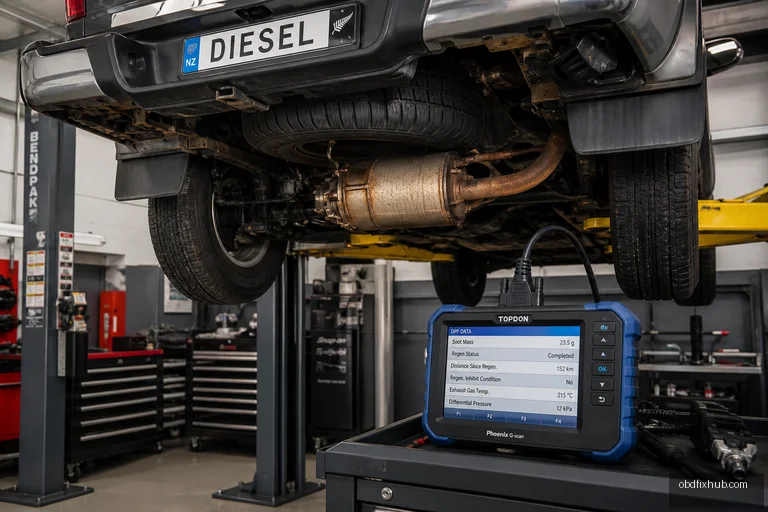
If your scan tool displays P24FD Incorrect Diesel Particulate Filter Installed, the engine computer believes the diesel particulate filter (DPF) fitted to the vehicle does not match the expected specification. The problem may be an incorrect replacement filter, an uncompleted ECU adaptation, wrong sensor data, or a wiring and calibration fault—not necessarily a blocked DPF.
This is primarily an informational and diagnostic search intent: the correct repair depends on identifying why the control module cannot validate the filter. Avoid forcing a regeneration or replacing expensive parts before checking the DPF identification, pressure readings, temperature sensors, and software configuration.
What Does P24FD Incorrect Diesel Particulate Filter Installed Mean?
P24FD is a powertrain diagnostic trouble code associated with DPF identification or configuration. The engine control module compares expected values—such as filter type, flow characteristics, pressure behavior, and sometimes a stored component ID—with the data it receives from the exhaust system.
If those values do not agree, the module may set P24FD. Exact wording and test logic vary by manufacturer, so the factory service information for the specific vehicle remains the final authority. On some models, the code appears after a DPF replacement when the required replacement procedure or adaptation has not been completed.
Common Causes of the P24FD DPF Code
- Incorrect DPF specification: A filter may physically fit the exhaust but have the wrong cell density, catalyst coating, volume, or pressure-flow characteristics.
- Aftermarket filter incompatibility: Some low-cost filters do not reproduce the backpressure profile expected by the ECU, even when they are advertised for the correct engine.
- DPF replacement not registered: Many vehicles require a scan-tool procedure to record the new filter and reset calculated ash or loading values.
- Wrong software or calibration: An ECU, engine, or exhaust system may have been replaced without programming the correct vehicle configuration.
- Pressure sensor problems: A biased DPF differential-pressure sensor, blocked sensing pipe, split hose, or reversed hose can make a correct filter appear incorrect.
- Exhaust temperature sensor faults: Implausible temperature readings can prevent the ECU from validating regeneration and filter operation.
- Wiring or connector damage: Heat near the turbocharger and DPF can harden insulation, loosen terminals, or cause intermittent reference-voltage faults.
- Incorrect installation: Leaks before or around the DPF, missing seals, incorrect clamps, or a filter installed in the wrong flow direction can distort diagnostic readings.
P24FD Symptoms to Watch For
Some drivers notice only a warning light, while others experience reduced performance. The symptoms depend on whether P24FD is a configuration issue or has allowed soot loading to increase.
- Check Engine or emissions warning light
- Reduced-power or limp-home mode
- Failed or interrupted automatic DPF regeneration
- Higher fuel consumption
- Cooling fans running after the engine is switched off
- Slow acceleration, especially under load
- Frequent regeneration attempts or a rising oil level
- Additional DPF, exhaust-temperature, or pressure-sensor trouble codes
A rising engine-oil level deserves immediate attention. Repeated regeneration attempts can introduce diesel fuel into the crankcase, reducing oil viscosity and potentially damaging bearings or the turbocharger. Do not continue driving indefinitely simply because the vehicle still starts normally.
How to Diagnose P24FD Correctly
1. Scan all modules, not just the engine ECU
Record every stored, pending, and manufacturer-specific code before clearing anything. Codes relating to the differential-pressure sensor, exhaust gas temperature sensors, EGR system, or glow plugs may explain why the DPF validation failed.
2. Confirm the filter’s identity and installation
Compare the DPF part number with the vehicle’s engine code, emissions standard, model year, and transmission configuration. A filter designed for a similar engine may still be wrong because different versions use different catalyst coatings or pressure characteristics.
Inspect the filter for an arrow or marked exhaust-flow direction, damaged mounting points, leaking joints, missing gaskets, and signs that the filter has been hollowed out or modified. A professional technician may also compare the unit’s measured restriction with the manufacturer’s specifications.
3. Test the differential-pressure system
With the engine off, pressure-sensor readings should normally be close to zero, although the precise acceptable range is manufacturer-dependent. Check both hoses for soot blockage, condensation, cracking, and incorrect routing. A blocked upstream port can create a false high-pressure signal; a detached hose can create a false low or implausible signal.
During a controlled road test, compare pressure readings at idle and under load with scan-tool data. Do not rely on one universal pressure limit because readings vary by engine size, exhaust temperature, RPM, and sensor design.
4. Check temperature sensors and live data
Cold-start temperature readings should be reasonably consistent with ambient temperature. A sensor showing an implausibly high or low value can stop regeneration and produce secondary DPF faults. Check sensor wiring close to the exhaust, where heat damage is common.
5. Verify adaptations and software
After installing a new DPF, use a manufacturer-capable diagnostic tool to perform the DPF replacement, ash reset, or component adaptation procedure specified for that vehicle. Clearing the fault code alone does not update the ECU’s learned values.
How to Fix P24FD
- Repair wiring, connectors, or sensor hoses if live data proves the pressure or temperature signal is inaccurate.
- Replace a faulty pressure or temperature sensor using the correct part and confirm its calibration afterward.
- Install the correct DPF if the fitted filter is for the wrong engine, emissions level, or vehicle configuration.
- Repair exhaust leaks and installation errors before attempting regeneration.
- Complete the DPF replacement adaptation with a suitable diagnostic tool.
- Perform regeneration only when appropriate. A forced regeneration is unsafe if the filter is overloaded with ash, damaged, contaminated with oil, or supplied with unreliable sensor data.
A DPF filled with ash cannot be restored by regeneration because ash is non-combustible. It may require professional off-car cleaning or replacement. If the filter is heavily soot-loaded, investigate the original cause—such as failed glow plugs, an EGR fault, injector over-fueling, or repeated short journeys—before fitting another filter.
Can You Drive With P24FD?
Short, gentle driving to a repair facility may be possible if there is no severe power loss, flashing warning lamp, overheating, or rising oil level. Avoid towing, high-load driving, and repeated attempts to force a regeneration. Stop driving and arrange recovery if the vehicle enters severe limp mode, emits excessive smoke, or the oil level is above the maximum mark.
What Is a Good Website for Fixing Things?
For general repair procedures, iFixit is a useful website because it provides step-by-step guides, photographs, and community troubleshooting. Fix.com can also be helpful for parts identification and DIY repair information, particularly for household and equipment repairs.
For a P24FD diagnosis, however, generic repair websites should be treated as a starting point. The most reliable sources are the vehicle manufacturer’s service information, wiring diagrams, technical service bulletins, and a scan tool that supports the car’s manufacturer-specific DPF functions. The correct filter part number and adaptation procedure matter more than a generic “clear the code” guide.
Summary: The Right Next Step
P24FD does not automatically mean the DPF is blocked. It indicates that the ECU cannot reconcile the installed filter with the expected system configuration or sensor data. Confirm the filter specification, inspect the installation, test pressure and temperature signals, and complete the required replacement adaptation before considering a forced regeneration.
If the code returns immediately after clearing, stop replacing parts at random. Have the vehicle diagnosed with manufacturer-level equipment, especially when the filter was recently replaced or the engine oil level is increasing.
Frequently Asked Questions
Is P24FD caused by a bad DPF?
Sometimes, but not always. An incorrect or poor-quality filter can trigger the code, yet a pressure sensor, blocked hose, wiring fault, exhaust leak, or missing adaptation can produce the same result.
Will clearing P24FD fix the problem?
No. Clearing the code removes the stored fault temporarily but does not correct an incorrect filter, sensor fault, or missing DPF replacement registration. The code will usually return when the ECU repeats its validation test.
Does a new DPF need to be programmed?
Many vehicles require a DPF replacement or adaptation procedure, while others use a different reset process. Follow the manufacturer’s instructions rather than assuming every diesel uses the same scan-tool function.
Can a forced regeneration remove P24FD?
Only if the underlying problem is soot loading and every sensor is reporting correctly. Forced regeneration will not correct the wrong filter, remove ash, repair a wiring fault, or compensate for an unregistered replacement.




