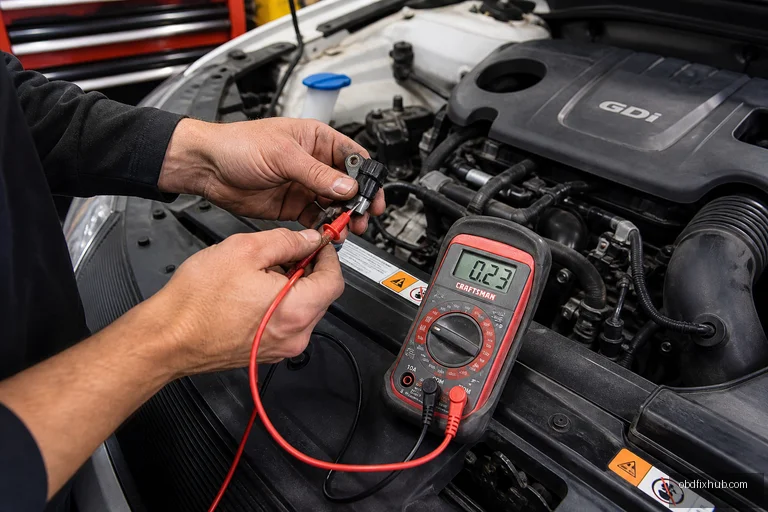
P254F Engine Hood Switch Circuit means the vehicle’s engine hood switch or its wiring is reporting an abnormal signal to the body control module or powertrain control module. In most cases, the problem affects hood-open detection, remote start, or stop-start operation rather than engine performance. The related code P257D usually indicates that the hood switch circuit signal is too high, often because of an open circuit, poor connection, or a failed switch.
What Does the P254F Fault Code Mean?
P254F is a generic OBD-II trouble code for an issue in the engine hood switch circuit. The switch is commonly mounted near the hood latch and tells the vehicle whether the hood is closed. This information is used as a safety input for systems such as remote engine start, automatic stop-start, alarm monitoring, and certain service procedures.
The exact wording can vary by manufacturer. Some vehicles use a simple hood-ajar switch, while others use a latch assembly with an integrated position sensor. Therefore, the code description alone does not identify the defective part. The vehicle’s wiring diagram and live data are needed to separate a bad switch from a wiring fault.
What Does “Engine Hood Switch Circuit High” Mean?
“Circuit high” means the control module is seeing a higher-than-expected voltage on the hood switch signal wire. It does not necessarily mean that the hood is physically open. A high reading can result from a broken signal wire, a disconnected connector, corrosion inside the plug, or a switch that is not pulling the circuit to the expected voltage when the hood is closed.
On many systems, the circuit is monitored with a reference voltage. When the hood switch changes state, the voltage should move within a specific range. If the module continuously sees battery voltage or an open-circuit voltage, it may store P257D. Always confirm the manufacturer’s specified voltage before testing; circuit logic differs between makes and models.
Common Causes of P254F and P257D
- A failed hood latch switch or integrated hood position sensor
- Damaged wiring near the hood latch, radiator support, or front bumper
- Loose, bent, pushed-back, or corroded connector terminals
- A hood latch that is dirty, misaligned, or not fully engaging
- Previous body or front-end repair that pinched or stretched the harness
- Water intrusion from pressure washing or a damaged connector seal
- An incorrectly adjusted hood, worn latch, or loose hood bump stop
- A control module or software issue, which is less common than a circuit fault
A frequent real-world mistake is replacing the latch immediately. On vehicles that have had front-end work, the most likely fault may be a harness clipped incorrectly against a sharp bracket. Inspect the first 30–60 centimeters of wiring from the latch before ordering parts.
P254F Symptoms You May Notice
- Check Engine Light or a body-system warning message
- A persistent “hood open” warning with the hood fully closed
- Remote start being disabled or refusing to activate
- Automatic stop-start becoming unavailable
- Alarm or vehicle security functions behaving inconsistently
- The code returning immediately after being cleared
Usually, P254F does not cause rough running, reduced acceleration, overheating, or a no-start condition. If those symptoms are present, diagnose them separately rather than assuming the hood switch code is responsible.
How to Diagnose the Engine Hood Switch Circuit
- Confirm the code and vehicle data. Record all stored and pending codes, freeze-frame information, and the make-specific description. Check whether the code is P254F, P257D, or another hood-related fault.
- Inspect the hood and latch mechanically. Make sure the hood closes evenly and the latch fully locks. Do not test the electrical circuit while relying on an unsecured hood.
- Check live data. With a professional scan tool, monitor “hood switch,” “hood ajar,” or similar data while opening and closing the hood. The status should change consistently without flickering.
- Examine the connector and harness. Look for green corrosion, moisture, loose terminals, broken insulation, and wires pulled tight at the latch. A visual inspection often finds the fault faster than replacing components.
- Test voltage and continuity. Use the wiring diagram and a digital multimeter to verify reference voltage, ground, signal voltage, and continuity. Do not probe terminals aggressively, because enlarged terminals can create a new intermittent fault.
- Repair, clear, and retest. After the repair, clear the code, cycle the hood several times, test remote start if equipped, and perform a road test. Confirm that the code does not return as pending.
A useful workshop technique is a gentle wiggle test while watching live data. If the hood status changes when the harness is moved, the problem is probably an intermittent connection or broken conductor rather than the latch itself.
How Is P254F Fixed?
The correct repair depends on the test results. A corroded connector may need terminal repair and a new weather seal. A damaged wire should be repaired with automotive-grade crimp connections or soldered joints protected by heat-shrink tubing, then secured away from the latch and hot components.
If the sensor is integrated into the latch, the complete hood latch assembly may need replacement. After installation, check hood alignment and verify that the latch releases and locks normally. Some vehicles also require a body-control-module calibration or software update, but programming should not be the first response to an uninspected wiring fault.
How Much Does It Cost to Fix P257D?
The cost varies by vehicle and by whether P257D is caused by wiring or the latch assembly. Typical U.S. repair ranges are:
- Diagnosis: $75–$180
- Connector or wiring repair: $100–$300
- Hood switch replacement: $100–$250
- Integrated hood latch replacement: $200–$600
- Module programming or software work: $100–$250, when required
Dealer pricing, luxury vehicles, difficult harness access, and parts availability can increase the total. Ask the shop whether the estimate includes electrical testing, because replacing a latch without confirming the signal circuit can lead to an unnecessary expense.
Is It Safe to Drive With a P257D Code?
In most cases, the vehicle is mechanically safe to drive if the hood is properly latched and there are no other warning signs. However, P257D can disable remote start and may prevent the vehicle from recognizing that the hood is closed. Never use remote start until the fault is repaired, and physically verify the secondary hood catch before driving.
Stop driving and inspect the vehicle immediately if the hood is loose, the hood-open warning remains active, the latch does not engage firmly, or the code appeared after front-end damage. A hood that opens while driving is a serious safety hazard, even when the engine operates normally.
Final Takeaway
P254F points to an engine hood switch circuit problem, while P257D commonly identifies a high signal in that circuit. Start with the latch, connector, and nearby wiring before replacing parts. A scan-tool live-data check combined with a careful voltage and continuity test usually identifies the fault quickly and prevents an unnecessary latch replacement.
Action step: Confirm the exact code with a quality scan tool, inspect the hood latch and harness, and have the circuit tested before relying on remote start or ignoring the warning.
Frequently Asked Questions
Can a weak car battery cause P254F?
Low system voltage can create multiple unrelated codes, but it is not the most common cause of P254F. Test battery voltage and charging performance if several modules report faults at the same time. A single persistent hood-switch code usually requires circuit inspection.
Will clearing P254F fix the problem?
Clearing the code only resets the stored fault. If the switch signal remains incorrect, P254F or P257D will return immediately or after the next drive cycle. Clear it only after the wiring or switch has been repaired.
Can I bypass the hood switch?
Bypassing the switch is not recommended. The signal is a safety input for remote start and other vehicle functions, and a bypass can hide a hood-latch problem or create an unsafe condition.
Is P257D the same code as P254F?
No. Both relate to the hood switch circuit, but P254F is a general circuit fault and P257D commonly specifies a high circuit signal. Manufacturer definitions can vary, so verify the code using the vehicle’s service information.




