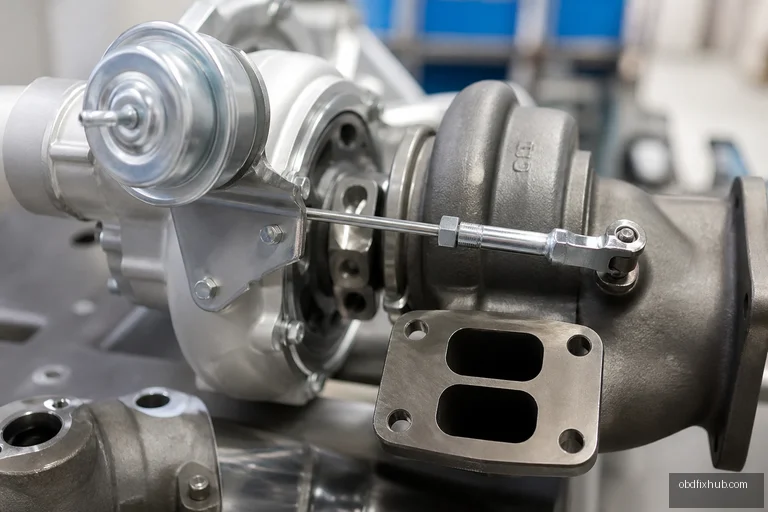
P25B3 turbocharger wastegate stuck open means the engine computer believes the wastegate is not closing when boost is required. The result is usually low or inconsistent turbo boost, reduced power, a check engine light, and sometimes limp mode. The fault may come from a seized wastegate mechanism, a failed actuator, a damaged linkage, a vacuum or electrical problem, or an incorrect position signal—not necessarily a failed turbocharger.
What Does Code P25B3 Mean?
P25B3 is commonly defined as Turbocharger Wastegate Stuck Open. The wastegate controls exhaust flow around the turbine. When it opens, some exhaust bypasses the turbine and turbocharger speed is limited. When the engine needs boost, the actuator should close the gate; if it remains open, the turbo cannot build the expected pressure.
Exact wording and test conditions can vary by manufacturer. Before replacing parts, check the vehicle-specific service information and scan for related codes. Codes involving wastegate position sensors, actuator circuits, boost pressure, or underboost can identify whether the problem is mechanical or electrical.
What Happens If a Turbo Wastegate Is Stuck Open?
A wastegate stuck open usually prevents the turbocharger from producing normal boost. The engine may still run and idle normally, but acceleration feels flat, particularly under load or above 2,000–3,000 rpm. On a turbocharged diesel, the vehicle may struggle on hills; on a turbocharged gasoline engine, throttle response and passing power can drop sharply.
- Turbo boost stays below the commanded level.
- The check engine light may illuminate and the ECU may limit engine torque.
- Fuel economy can worsen because the engine works harder to make the same power.
- Exhaust smoke may increase on some diesel engines because air supply is reduced.
- Boost may become intermittent if the linkage moves only part of the time.
A gate stuck open is generally less likely to cause an immediate overboost event than a gate stuck closed. However, continuing to drive with a malfunctioning actuator can damage the turbo, create excessive exhaust temperature, or leave you without power during a merge. Avoid towing or hard acceleration until the fault is diagnosed.
Common Causes of P25B3
1. Carbon, rust, or heat seizure
Turbocharger housings operate in an extremely hot environment. Carbon deposits and corrosion can bind the wastegate flap, shaft, or lever. Short trips, oil contamination, and high exhaust temperatures make this more likely. A linkage that feels free when cold may seize after the turbo reaches operating temperature.
2. Failed vacuum actuator or leaking hose
Many older turbo systems use a vacuum diaphragm to move the wastegate. A cracked hose, loose connection, failed vacuum solenoid, or punctured actuator diaphragm can prevent the rod from moving. A hand vacuum pump is useful here: the actuator should hold vacuum and move smoothly according to the manufacturer’s specification.
3. Electronic actuator or position sensor failure
Modern turbochargers often use an electronic wastegate actuator with an integrated position sensor. Internal gear wear, water intrusion, wiring damage, poor connector contact, or a lost actuator calibration can make the ECU see an open position even when the mechanism appears normal.
4. Bent linkage or incorrect adjustment
After turbocharger replacement, the actuator rod may be incorrectly adjusted, installed on the wrong lever hole, or left uncalibrated. Do not shorten or lengthen the rod by guesswork. A small adjustment can change preload and boost control enough to cause overboost or underboost.
5. False diagnosis caused by an air leak
A split charge-air hose, leaking intercooler, faulty boost control solenoid, or inaccurate MAP sensor can produce symptoms that resemble an open wastegate. This is why replacing the turbo immediately is often an expensive mistake.
Symptoms of a Bad or Stuck Wastegate
Look for a pattern rather than relying on one symptom. A vehicle with P25B3 may have low boost, slow acceleration, a whooshing sound, reduced fuel economy, or limp mode. Some vehicles show no unusual noise at all because the actuator has failed electrically while the gate remains mechanically intact.
- Check engine light with P25B3 or related boost codes.
- Measured boost consistently lower than requested boost.
- Weak acceleration under load, especially uphill.
- Engine hesitation or torque reduction after a fault is detected.
- Wastegate rod that does not move during an actuator test.
- Actuator position data that remains near the open limit.
The most useful clue is live data. Compare commanded wastegate position, actual position, target boost, and measured boost during a controlled road test. If the command changes but the actual position does not, suspect the actuator, wiring, or seized mechanism. If both positions agree but boost remains low, inspect the intake and exhaust systems for leaks or restrictions.
How to Diagnose P25B3 Correctly
- Record all codes and freeze-frame data. Note engine speed, load, coolant temperature, and requested boost when P25B3 was stored.
- Inspect the turbo linkage. Look for a disconnected rod, bent lever, missing retaining clip, rust, and contact marks around the wastegate arm.
- Check hoses and wiring. Examine vacuum lines, the boost-control solenoid, actuator connector, grounds, and harness sections near the turbocharger.
- Test actuator movement. Use a hand vacuum pump on vacuum systems or a bidirectional scan-tool test on electronic systems. Follow the specified travel range; do not apply random voltage to an electronic actuator.
- Check for air leaks. A regulated smoke or pressure test can reveal intercooler and charge-pipe leaks that are difficult to see visually.
- Verify calibration. Some electronic actuators require a learned stop position or turbocharger adaptation after installation.
A practical workshop tip is to compare the actuator’s cold behavior with its behavior after a heat soak. If the rod moves smoothly cold but sticks hot, the wastegate shaft or turbo housing is likely binding rather than the scan tool being incorrect.
How to Unstick a Wastegate
First determine whether the actuator is disconnected or the wastegate shaft itself is seized. With the engine off and fully cool, inspect the lever and gently check for smooth movement if the service procedure allows it. Never reach near a hot turbocharger, and never force the lever with excessive pressure; a bent arm or damaged shaft can turn a minor repair into a turbo replacement.
For light external corrosion, a suitable high-temperature penetrant and repeated gentle movement may temporarily restore operation. This is not a permanent cure if the shaft is worn or the internal flap is carbon-bound. Do not spray ordinary lubricant into the exhaust housing, drill the housing, or alter actuator preload without factory measurements.
If the actuator fails a vacuum-holding test, replace the actuator or the leaking control component. If the wastegate remains mechanically seized, the turbocharger may need removal for professional cleaning, bushing repair, or replacement. Clear the code only after the cause has been repaired and perform the required actuator relearn.
Can You Run a Turbo Without a Wastegate?
No—not safely on a conventional turbo system. Removing, wiring open, or bypassing the wastegate removes the mechanism that limits turbine speed and boost. The engine can develop uncontrolled boost, detonation, excessive cylinder pressure, turbo overspeed, or severe engine damage.
Some specialized turbochargers use variable turbine geometry or another boost-control design, but that does not make a conventional wastegate optional. If the wastegate has failed, repair the control system rather than trying to operate around it.
P25B3 Repair Options and Typical Outcome
The correct fix depends on the failed component. A loose hose or damaged connector may be inexpensive, while an electronic actuator or seized turbocharger can be costly. Replacing the entire turbo without testing the actuator, boost-control solenoid, and charge-air system is poor diagnostic practice.
- Replace cracked vacuum hoses, damaged wiring, or a failed solenoid.
- Replace and calibrate a defective electronic wastegate actuator.
- Repair or replace a seized wastegate mechanism or turbocharger.
- Repair boost leaks and verify MAP or boost sensor readings.
- Clear codes, complete the relearn procedure, and confirm requested versus actual boost on a road test.
Final Takeaway
P25B3 points to a wastegate that the ECU believes is stuck open, but the code does not automatically condemn the turbocharger. Start with the actuator, linkage, vacuum or electrical controls, and boost leaks. Drive gently until the fault is fixed, and use live data plus an actuator test to identify the real cause instead of guessing.
Frequently Asked Questions
How do I know if my turbo wastegate is bad?
Common signs include low boost, weak acceleration, a check engine light, actuator position errors, and a linkage that fails to move smoothly. A vacuum test or bidirectional scan-tool test is more reliable than listening for turbo noise.
Can a stuck-open wastegate damage the engine?
It can cause poor performance and high exhaust temperatures, and the underlying actuator or turbo problem may worsen. It is usually less immediately dangerous than a wastegate stuck closed, but hard driving and towing should be avoided.
Will clearing P25B3 fix the problem?
No. Clearing the code only removes the stored warning temporarily. If the actuator, linkage, wiring, or boost system is still faulty, the code and symptoms will return.
Can I lubricate a stuck wastegate?
External penetrant may help with light corrosion, but it is not a dependable repair for a seized internal shaft or worn turbocharger. Use only procedures approved for that turbo model and never lubricate a hot exhaust housing with an unsuitable product.




