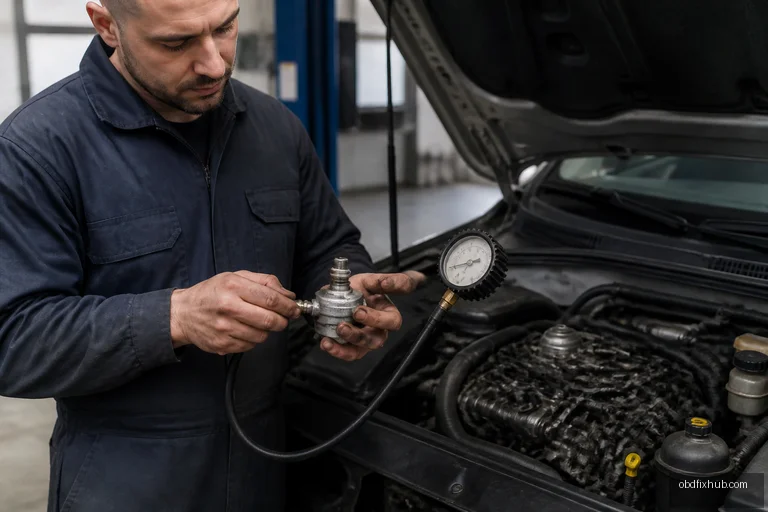
P2623 means the engine control module has detected an open or faulty circuit in the injector control pressure regulator system. In practical terms, the ECM cannot reliably control or monitor the pressure used to actuate the fuel injectors. The result may be hard starting, rough running, reduced power, or a no-start condition. Because the exact circuit design varies by manufacturer, always confirm the code definition and test values in the vehicle’s factory service information before replacing parts.
What Does the P2623 Code Mean?
The generic definition of P2623 is Injector Control Pressure Regulator Circuit/Open. It is a powertrain diagnostic trouble code, but the component involved is not always identical across every engine family. On some diesel applications, it relates to the injector control pressure regulator or its solenoid; on other vehicles, the system may use a high-pressure fuel control valve with a different name.
The word “open” is important. It usually indicates a broken wire, disconnected connector, failed solenoid winding, damaged terminal, or a loss of power or ground. It does not automatically mean the engine has a failed fuel pump or that the injectors themselves must be replaced.
Common P2623 Symptoms
Symptoms depend on whether the regulator is stuck, electrically open, or intermittently losing contact. A vehicle may still drive reasonably well when the fault is intermittent, then fail to start after being switched off.
- Extended cranking or a crank-no-start condition
- Rough idle, misfire, or engine vibration
- Low engine power and poor throttle response
- Stalling, particularly during acceleration or hot restarts
- Unstable injector control pressure or fuel pressure readings
- Illuminated Check Engine light
- Reduced fuel economy or excessive smoke on diesel engines
- Additional fuel pressure, injector, or engine performance codes
One useful diagnostic clue is the relationship between engine speed and pressure. If pressure does not build during cranking, the control circuit may be open, but a mechanical leak, weak pump, low battery voltage, or excessive injector return flow can create a similar symptom. That is why replacing the regulator based only on the code often leads to an unnecessary repair.
Most Common Causes of P2623
- Open, broken, or chafed wiring between the ECM and pressure regulator
- Corroded, loose, pushed-back, or oil-contaminated connector terminals
- Failed injector control pressure regulator solenoid
- Blown fuse, missing ignition feed, or poor ground
- Harness damage near the engine, turbocharger, exhaust, or fuel rail
- Low battery voltage during cranking
- High-pressure fuel or oil leakage, depending on the engine design
- Contaminated fuel or a sticking pressure control valve
- Incorrect previous repairs, aftermarket wiring, or an improperly installed connector
- Rarely, an ECM driver or internal ECM fault
How to Diagnose the P2623 Injector Control Pressure Regulator Circuit
A professional diagnosis should separate an electrical circuit problem from a pressure-generation problem. The following sequence prevents the common mistake of installing a regulator before proving that the circuit can operate it.
1. Confirm the code and freeze-frame data
Scan all modules, not just the engine computer, and record every stored and pending code. Freeze-frame data can show whether P2623 appeared during starting, idle, acceleration, or a low-voltage event. If several communication or voltage codes are present, test the battery and charging system before chasing the regulator.
2. Inspect the regulator and harness carefully
Follow the wiring from the pressure regulator back toward the main harness. Look for insulation rubbed through on a bracket, melted sections near the exhaust, oil inside the connector, and terminals that have spread and no longer grip the pin. A connector can look clean externally while a single terminal has backed out enough to cause an intermittent open.
3. Test power, ground, and continuity
Use the wiring diagram for the specific vehicle to identify the regulator’s power and control circuits. Check supply voltage with the circuit connected and loaded; a voltage reading with the connector unplugged may hide a poor connection. With the battery disconnected as required by the service procedure, check continuity from the regulator connector to the ECM and test for unwanted continuity to ground or voltage.
Do not rely on resistance alone. A wire can pass a static ohmmeter test but fail when the engine vibrates or when current flows through it. A voltage-drop test, wiggle test, and oscilloscope check are often more revealing on an intermittent fault.
4. Measure the regulator itself
Compare the solenoid resistance with the manufacturer’s specification at the correct temperature. An infinite reading generally indicates an open coil, while a near-zero reading suggests a shorted coil. Neither test proves that the valve moves correctly, so use an approved bidirectional scan-tool test or component activation procedure where available.
5. Compare commanded and actual pressure
Monitor the commanded pressure and actual pressure while cranking and at operating temperature. If the ECM commands the regulator but the electrical signal is missing, focus on wiring, the driver circuit, or the solenoid. If the signal is present but pressure remains low, investigate mechanical leaks, pump output, injector return flow, fuel supply restrictions, or—on certain diesel systems—high-pressure engine oil supply problems.
A practical workshop tip is to save scan data during both a cold start and a hot restart. Some regulators pass a cold resistance test but develop an open circuit once the coil or connector heats up. Reproducing the failure is more valuable than simply clearing the code and taking a short test drive.
How to Fix P2623
The correct repair depends on the test results. Common repairs include replacing a damaged connector terminal, repairing a chafed section of harness, restoring a missing power or ground feed, or replacing the injector control pressure regulator. If the regulator is contaminated, inspect the fuel system for the source of the contamination rather than installing a new valve alone.
- Repair wiring with sealed, correctly crimped automotive terminals; avoid twisting wires together and covering them with tape.
- Replace damaged connectors and confirm terminal tension before reconnecting them.
- Replace the regulator only after confirming that its power, ground, control signal, and mechanical pressure readings are incorrect.
- Replace damaged seals and lubricate them with the specified fluid during installation.
- Prime the fuel system or perform the manufacturer’s relearn procedure when required.
- Clear the code, start the engine, verify pressure data, and complete a road test under the conditions shown in freeze-frame data.
Can You Drive With a P2623 Code?
Short-distance driving may be possible if the engine starts and runs smoothly, but it is not a code to ignore. A circuit that is intermittently open can become a complete failure without warning, leaving the vehicle unable to start. Continued driving with unstable injector control pressure can also cause misfires, smoke, poor lubrication on some diesel systems, or excessive stress on the high-pressure fuel system.
What Not to Replace First
Do not begin with injectors, the ECM, or a complete high-pressure pump simply because P2623 is stored. The code points toward a regulator control circuit, and a visual inspection frequently finds the actual fault in the connector or harness. Use scan data and a wiring diagram to prove the failed component before authorizing an expensive parts replacement.
Summary and Next Step
P2623 indicates an open or malfunctioning injector control pressure regulator circuit, but the root cause may be electrical, mechanical, or voltage-related. Start with a full scan, battery check, connector inspection, loaded circuit tests, and a comparison of commanded versus actual pressure. If the fault returns after a repair, perform a heat-and-vibration test instead of assuming the replacement regulator is defective.
Frequently Asked Questions
Is P2623 the same on every vehicle?
No. The generic code definition concerns the injector control pressure regulator circuit, but the component name, wiring strategy, pressure source, and testing procedure can vary by manufacturer and engine. The factory repair manual should take priority over generic scan-tool descriptions.
Can a weak battery cause P2623?
Yes. Low cranking voltage can prevent the regulator from operating correctly or cause the ECM to interpret the circuit as faulty. Check battery voltage and voltage drop during cranking before condemning the regulator.
Will replacing the injector control pressure regulator fix the code?
Only if the regulator itself has failed. A broken wire, loose connector terminal, missing fuse feed, pressure leak, or ECM driver problem will remain after the valve is replaced.
Is P2623 serious?
It can be serious, especially if the vehicle has hard starting, stalling, severe misfires, or unstable high-pressure fuel readings. Avoid continued driving if the engine may shut off in traffic or if the engine oil or fuel system shows signs of contamination.




