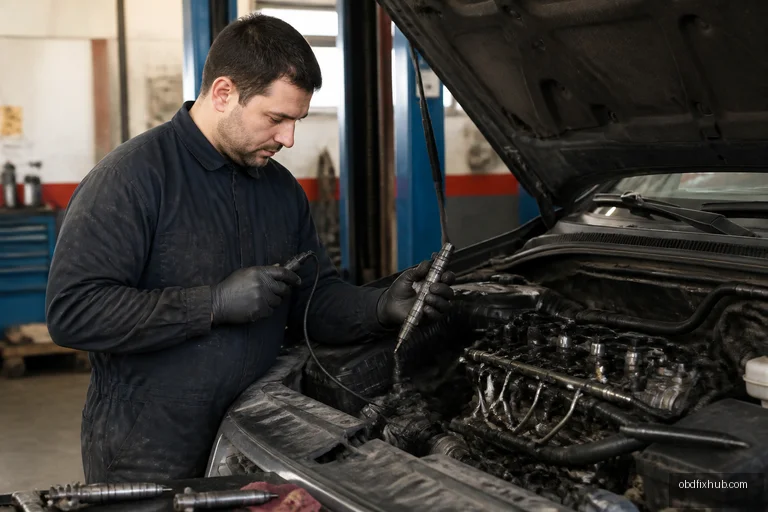
Search intent: Informational. The P262A fuel injector pilot injection not learned code means the engine control module has not successfully learned or accepted the pilot-injection calibration for one or more diesel fuel injectors. It does not automatically prove that an injector is defective. The fault may appear after injector replacement, incorrect coding, low system voltage, fuel-pressure problems, wiring faults, or a failed injector control circuit.
This code is also easy to confuse with P0262. P0262 normally means Cylinder 1 Injector Circuit High, which is an electrical circuit fault. P262A is a learned-value or calibration-related fault, and the exact description can vary by manufacturer and engine family. Always confirm the code definition with a factory-level scan tool and the vehicle’s service information before replacing parts.
What Does P262A Mean?
Modern common-rail diesel injectors often perform a small pre-injection event before the main injection pulse. This is called pilot injection. It helps control combustion noise, emissions, cold-start behavior, and cylinder pressure.
The engine control module monitors how each injector responds and stores correction or learning values. When those values cannot be learned, are outside the permitted range, or do not match the injector calibration data, the module may set P262A. In practical terms, the control system is saying: I cannot establish a reliable pilot-injection correction for this injector system.
P262A Symptoms
Some vehicles will show only a check-engine light, while others develop noticeable drivability problems. Symptoms depend on whether the root cause is a coding mistake, an injector problem, or a wider fuel-system fault.
- Check-engine or malfunction indicator light
- Rough idle, especially when the engine is cold
- Extended cranking or difficult starting
- Uneven acceleration, hesitation, or reduced torque
- Diesel combustion knock or unusually harsh engine noise
- Increased smoke or fuel consumption
- Engine derating or limp-home operation
- Additional injector, rail-pressure, or cylinder-balance codes
A useful diagnostic clue is timing. If P262A appeared immediately after an injector was replaced, programmed, or moved between cylinders, configuration and relearn procedures should be checked before condemning the new injector.
Common Causes of P262A
1. Injector calibration was not entered
Many diesel injectors carry an individual correction code printed on the injector body or supplied with the part. Installing the injector without entering its code into the engine control module can prevent pilot-injection learning. A code entered into the wrong cylinder can create the same problem.
2. The required injector relearn was skipped
Some systems require a specific sequence involving engine temperature, battery voltage, idle speed, and scan-tool commands. Disconnecting the battery is not a substitute for an injector quantity adjustment or pilot-injection learning routine. The procedure varies considerably between Ford, Fiat, Iveco, Volkswagen, Mercedes-Benz, and other platforms.
3. Incorrect, damaged, or mismatched injector
A visually identical injector may have different flow characteristics or calibration data. Poor-quality remanufactured injectors are another common source of failed learning. A connector that is not fully locked, a bent terminal, or diesel contamination inside the electrical plug can also interfere with the correction process.
4. Fuel-pressure or fuel-quality problems
Low rail pressure, excessive injector return flow, a restricted fuel filter, air entering the supply line, or contaminated fuel can make the pilot event unstable. The module may report a learning failure even though the electrical wiring is intact.
5. Voltage, wiring, or control-module faults
Weak batteries and voltage drops during cranking can interrupt injector learning. Inspect the injector harness for chafing near the cylinder head, oil intrusion, loose grounds, and high resistance. In less common cases, the injector driver inside the PCM or a separate injector driver module may be defective.
How to Diagnose P262A Properly
- Record all codes and freeze-frame data. Do not erase the code before noting engine temperature, battery voltage, rail pressure, and related cylinder codes.
- Check service information. Confirm whether the vehicle requires injector coding, a pilot-injection learn, a quantity adjustment, or a special post-repair drive cycle.
- Verify injector identity and cylinder position. Compare the code on each injector with the value stored in the module. Confirm that no injector was installed in the wrong cylinder.
- Test battery and charging voltage. Learning procedures can fail if voltage falls sharply during cranking or remains below the manufacturer’s required range.
- Inspect the harness and connectors. Perform a terminal-tension check rather than relying only on a visual inspection. A connector can look clean while losing contact under vibration.
- Compare live data. Review commanded and actual rail pressure, injector correction values, cylinder contribution, and return-flow measurements. One cylinder that is far outside the others is an important lead.
- Run the factory relearn procedure. After correcting the underlying problem, clear the learned values only as instructed and complete the required drive cycle. Confirm that the code does not return.
One practical mistake is replacing the injector with the highest correction value without checking fuel pressure and return flow. A weak high-pressure pump or restricted filter can make several injectors appear abnormal at once. The pattern across all cylinders is often more informative than one number in isolation.
What Is the Fix for P262A?
The repair depends on the failed test. Possible fixes include entering the correct injector calibration code, performing the manufacturer-specified pilot-injection relearn, repairing a terminal or ground, replacing contaminated fuel and the filter, correcting a rail-pressure problem, or replacing a failed injector with a properly coded unit.
If an injector is replaced, use the correct part number, record its cylinder position, enter its calibration data, and complete the relearn. Simply clearing P262A may make the warning light disappear temporarily, but the code will often return when the module again evaluates pilot injection.
What Are the First Signs of a Bad Fuel Injector?
The earliest signs are often subtle: a slightly uneven idle, longer cranking after the vehicle sits, a change in diesel knock, or a small increase in fuel consumption. A driver may notice a brief stumble under light acceleration before a major misfire develops.
- Rough or unstable idle
- Hard starting or extended cranking
- White smoke during cold start or black smoke under load
- Sharp diesel knock from one cylinder
- Fuel dilution in the engine oil
- Uneven cylinder-balance or injector-correction readings
These signs are not proof by themselves. Compression problems, glow-plug faults, air in the fuel, and low rail pressure can produce similar symptoms. Injector return-flow and cylinder-balance tests are more reliable than sound or smoke alone.
Is Replacing a Fuel Injector a Big Job?
It ranges from a straightforward repair to a time-consuming job. On an accessible four-cylinder engine, replacement may take a few hours. On some modern diesel engines, the injector is buried under the intake manifold, high-pressure pipes, wiring, or other components.
Removal can become difficult when an injector has seized in carbon or corrosion. The sealing washer and injector bore must be cleaned correctly, the high-pressure line must be handled safely, and the injector must be coded afterward. Do not loosen high-pressure diesel lines while the engine is running; the spray can penetrate skin and cause a medical emergency.
Symptoms of a Bad Fuel Injector Control Module
Depending on the vehicle, the injector driver may be integrated into the PCM or housed in a separate injector control module. A failing driver can cause multiple injector circuit codes, several cylinders to stop firing, intermittent stalling, a no-start condition, or injectors that lose control when the module becomes hot.
- Multiple injector circuit faults at the same time
- No-start or sudden stalling with fuel pressure still present
- Intermittent misfire that changes with module temperature
- No injector command on one or more channels
- Communication or internal-module fault codes
A single-cylinder P262A code does not automatically indicate a bad injector control module. A driver-module diagnosis requires circuit testing, power and ground checks, injector command testing, and often an oscilloscope. Replacing the module before proving its inputs and outputs can be an expensive guess.
P262A vs. P0262: Do Not Mix These Codes Up
P262A generally points to a failed or incomplete fuel-injector pilot-injection learning process on supported applications. P0262 generally indicates a high electrical signal in the Cylinder 1 injector circuit. P0262 may be caused by a short to voltage, a damaged driver, incorrect resistance, or a connector fault.
The two codes can appear together, particularly after wiring or injector work, but they require different diagnostic paths. Read the complete manufacturer-specific description, not just the first generic code label shown by an inexpensive scanner.
Final Takeaway
P262A is a calibration and learning warning, not an automatic instruction to buy an injector. Start with injector coding, the required relearn procedure, battery voltage, wiring, rail pressure, and return-flow data. If the code appeared after repair work, verify the repair process first; if it returns with abnormal cylinder data, test the injector and fuel system before replacing parts.
Frequently Asked Questions
What does fault code P0262 mean and what are the symptoms?
P0262 usually means the Cylinder 1 fuel-injector circuit signal is higher than expected. Symptoms may include a rough idle, misfire, hard starting, reduced power, increased smoke, and a check-engine light. It is an electrical circuit code and is different from P262A.
Can I drive with P262A?
Short trips may be possible if the engine runs smoothly and the warning light is steady, but continued driving is not ideal. Rough running, heavy smoke, fuel dilution, severe knocking, or a flashing warning light requires prompt diagnosis to prevent cylinder, turbocharger, or emissions-system damage.
Does P262A always mean the injector is bad?
No. Incorrect injector coding, a missed relearn, low battery voltage, poor fuel pressure, wiring damage, and control-module faults can all prevent pilot injection from being learned.
How is an injector control module fault confirmed?
A technician checks module power, grounds, communication, injector wiring, and the commanded injector waveform. Multiple injector faults or a temperature-related no-start can support the diagnosis, but the module should not be replaced without circuit testing.
What should be done after replacing a diesel injector?
Enter the injector’s calibration code in the correct cylinder, perform the manufacturer’s quantity or pilot-injection learning routine, clear codes as directed, and complete the specified drive cycle. Recheck for returning codes and abnormal correction values.




