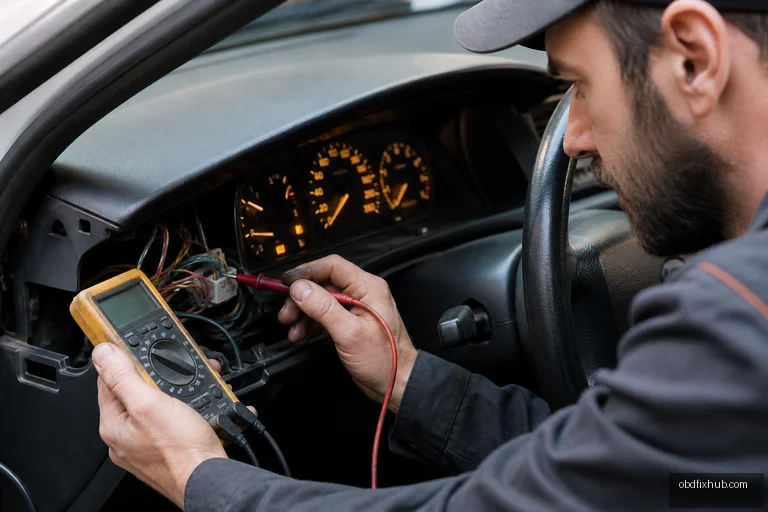
P2668 Fuel Mode Indicator Lamp Circuit means the vehicle’s powertrain control module (PCM) has detected an electrical problem in the circuit that controls the fuel-mode indicator lamp. The fault may be caused by a failed bulb or LED, damaged wiring, a poor ground, a blown fuse, a defective instrument cluster, or a PCM-side control problem. The code does not automatically mean the fuel system itself is failing, so testing the circuit before replacing expensive parts is essential.
What Does P2668 Mean?
P2668 is a generic OBD-II trouble code associated with the fuel mode indicator lamp control circuit. This lamp can be used to show a selected fuel type, alternate-fuel operation, fuel-system status, or a commanded operating mode, depending on the vehicle. Its exact design varies considerably between manufacturers, so the factory wiring diagram and service information matter more than a generic code description.
On some vehicles, the PCM controls the lamp by switching the ground side of the circuit. On others, the body control module, instrument cluster, or a dedicated fuel-system controller may operate it. That difference changes the diagnostic procedure and explains why the same P2668 code can have different repair steps on different models.
Common Symptoms of P2668
The most obvious symptom is an illuminated check-engine light, but the indicator lamp may also behave abnormally. A vehicle can store P2668 even when it drives normally because the fault affects reporting rather than fuel delivery.
- The fuel mode indicator lamp stays off when it should illuminate.
- The lamp remains on, flickers, or displays the wrong fuel mode.
- The check-engine light is illuminated.
- The vehicle fails an emissions inspection because of the stored code.
- A scan tool shows P2668 as current, pending, or history.
- In some alternative-fuel vehicles, the system may default to a conventional fuel mode.
If the vehicle also has hard starting, stalling, fuel odor, reduced power, or an engine that runs poorly, do not assume those symptoms are caused by the indicator-lamp circuit. Additional fuel-pressure, injector, mixture, or sensor codes may be present and should be diagnosed separately.
Most Common Causes of P2668
- Open, shorted, or corroded wiring between the controller and the indicator lamp.
- A poor ground at the instrument cluster, controller, or body ground point.
- A blown fuse or an ignition-power supply problem.
- A failed indicator bulb, LED driver, or instrument cluster circuit board.
- Loose terminals, pushed-out pins, or moisture inside a connector.
- Incorrectly installed aftermarket equipment or remote-start wiring.
- A failed fuel-mode switch or mode-selection input, where fitted.
- A software issue or defective PCM, body control module, or fuel-system controller.
In real-world diagnosis, connector and ground faults are more common than a failed PCM. A vehicle that recently had dashboard work, battery replacement, water intrusion, or an engine conversion deserves a careful visual inspection before module replacement is considered.
How to Diagnose P2668 Correctly
1. Confirm the code and check related faults
Use a capable scan tool to record all stored and pending codes, freeze-frame data, and the modules reporting the fault. Do not clear P2668 before noting whether the lamp was commanded on or off when the code set. Manufacturer-specific scan data may show a fuel-mode lamp command, circuit status, or output test that a basic code reader cannot access.
2. Verify the indicator’s operation
Turn the ignition on and observe the instrument-panel bulb check. Many vehicles briefly illuminate warning and status lamps at key-on. If every other cluster lamp works but the fuel-mode lamp never illuminates, the fault may be inside the cluster or its power supply. If the lamp is stuck on, the control wire may be shorted to ground or the cluster may be interpreting a false command.
3. Inspect power, grounds, and connectors
Check the relevant fuse with a test light or multimeter on both sides of the fuse; visual inspection alone can miss a poor fuse connection. Inspect the cluster and controller connectors for green corrosion, water marks, bent terminals, and terminals that have backed out of the plastic housing. Perform a voltage-drop test on the ground circuit with the lamp commanded on. A ground that appears good with no load can fail when current flows.
4. Test the control circuit, not just continuity
Follow the wiring diagram to identify the lamp feed and control wire. With the circuit disconnected as specified by the manufacturer, check for continuity, unwanted continuity to ground, and unwanted voltage. A wire can pass a static continuity test yet fail under vibration or load because of broken strands inside the insulation. A current-limited test lamp or suitable load can reveal a high-resistance connection more effectively than an ohmmeter alone.
Use an oscilloscope or a manufacturer-approved output test when the controller pulses or modulates the lamp circuit. Never apply battery voltage directly to a PCM output terminal unless the service procedure explicitly instructs you to do so; an incorrect test can damage a control module.
Repair Options for P2668
The correct repair depends on the failed section of the circuit. Repair damaged wires with the correct gauge, sealed crimp connections, and heat-shrink protection rather than twisting wires together. Clean corroded terminals only when the terminal tension remains correct; a terminal that no longer grips its mating pin should be replaced.
- Replace a blown fuse only after finding and repairing the underlying short or overload.
- Repair or replace damaged connectors and restore proper terminal tension.
- Repair a faulty ground connection and remove paint, rust, or oxidation from the contact area.
- Replace a failed bulb, LED assembly, or instrument cluster when testing proves it is defective.
- Program or replace a control module only after wiring, power, grounds, and software have been verified.
After the repair, clear the code, cycle through the available fuel modes if the vehicle supports them, and confirm that the indicator responds correctly. Complete a road test and rescan the vehicle. A code that returns immediately during the lamp self-test usually points to an active circuit fault, while a code that returns only after driving may require a wiring-movement test or analysis of live data.
Can You Drive With P2668?
Usually, P2668 does not create an immediate drivability hazard when the engine runs normally and the only symptom is a failed indicator lamp. However, the driver may not know which fuel mode is active, and an alternative-fuel vehicle may switch to a fallback strategy. Avoid extended driving if the check-engine light flashes, the engine runs poorly, fuel leaks are present, or other fuel-system codes appear.
Practical Diagnostic Tip
Do not replace the instrument cluster simply because the lamp does not illuminate. Back-probe the circuit while commanding the lamp with a scan tool, then compare the measured voltage with the manufacturer’s specification. This single test often separates a cluster fault from a wiring fault in minutes and prevents an unnecessary, expensive replacement that may also require immobilizer or configuration programming.
Summary: The Best Way to Fix P2668
P2668 identifies a problem in the fuel mode indicator lamp circuit, not necessarily a defective fuel pump, injector, or fuel supply. Start with a complete scan, confirm the lamp behavior, inspect fuses and grounds, test the wiring under load, and use an output command when available. Repair the proven fault, then verify the indicator and rescan before returning the vehicle to service.
Frequently Asked Questions
Is P2668 a serious engine problem?
Often it is a circuit or display problem rather than an engine failure. It becomes more important when the vehicle uses multiple fuel modes or has additional fuel-system, stalling, or reduced-power symptoms.
Can a bad fuse cause P2668?
Yes. A blown fuse or missing ignition feed can prevent the indicator lamp or its control module from operating. Always find out why the fuse failed before installing another one.
Will clearing P2668 fix the problem?
Clearing the code only removes the stored fault temporarily. If the circuit problem remains, the PCM will usually set P2668 again during the next lamp self-test or driving cycle.
Can I diagnose P2668 with a cheap code reader?
A basic reader can retrieve the code, but it may not access module-specific data or command the indicator lamp. A professional scan tool and the correct wiring diagram make diagnosis faster and safer.
Should I replace the PCM for P2668?
PCM replacement should be a last resort. Verify power, grounds, connectors, wiring, the lamp assembly, and software updates first. Many apparent module faults are caused by corrosion or high resistance in the circuit.




