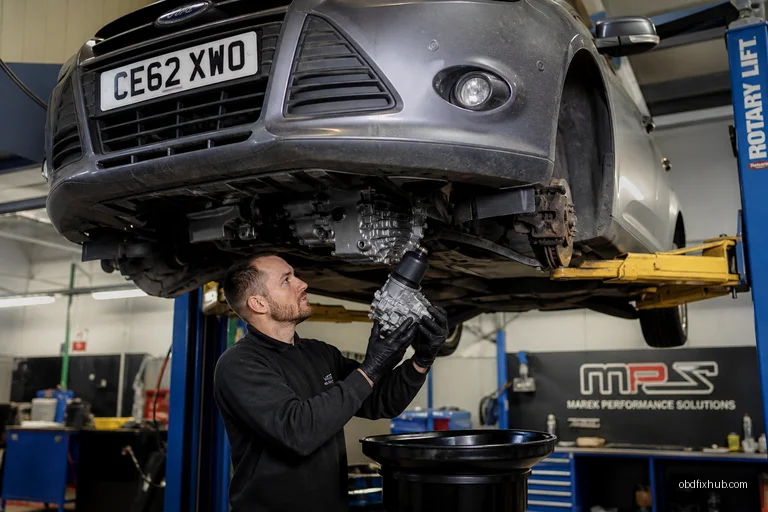
P287B Shift Fork Calibration Not Learned means the transmission control module could not complete or store the learned position of a shift fork, usually shift fork B in the Ford DPS6 dual-clutch transmission. On a Ford Focus, the fault can cause a flashing wrench light, loss of gears, harsh engagement, or a transmission that displays Park regardless of the selected position. A proper repair requires finding out why calibration failed before running the clutch and shift-fork relearn procedure.
What Does Engine Code P287B Mean?
P287B is not normally an engine fault in the conventional sense. It is a manufacturer-specific powertrain code associated with the transmission control module (TCM). The module monitors the electric shift-fork actuator and compares its actual movement with the position it expects to see.
When the fork does not reach the commanded position, moves too slowly, or produces an implausible position signal, the TCM cannot complete its calibration. The exact wording may vary slightly between scan tools, but Ford applications commonly describe P287B as Shift Fork B Calibration Not Learned.
The code is especially common on vehicles equipped with Ford’s DPS6 six-speed automatic manual transmission, including many 2011–2018 Ford Focus models. Calibration data may be lost after a TCM replacement, clutch or actuator work, low-voltage event, internal transmission repair, or an unsuccessful adaptive-learning attempt.
Symptoms of P287B on a Ford Focus
The symptoms depend on whether the fault is electrical, mechanical, or simply the result of an incomplete relearn. In practice, owners often report one or more of the following:
- The vehicle will not select Drive or Reverse.
- The instrument cluster shows “P” or a transmission malfunction message in every gear.
- A flashing wrench light, check-engine light, or transmission warning appears.
- The car gets stuck in neutral or in one gear.
- Clutch engagement is delayed, harsh, or accompanied by shuddering.
- The engine revs but the vehicle barely moves.
- Starting is disabled because the TCM cannot confirm Park or Neutral.
A useful diagnostic clue is when P287B returns immediately after calibration is commanded. That pattern points more strongly to an actuator, wiring, fork, gearbox mechanism, or position-sensor problem than to a simple lost-adaptation issue.
Most Common Causes of P287B
1. Low battery voltage or a voltage interruption
The DPS6 system is highly sensitive to voltage during actuator movement. A weak battery, poor ground, corroded battery terminal, or charging-system fault can interrupt the learning routine. Check battery voltage under load before condemning the TCM; a battery that appears acceptable at rest can still collapse during actuator operation.
2. Failed shift-fork actuator
The electric actuator may have an open circuit, worn motor, damaged gearset, or internal position-sensor fault. If the actuator cannot move the fork smoothly through its full travel, the TCM will stop the procedure and store P287B.
3. Damaged wiring or connector contamination
Inspect the actuator and TCM connectors for bent terminals, water intrusion, oil contamination, loose pins, and damaged insulation. Do not rely only on a visual inspection. A voltage-drop or continuity test while moving the harness can reveal an intermittent connection that disappears when the vehicle is stationary.
4. Mechanical binding inside the transmission
A bent shift fork, damaged selector rail, worn synchronizer component, or debris inside the gearbox can prevent the fork from reaching its learned stops. In this situation, repeatedly commanding calibration will not solve the problem and may overwork the actuator.
5. Clutch or TCM-related faults
A clutch replacement performed without the correct adaptive procedures can leave the TCM with invalid engagement data. A failing TCM is possible, but it should be considered only after power, grounds, communication, actuator operation, and mechanical movement have been tested. Replacing the TCM first is one of the most expensive ways to misdiagnose P287B.
How to Diagnose P287B Correctly
- Scan all modules. Record every stored and pending code, not just P287B. Related clutch, actuator, communication, and low-voltage codes often identify the real starting point.
- Verify battery and charging voltage. Use a suitable charger or stabilized power supply during testing and programming.
- Check TCM power, grounds, and communication. A scan tool that repeatedly loses communication should be treated as a clue, not ignored.
- Inspect both shift actuators and their connectors. Look for fluid contamination, damaged terminals, and signs that an actuator has been forced or installed incorrectly.
- Use a Ford-capable scan tool. Generic OBD readers can display P287B but usually cannot perform the required shift-fork and clutch adaptive routines.
- Run the calibration only after basic checks pass. Note whether the routine fails at the beginning, during fork travel, or while storing the learned value.
How Do I Reset the Clutch Actuator on My Ford Focus?
There is no dependable button combination that resets and calibrates the DPS6 clutch actuator. Disconnecting the battery may clear some temporary values, but it does not teach the TCM the correct clutch touchpoints or shift-fork positions.
The correct method is to connect a Ford IDS, FDRS, or an equivalent professional scan tool and select the transmission service functions. Depending on the model year and software version, the procedure may be named Clutch Adaptive Learn, Clutch Touchpoint Learn, Transmission Adaptive Learning, or a similar term.
Before starting, the vehicle generally needs a healthy battery, the correct fluid and clutch installation, a transmission at the required temperature, and no blocking fault codes. Follow the scan-tool prompts exactly. If the routine fails, do not keep repeating it; the failure point is valuable diagnostic information.
How Do I Reset the TCM on My Ford Focus?
A basic power reset can be attempted by switching the ignition off, disconnecting the negative battery cable, waiting several minutes, and reconnecting it securely. However, this is not a complete TCM reset and will not repair a failed actuator, damaged wiring, or a mechanically stuck fork. It can also erase learned values without completing the required relearn.
The preferred approach is a scan-tool reset of TCM adaptive values followed by the Ford-recommended clutch and gear-selection learning routines. Some model years also require module programming or configuration after TCM replacement. Use a battery maintainer during programming because a voltage drop can corrupt the process.
What Are the Symptoms of a Bad TCM in a Ford Focus?
A defective TCM can cause multiple unrelated transmission functions to fail at once. Common signs include intermittent or complete loss of communication, no-crank due to missing Park/Neutral confirmation, erratic gear selection, repeated actuator codes, incorrect gear display, and a failure to complete every relearn despite verified mechanical components.
By contrast, a single P287B with stable communication and a calibration failure at one specific fork does not automatically prove that the TCM is bad. Check the actuator circuit and mechanical travel first. In many real-world DPS6 repairs, the underlying cause is a worn actuator, poor connector contact, or an interrupted learning procedure rather than the computer itself.
Can You Drive With P287B?
Driving is not recommended if the Focus cannot select gears reliably, slips, remains in neutral, or displays a transmission malfunction warning. Continued operation can leave you stranded and may increase clutch or gearbox damage. If the car still moves normally and the code is only pending, drive only the minimum distance needed for diagnosis and avoid heavy traffic, steep hills, and repeated stop-and-go operation.
Repair Strategy and Typical Outcome
Start with the least invasive checks: battery condition, grounds, connectors, fault-code freeze-frame data, and actuator wiring. If the actuator fails an electrical or functional test, replace the affected unit with the correct part and perform the required calibration. If the actuator moves but the fork binds, transmission removal and mechanical inspection may be necessary.
After the repair, clear the codes, perform the shift-fork calibration, complete the clutch adaptive learn, and road-test the vehicle through multiple forward gears and Reverse. Re-scan the vehicle afterward. A successful repair is not confirmed merely because the warning light turns off; the learned values must remain valid during the road test.
Summary: The Right Way to Fix P287B
P287B indicates that the Ford Focus TCM has not learned the required shift-fork position. Low voltage, actuator failure, wiring faults, mechanical binding, incorrect clutch work, and TCM problems can all produce the same code. A battery disconnect may reset temporary data, but a Ford-capable scan tool is normally required for the actual calibration and adaptive-learning procedures.
If P287B returns immediately, stop repeating the relearn and diagnose the actuator circuit and fork movement. That approach prevents unnecessary TCM replacement and gives the best chance of restoring reliable gear selection on the first repair.
Frequently Asked Questions
Is P287B a serious transmission code?
Yes. It can prevent the vehicle from selecting Drive or Reverse and may leave the Focus stuck in neutral. Have it diagnosed promptly, especially if the gear display is incorrect or the wrench light is flashing.
Will disconnecting the battery fix P287B?
Usually not. Battery disconnection may clear temporary data, but it cannot repair a failed actuator, damaged wiring, or a mechanically restricted shift fork. The transmission will normally need a proper adaptive relearn afterward.
Can a generic OBD2 scanner calibrate the shift fork?
Most basic scanners can read or clear P287B but cannot command the Ford DPS6 clutch and shift-fork learning routines. Use Ford IDS, FDRS, or a professional scan tool with the correct transmission functions.
Does P287B always mean the TCM must be replaced?
No. The actuator, connector, battery voltage, grounds, and internal shift mechanism should be tested first. TCM replacement is justified only when communication, power supply, and module operation point to a confirmed control-unit fault.




