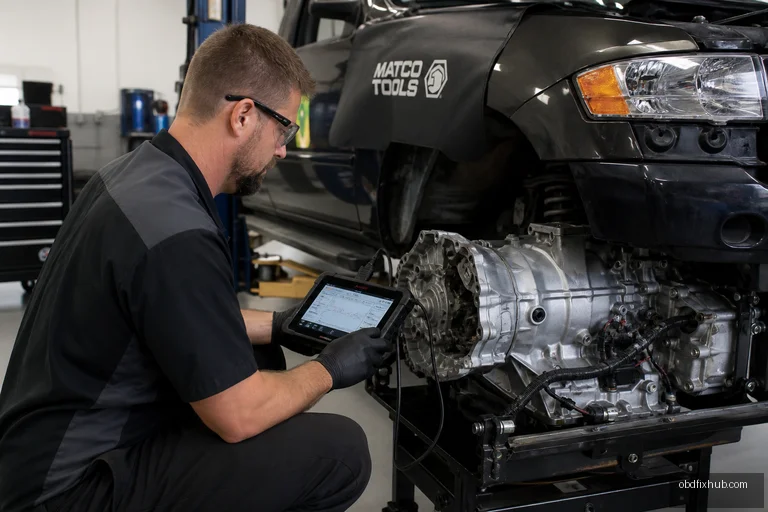
P287C Transmission Adaptive Values Not Learned means the transmission control module has not successfully stored or completed the clutch and shift adaptation values it needs for accurate gear changes. In many vehicles, especially models using electronically controlled automatic transmissions, the code appears after a battery disconnect, transmission repair, software update, control-module replacement, or an interrupted relearn procedure. Resetting the adaptive data with a capable scan tool and completing the manufacturer-specific drive cycle often fixes it—but a returning code usually points to a voltage, fluid, sensor, solenoid, or mechanical problem.
What Does P287C Transmission Adaptive Values Not Learned Mean?
Automatic transmissions do not rely only on fixed factory settings. The transmission control module, or TCM, continually adjusts clutch fill time, line pressure, shift timing, and torque-converter operation based on wear, fluid temperature, load, and driving conditions. These learned corrections are called adaptive values.
P287C indicates that the required adaptive values are missing, incomplete, outside the acceptable range, or rejected during the learning routine. The exact wording and application of P287C can vary by manufacturer, so the vehicle’s factory service information should always take priority over a generic code database.
This is usually a control and calibration issue rather than proof that the transmission itself has failed. However, the reason the values were not learned matters. A transmission that cannot complete adaptation because of low fluid pressure or a slipping clutch needs a very different repair from one that simply lost memory after a weak battery.
Common Causes of P287C
- Battery disconnection or low system voltage: A weak battery, poor ground, or charging fault can interrupt the learning process and erase volatile or stored transmission data.
- Transmission or TCM replacement: New or replacement components often require initialization, coding, and a complete adaptive learning procedure.
- Interrupted relearn drive: Excessive wheel slip, heavy traffic, an engine stall, an ignition cycle, or a scan-tool timeout can stop the procedure before it finishes.
- Incorrect or degraded transmission fluid: Low level, the wrong fluid specification, aeration, contamination, or overheating can prevent stable clutch pressure.
- Faulty input or output speed sensors: The TCM cannot calculate shift slip correctly if speed signals are missing, erratic, or implausible.
- Solenoid, valve-body, or wiring faults: A sticking pressure-control solenoid, damaged connector, or internal valve-body leak can make adaptation impossible.
- Internal clutch or gear wear: Excessive clutch clearance or hydraulic leakage may cause the module to reach its adjustment limit without achieving the expected shift quality.
Symptoms You May Notice
Some vehicles store P287C with no obvious drivability complaint, particularly after service or a power interruption. Others enter a protective strategy and limit available gears. The symptoms depend on whether the code is merely waiting for a relearn or is being caused by a physical transmission fault.
- Harsh, delayed, or unusually soft gear changes
- Transmission warning light or check-engine light
- Delayed engagement when selecting Drive or Reverse
- Shift flare, slipping, or a sudden increase in engine speed between gears
- Fail-safe or limp-home mode
- Limited gear availability or refusal to shift normally
- Shudder during light acceleration or torque-converter lockup
How to Diagnose P287C Correctly
Do not begin by repeatedly clearing the code. First record every stored, pending, and manufacturer-specific transmission code, along with freeze-frame data. A companion code for low voltage, a speed sensor, pressure control, or a gear-ratio error may identify the real cause.
- Test battery and charging voltage. Check resting voltage, cranking voltage, alternator output, and the engine-to-body ground. A relearn performed with unstable voltage is likely to fail.
- Check transmission fluid properly. Follow the manufacturer’s temperature and level-check procedure. Many modern units cannot be checked accurately with a simple dipstick inspection.
- Inspect connectors and wiring. Look for fluid intrusion, bent terminals, corrosion, damaged harness insulation, and loose grounds near the transmission and TCM.
- Review live data. Compare commanded gear, actual gear, input speed, output speed, clutch slip, fluid temperature, and pressure-control data during a road test.
- Confirm software and calibration. A TCM or powertrain control module may need a manufacturer update or a programming procedure before adaptive learning will complete.
- Perform the exact relearn routine. Use a bidirectional scan tool that supports the vehicle. A basic code reader can erase faults but generally cannot command transmission initialization or monitor adaptation status.
How Do I Reset the Transmission Adaptive Learning Process?
The safest reset is performed through the TCM or powertrain control module menu on a factory-level or high-quality bidirectional scan tool. The usual sequence is to connect a stable battery support unit, bring the transmission to the specified temperature, save diagnostic data, clear the adaptive values, and run the required initialization or clutch touch-point procedure.
After the static procedure, the vehicle normally needs a controlled road test. This may include gentle acceleration, separate upshifts and downshifts, coast-down events, and repeated Drive-to-Stop cycles. Follow the manufacturer’s speed, throttle, temperature, and gear instructions exactly; a generic “drive it normally” routine is not always sufficient.
Disconnecting the battery is not a reliable substitute. It may clear some learned engine data, but it may not erase TCM adaptations and can create additional idle, emissions, or security-related issues. If a scan tool shows that the relearn is unavailable, diagnose the enabling conditions and related codes instead of forcing repeated resets.
How Long Does It Take for a Transmission to Relearn?
The initial relearn can take approximately 15 to 30 minutes when the transmission is warm and all conditions are met. Some vehicles complete the essential procedure during a short road test, while others require several stages and 30 to 100 miles of mixed driving before shifts feel fully settled.
It is normal for a transmission to shift slightly differently during the first few drive cycles. Smooth, moderate throttle inputs are more useful than aggressive acceleration. If harsh shifts improve steadily, adaptation is probably progressing. If the same shift remains violent, the code returns immediately, or the TCM reports that learning is out of range, continuing to drive will not repair the underlying fault.
When P287C Requires More Than a Reset
A reset is appropriate after documented power loss, module replacement, software programming, or transmission service when there are no other active faults. It is not a repair for slipping clutches, incorrect fluid level, hydraulic pressure loss, or a failing solenoid.
Stop testing and arrange professional diagnosis if the transmission bangs into gear, loses Drive or Reverse, overheats, produces metal debris in the fluid, or repeatedly enters limp mode. A technician should compare commanded and actual pressure, perform pressure or air-check testing where applicable, and inspect the valve body before recommending a complete transmission replacement.
Practical Example
Consider a vehicle that develops P287C immediately after a battery replacement. The battery tests correctly, there are no ratio or pressure codes, and the transmission fluid is at the correct level. In that case, initializing the TCM and completing the prescribed relearn may solve the issue.
Now compare that with a vehicle showing P287C, P0734, a delayed Reverse engagement, and rising engine speed during the 3–4 shift. Clearing adaptations may temporarily change the symptoms, but the combination strongly suggests a hydraulic or clutch-capacity problem. The next step is pressure and mechanical diagnosis, not another reset.
Key Takeaways
- P287C means the transmission has not successfully learned its adaptive shift values.
- Low voltage, lost memory, interrupted relearn, fluid problems, sensor faults, solenoids, and internal wear can all be involved.
- Use a bidirectional scan tool and the vehicle-specific service procedure rather than disconnecting the battery.
- Relearning may take 15–30 minutes initially and several additional drive cycles or up to roughly 100 miles.
- If the code returns or the transmission slips, diagnose the physical cause before continuing to drive.
Frequently Asked Questions
Can I drive with P287C?
Short, gentle driving may be acceptable when the transmission shifts normally and no warning symptoms are present. Avoid towing, hard acceleration, and long trips if it slips, bangs into gear, overheats, or enters limp mode.
Will clearing the check-engine light fix P287C?
No. Clearing the fault may remove the warning temporarily, but it does not perform the adaptive initialization. The TCM must complete the correct relearn procedure, and any underlying fault must be repaired.
Does changing transmission fluid clear the code?
Only if incorrect level, contaminated fluid, or fluid-related pressure instability caused the failed learning process. Fluid service alone will not correct a bad sensor, solenoid, wiring fault, or worn clutch.
Why does P287C return immediately after a relearn?
Common reasons include insufficient battery support, incorrect temperature or procedure, unaddressed companion codes, bad speed data, hydraulic pressure problems, or mechanical wear that prevents the clutch from reaching its target position.
Next step: scan the transmission module for companion codes, verify voltage and fluid level, then perform the manufacturer-specific adaptive learning routine with a capable scan tool. If learning fails twice under correct conditions, move to pressure, sensor, solenoid, and mechanical testing rather than repeatedly clearing P287C.




