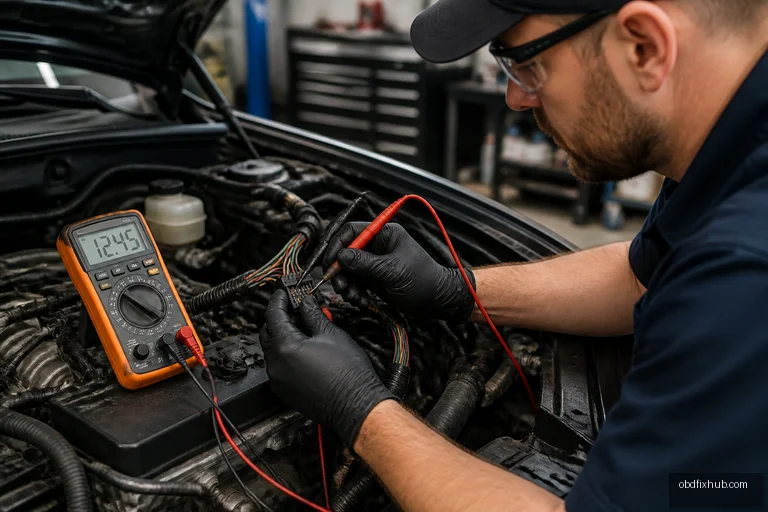
P28C0 means the engine computer has detected a problem in the ion-sense module supply voltage circuit. The fault may be caused by a weak power supply, blown fuse, damaged wiring, poor ground, a failed ion-sense module, or—in less common cases—a control module problem. Because ion-sense systems are closely tied to ignition and combustion monitoring, this code should be diagnosed before replacing expensive ignition components.
What Is the P28C0 Ion-Sense Module Supply Voltage Circuit?
An ion-sense system measures the electrical current that exists across the spark plug gap after combustion begins. The pattern of this ionization current helps the vehicle monitor combustion quality, detect misfires, and sometimes identify abnormal combustion such as knock or pre-ignition.
The ion-sense module needs a reliable supply voltage and ground to process that signal. The power may be provided through a dedicated fuse, ignition relay, engine harness, or control module circuit. The exact voltage specification and module location vary by manufacturer, so the vehicle-specific wiring diagram and service information are essential.
When the power supply falls outside the expected range, disappears intermittently, or contains excessive electrical noise, the powertrain control module can store P28C0. The code describes a circuit fault; it does not automatically prove that the ion-sense module itself has failed.
P28C0 Symptoms You May Notice
Some vehicles will drive almost normally with this code stored, while others will show clear ignition-related problems. The symptoms depend on whether the fault is permanent, intermittent, or present only during cranking or heavy engine load.
- Illuminated check engine light or malfunction indicator lamp
- Rough idle, hesitation, or reduced engine power
- Engine misfire under acceleration
- Hard starting or extended cranking
- Engine stalling, especially when hot
- Reduced fuel economy
- Fail-safe or limp-home operation
- Additional ignition, misfire, or communication trouble codes
A particularly useful clue is a fault that appears after an engine wash, heavy rain, battery replacement, or recent ignition-system repair. Moisture in a connector, a partially locked terminal, or a harness pulled tight against the engine can create an intermittent P28C0 that is easy to miss during a quick visual inspection.
Common Causes of P28C0
1. Low system voltage
A weak battery, poor battery terminal, failing alternator, or loose engine ground can reduce the voltage available to the ion-sense module. Check the vehicle’s basic charging system first. A sophisticated module cannot operate correctly if system voltage collapses during cranking.
2. Open fuse or ignition-feed problem
A blown fuse may be the result of a shorted harness or a failed module rather than the original problem. Do not install a larger fuse. Inspect the related fuse, ignition relay, and power feed, then determine why the fuse opened.
3. Damaged wiring or poor connector contact
Look for chafed insulation near the cylinder head, valve cover, ignition coils, and harness brackets. Oil contamination, water intrusion, green corrosion, pushed-back terminals, and loose connector locks are frequent real-world causes. A circuit can show battery voltage with no load yet fail when the module draws current.
4. Failed ion-sense module
Internal power-supply failure, heat damage, or moisture contamination can prevent the module from producing the correct output. Confirm that its power, ground, and communication or signal circuits meet specification before condemning the module.
5. Control module or software issue
PCM or ECM failure is possible but should be near the end of the diagnostic process. On some vehicles, a software update or manufacturer service bulletin may address false or intermittent ion-sense faults. Check technical service information using the exact vehicle identification number.
How to Diagnose P28C0 Correctly
- Record all codes and freeze-frame data. Note engine speed, battery voltage, coolant temperature, and whether the code is current or pending. Related misfire codes can help identify whether the problem occurs on one cylinder or affects the whole supply circuit.
- Perform a battery and charging test. Load-test the battery and verify charging voltage according to the vehicle manufacturer’s specification. Watch voltage while cranking; a dramatic drop can create several misleading electronic fault codes.
- Identify the correct circuit. Use the factory wiring diagram to locate the ion-sense module, fuse, relay, ground points, and PCM connection. Do not assume that a similarly named ignition component is the ion-sense module.
- Test the fuse under load. Confirm voltage on both sides of the fuse with the ignition in the required position. A test light or loaded circuit tester can reveal a high-resistance feed that a digital meter alone may not expose.
- Check power and ground at the module. Measure voltage at the connector while the circuit is active. Perform a voltage-drop test on the ground side during operation or cranking. A ground that appears good during a continuity check may still fail under load.
- Inspect terminals and harness movement. With the engine running or the circuit energized, gently move the harness and connectors while monitoring the scan tool or meter. If the voltage changes, repair the terminal tension or wiring rather than simply clearing the code.
- Compare the signal with service specifications. If supply and ground are correct but the module output is missing or implausible, follow the manufacturer’s signal test. Avoid applying random voltage to an ion-sense circuit; some systems use sensitive reference or communication lines.
Important Safety and Testing Notes
Ion-sense systems operate alongside high-voltage ignition components. Keep hands, test leads, and loose clothing away from spark plug wires, coils, and moving belts while the engine is running. Use a back-probe method and equipment rated for the circuit instead of piercing insulation or disconnecting components while energized.
Do not use a conventional test light on an unknown reference or signal wire. If the service procedure requires an oscilloscope, current probe, or special breakout harness, follow that procedure. Incorrect probing can damage a control module and create a second fault that was not present initially.
How to Fix P28C0
The correct repair depends on the failed test result. Typical repairs include replacing a blown fuse after correcting its short circuit, repairing a damaged power or ground wire, cleaning or replacing corroded terminals, securing an engine ground strap, replacing a defective relay, or installing a confirmed-good ion-sense module.
After the repair, clear the codes and perform the manufacturer’s drive cycle. Confirm that the ion-sense voltage remains stable during cold start, warm idle, acceleration, and deceleration. A repair is not complete simply because the check engine light turns off; the monitor must run without P28C0 returning.
Can You Drive With P28C0?
Short-distance driving may be possible if the engine runs smoothly and the check engine light is steady. However, avoid continued driving when the light flashes, the engine is misfiring, power is severely reduced, or the vehicle stalls. An active misfire can overheat and damage the catalytic converter, while repeated stalling can create a safety hazard.
Key Takeaway
P28C0 identifies a supply-voltage problem affecting the ion-sense module, not necessarily a defective module. Start with battery voltage, fuses, grounds, connector condition, and voltage-drop testing. Use the exact factory wiring diagram and specifications before replacing parts; this approach is faster, cheaper, and far more reliable than guessing.
Frequently Asked Questions
Is P28C0 the same on every vehicle?
No. The code definition is generally associated with the ion-sense module supply voltage circuit, but the module design, voltage range, wiring, and diagnostic procedure vary by manufacturer and model year. Always verify the definition in vehicle-specific service information.
Can a weak battery cause P28C0?
Yes. Low cranking voltage, poor battery terminals, or a weak ground can interrupt module operation and trigger the code. Test the battery and charging system before replacing the ion-sense module.
Will replacing the spark plugs fix P28C0?
Usually not. Worn or incorrect spark plugs can contribute to misfire symptoms, but P28C0 specifically points toward the module’s supply circuit. Inspect the ignition system when other misfire codes are present, but test the power and ground circuit first.
Can I clear P28C0 without repairing it?
You can erase the stored code with a scan tool, but it will return if the circuit fault remains. Clearing codes also removes useful freeze-frame information, so record the data before resetting the system.




