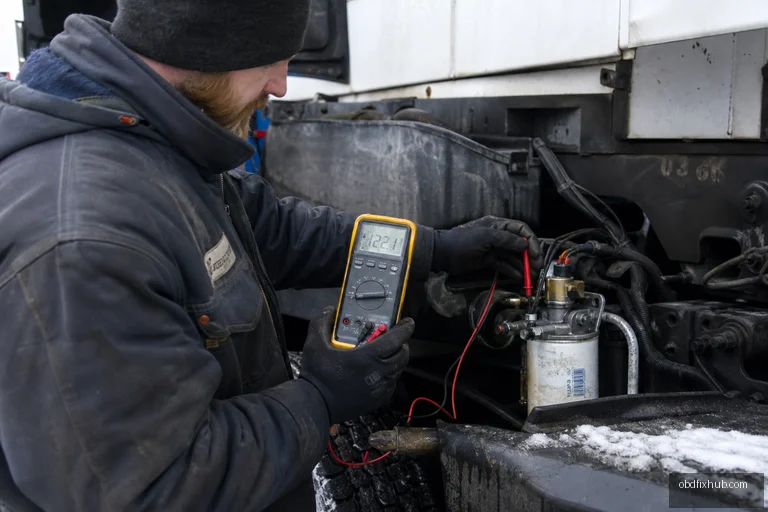
P2A0F Fuel Supply Heater Performance: Meaning, Causes, Symptoms & Fix
P2A0F Fuel Supply Heater Performance means the engine control module (ECM or PCM) has detected that the fuel supply heater is not operating within its expected electrical or temperature range. This code is most common on diesel vehicles that use a fuel heater to prevent waxing or fuel thickening in cold conditions. It does not automatically mean the fuel pump has failed; the heater circuit, wiring, relay, temperature sensor, or fuel contamination may be responsible.
This is an informational and diagnostic search intent: the priority is understanding the code and identifying the correct repair before replacing expensive parts. The exact test procedure varies by vehicle, so always compare your findings with the manufacturer’s wiring diagram and service specifications.
What Does P2A0F Mean?
The code can be divided into two parts. “P2” identifies a powertrain code that is often manufacturer-specific or less universal than a standard P0 code. “A0F” identifies the particular monitored function. In this case, the monitored function is the fuel supply heater and its operating performance.
A fuel supply heater is normally installed near the fuel filter, fuel line, fuel tank module, or another part of the low-pressure fuel supply system. Its job is to warm diesel fuel enough to reduce the risk of paraffin wax restricting the filter or fuel passages. The PCM may evaluate heater current draw, circuit resistance, fuel temperature change, and feedback from a temperature sensor.
“Performance” does not necessarily mean the heater is completely dead. It can mean that the heater turns on but draws too little current, heats too slowly, remains on too long, or produces a temperature change that does not match the PCM’s expected result.
Common Symptoms of P2A0F
Some vehicles store P2A0F without producing an obvious drivability complaint, particularly when the outside temperature is mild. In cold weather, however, the fault can become much more noticeable because the fuel heater is genuinely needed.
- Check Engine Light or diesel engine warning lamp
- Hard starting after the vehicle has been parked in freezing weather
- Extended cranking before the engine starts
- Rough running or hesitation during the first few minutes
- Reduced engine power or limp mode on certain models
- Fuel filter restriction or repeated fuel starvation symptoms
- Lower fuel pressure on the supply side
- Intermittent stalling in very cold conditions
A useful real-world clue is temperature dependence. If the vehicle starts normally in a warm workshop but struggles after an overnight cold soak, the heater circuit or fuel waxing deserves attention. If the same symptoms occur at all temperatures, check the broader fuel supply system instead of assuming the heater is the only problem.
P2A0F Fuel Supply Heater Performance: Main Causes
1. Failed fuel supply heater element
The heating element can develop an open circuit, an internal short, or increased resistance as it ages. A heater may look clean and undamaged externally while failing an electrical load test. Measuring resistance with the component disconnected is a useful first check, but the value must be compared with the vehicle’s specification.
2. Blown fuse or defective relay
Fuel heaters can draw substantial current, especially during initial warm-up. A blown fuse may be caused by an internally shorted heater, damaged wiring, water intrusion, or an overloaded circuit. Replacing the fuse without finding the reason it failed can result in another failure or wiring damage.
3. Corroded connectors or damaged wiring
The heater is commonly exposed to moisture, road salt, fuel residue, and vibration. Inspect the connector for green corrosion, pushed-back terminals, heat discoloration, loose locking tabs, and broken insulation. Voltage may appear correct with no load but collapse when the heater is commanded on, so a loaded voltage-drop test is more revealing than a simple continuity check.
4. Faulty fuel temperature sensor
The PCM needs a reliable temperature signal to decide when the heater should operate. A sensor that falsely reports warm fuel may prevent heater activation; one that reports implausibly cold fuel may command the heater unnecessarily or set additional sensor-related codes.
5. Restricted fuel filter or waxed diesel fuel
A clogged filter can imitate a heater fault by restricting fuel flow and causing hard starting or low supply pressure. In cold climates, incorrect seasonal fuel, contaminated diesel, or water in the filter can make the problem worse. If the filter contains cloudy fuel or wax-like particles, replace it and investigate fuel quality before condemning the heater module.
6. Control-module or software issue
Less commonly, the heater control circuit inside the PCM, a dedicated control module, or the vehicle software may be involved. This should be considered only after power, ground, wiring, heater resistance, and sensor data have been verified.
How to Diagnose P2A0F Correctly
- Record all codes and freeze-frame data. Note coolant temperature, fuel temperature, battery voltage, engine speed, and ambient conditions when P2A0F was stored. Related fuel-pressure or temperature codes can change the diagnostic direction.
- Confirm the complaint. Ask whether the problem occurs only below freezing, after refueling, or after the vehicle sits overnight. This information often separates a cold-weather heater issue from a permanent fuel-delivery fault.
- Check the fuel filter and fuel condition. Replace a restricted filter with the correct specification. Drain a small sample into a transparent container and look for water separation, debris, or wax crystals.
- Inspect the heater circuit. Check the fuse, relay, power feed, ground, connectors, and harness routing. Look especially closely where the harness passes near the fuel tank, filter housing, frame, or exhaust heat.
- Test resistance and current draw. A heater with infinite resistance is open; a reading close to zero may indicate a short. Neither result is interpreted properly without the manufacturer’s specified range. If the circuit is commanded on, current draw should be measured with an appropriate meter or current clamp.
- Use a scan tool for active testing. If supported, command the fuel heater on and monitor fuel temperature, heater status, and supply voltage. A functional system should show a plausible current response and temperature change rather than only a status message.
- Clear the code and verify under matching conditions. After repair, test the vehicle from a cold start and confirm that the code does not return. A short warm-road test may not prove the repair if the fault occurs only during a cold soak.
Do not apply battery power directly to a fuel heater unless the service information explicitly permits it. Some systems use a controlled ground, pulse-width modulation, or an integrated temperature-monitoring circuit. Direct power can damage the heater, wiring, or control module.
How Is P2A0F Repaired?
The correct fix depends on the failed test result. A blown fuse caused by a shorted heater requires heater replacement and circuit inspection, not just a new fuse. Corroded terminals may require connector repair rather than spraying contact cleaner and reconnecting the old damaged pins.
- Replace the fuel supply heater if its resistance or current draw is outside specification.
- Repair damaged wires, grounds, terminals, or connector seals.
- Replace a failed fuse or relay only after checking for the cause of failure.
- Replace a biased fuel temperature sensor and verify its live-data reading.
- Install the correct fuel filter and remove contaminated or waxed fuel when necessary.
- Perform any required PCM programming or software update only after hardware tests pass.
On some vehicles, the heater is integrated into the fuel filter housing or fuel tank module. That design can make the repair more expensive than replacing an external heater, and it is one reason the wiring and power supply should be tested before ordering a complete module.
What Does “Performance” Mean?
In ordinary English, performance means how well a person, machine, or system carries out an expected function. “A great performance” describes an especially effective presentation, action, or result. In the P2A0F code, performance is a technical term: the PCM is judging whether the fuel heater behaves as expected, not whether the vehicle’s overall performance is good.
Who Is “Perfor”?
“Perfor” is not a person, component, or automotive term related to P2A0F. It is usually a shortened word, a typing error, or an incomplete search for “performance.” If you saw “perfor” in a scan-tool description, check the full code text and the manufacturer’s diagnostic information before drawing a conclusion.
Frequently Asked Questions
Can I drive with P2A0F?
Usually, short-distance driving is possible if the engine starts and runs normally, but cold-weather starting may become unreliable. Avoid ignoring the code if the vehicle stalls, loses power, or has low fuel pressure.
Does P2A0F mean I need a new fuel pump?
No. The code points to fuel supply heater performance, not automatically to a failed pump. Test heater power, ground, resistance, current draw, fuel temperature, filter condition, and supply pressure before replacing the pump.
Can a bad battery cause P2A0F?
Low system voltage can prevent a high-current heater from operating correctly and may create misleading symptoms. Check battery voltage and charging performance, but do not assume the battery is the root cause without testing the heater circuit.
How do I clear P2A0F?
A scan tool can clear the stored code, but clearing it does not repair the fault. Diagnose and correct the underlying problem first, then clear the code and complete a cold-start verification drive.
What is the definition of a performance?
Performance is the way an action, person, machine, or system performs a task, including the quality and effectiveness of its result. In automotive diagnostics, it means measured operation against an expected standard.
Final Takeaway
P2A0F indicates that the vehicle’s fuel supply heater is not meeting the PCM’s expected operating behavior. Start with freeze-frame data, fuel condition, fuses, connectors, voltage drop, heater resistance, current draw, and temperature-sensor readings. A structured diagnosis prevents the common mistake of replacing a fuel pump or filter housing when the actual fault is a corroded connector, failed relay, or damaged heater element.




