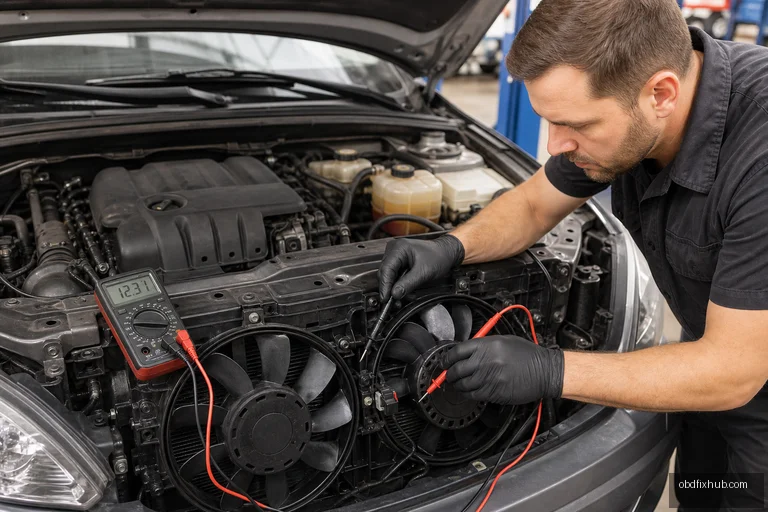
The P2B2F engine cooling fan code means the vehicle computer has detected that the electric cooling fan is not delivering the expected performance or appears to be stuck off. The most common causes are a failed fan motor, blown fuse, faulty relay or fan control module, damaged wiring, poor ground, or an engine temperature or air-conditioning pressure signal that is incorrect. Do not replace the fan module immediately; first confirm whether the fan is receiving power, ground, and a valid control command.
What Does P2B2F Mean?
P2B2F is an OBD-II diagnostic trouble code associated with engine cooling fan performance or a fan that is stuck in the off position. The exact testing strategy can vary by manufacturer, so the factory service information for the specific year, make, engine, and fan system remains important.
In a typical system, the powertrain control module (PCM) requests a fan speed based on coolant temperature, air-conditioning operation, vehicle speed, and refrigerant pressure. A separate fan module, relay pack, or integrated control circuit then supplies current to the fan motor. The PCM may set P2B2F when the requested fan operation does not match the actual electrical response or feedback signal.
Symptoms of a P2B2F Cooling Fan Fault
A vehicle can set this code before the temperature gauge reaches the red zone. The fan is especially important when the car is stopped, moving slowly, idling with the air conditioner on, or climbing a hill.
- Engine temperature rises during idle or low-speed driving.
- The air conditioner becomes warm at a stop and cools again while driving.
- The cooling fan never starts, even with a hot engine or the A/C switched on.
- The radiator fan runs at only one speed or operates intermittently.
- The temperature warning light, check engine light, or reduced-power warning appears.
- The vehicle enters fail-safe mode and commands the fan continuously.
- Coolant boils over or the engine overheats after parking.
A normal temperature gauge does not prove the fan system is healthy. The fan may still be needed when the vehicle is stationary, and a brief road test may not reproduce the fault.
Why Is the Cooling Fan Stuck Off?
1. Failed fan motor
Electric fan motors wear internally. A worn brush, seized bearing, overheated winding, or damaged commutator can cause a dead spot where the fan works sometimes and then refuses to start. Spin the blades by hand only with the ignition off and the connector disconnected; excessive resistance or grinding is a strong warning sign.
2. Blown fuse or faulty relay
The fan circuit draws substantial current, so a weak connection or failing motor can blow the high-amperage fuse. A relay may click but still have burned contacts that cannot carry current. Always determine why a fuse failed instead of installing a larger fuse, which can damage the harness or cause a fire.
3. Defective cooling fan control module
Many newer vehicles use a solid-state fan control module rather than a simple relay. The module may receive battery power and a command from the PCM but fail to send the correct voltage or pulse-width-modulated signal to the fan. Water intrusion near the radiator, corrosion in the connector, and heat damage are common clues.
4. Wiring, connector, or ground problem
A corroded terminal can pass a small test-light load but fail when the fan demands high current. Inspect the fan connector, fuse-box terminals, module plug, harness near the radiator support, and engine or chassis grounds. A voltage-drop test while the fan is commanded on is more reliable than checking continuity with the circuit unloaded.
5. Incorrect temperature or pressure information
The PCM may not command the fan if it receives an implausible coolant temperature signal, a failed A/C pressure signal, or a communication fault from another control module. Scan for additional codes before focusing only on P2B2F. A coolant temperature reading that remains at -40 degrees or jumps unrealistically is more likely to indicate a sensor or circuit problem than a bad fan.
How to Diagnose P2B2F Correctly
Use caution: the fan can start unexpectedly even when the engine is off. Keep hands, clothing, and tools away from the blades, and never remove a pressurized radiator cap from a hot engine.
- Check the complete scan-tool report. Record freeze-frame data, coolant temperature, A/C status, fan commanded percentage, and any related codes. Clear nothing until the evidence has been saved.
- Confirm the complaint. With the engine cold, observe whether the fan runs during an A/C request if the vehicle strategy allows it. Then monitor fan operation as coolant temperature rises, following the manufacturer’s specified test conditions.
- Inspect the fuse and relay circuit. Test both sides of the fuse with the circuit loaded. If a relay is used, verify its control voltage and output rather than relying only on an audible click.
- Test power and ground at the fan. A digital multimeter should be used together with a voltage-drop test. A healthy battery voltage measured at an unplugged connector does not guarantee that the circuit can deliver current under load.
- Command the fan with a bidirectional scan tool. Request low and high speed, or specific fan percentages where supported. If the PCM commands 80 percent but the fan remains still, compare the module input and output signals.
- Test the motor separately when appropriate. A fused power supply can confirm whether the motor spins, but use the manufacturer’s wiring diagram and the correct fuse rating. Do not apply battery power to a control or signal terminal.
- Check the control module and communication circuit. If power, ground, motor, and wiring are good but the output is missing, the fan module becomes a strong suspect. Verify the command signal before replacing it.
How Do You Fix a Cooling Fan Problem?
The repair depends on the failed part. Replace a seized or electrically open fan assembly, repair damaged wiring with sealed automotive-grade connections, replace a failed fuse or relay only after finding the cause, and replace the fan control module when its power, ground, command, and output tests prove it has failed.
After the repair, clear the code and repeat the same conditions recorded in the freeze-frame data. Confirm that the fan responds to scan-tool commands, the A/C remains cold at idle, and the engine temperature stays stable in traffic. A short idle test is often more revealing than a highway drive because airflow from vehicle speed can hide a weak fan.
How Do You Know If the Engine Cooling Fan Is Bad?
The fan assembly is likely bad when it has correct battery power and ground but will not run when directly commanded, or when it draws excessive current and repeatedly blows its fuse. A motor that starts only after tapping the housing, stops when hot, or makes grinding noises should be replaced rather than trusted.
Do not condemn the fan based only on the fact that it is not running at a cold start. Many vehicles intentionally keep the fan off until coolant temperature, A/C pressure, or another operating condition requires it.
How Do You Know If a Cooling Fan Module Is Bad?
A fan control module is suspect when its power supply and ground remain stable, the fan motor passes its test, and the PCM is sending a valid command, but the module produces no usable output. Some modules use a digital or pulse-width-modulated signal, so a simple voltage reading may be misleading; a wiring diagram, oscilloscope, or manufacturer-approved scan-tool test may be required.
Visible water intrusion, green corrosion inside the connector, melted terminals, or a module that works only after cooling down are additional clues. Before replacing it, check for a seized motor because an overloaded motor can damage a new module.
Why Is My Cooling Fan Stuck On?
P2B2F describes a fan that may be stuck off, but a related electrical or control fault can also leave the fan running continuously. Common causes include a shorted relay, a failed fan module stuck in the on state, a high coolant temperature signal, excessive A/C refrigerant pressure, or a PCM fail-safe strategy after detecting a sensor or communication fault.
Continuous fan operation may protect the engine, but it can discharge the battery, create excessive noise, and mask the original problem. Scan live data before disconnecting the battery, and check whether coolant temperature and A/C pressure readings are believable.
Can You Drive With P2B2F?
Short trips may be possible if the fan operates correctly and the temperature remains normal, but driving in traffic with a non-working fan can cause rapid overheating. Stop immediately if the temperature warning appears, the gauge rises above normal, steam is visible, or the heater suddenly blows cold air while the engine is hot. An overheated aluminum cylinder head can warp, turning an electrical repair into a major engine repair.
Key Takeaway
P2B2F is not automatically proof that the cooling fan module needs replacement. Diagnose the system in order: confirm the PCM command, inspect the fuse and wiring, verify power and ground under load, test the motor, and then evaluate the control module. Repair the cause, verify fan operation at idle and with the air conditioner running, and do not continue driving an overheating vehicle.
Frequently Asked Questions
Can a bad coolant temperature sensor cause P2B2F?
Yes. If the sensor reports an implausible temperature, the PCM may fail to request the correct fan speed or may set a protective fault. Check live temperature data and related sensor codes before replacing fan components.
Should the radiator fan run whenever the engine is running?
No. Most electric fans cycle on and off according to coolant temperature, A/C pressure, vehicle speed, and engine load. A fan that is off during a cold start can be operating normally.
Can a blown fan fuse cause an overheating engine?
Yes. The fan may not operate at low speed or at all, especially when the vehicle is idling. Replace the fuse only after checking the motor and wiring for an excessive-current problem.
Is P2B2F safe to clear without repairing?
Clearing the code does not repair the fault. It may temporarily turn off the warning light while the fan remains inoperative, increasing the risk of overheating. Diagnose the circuit and confirm operation before returning the vehicle to normal use.




