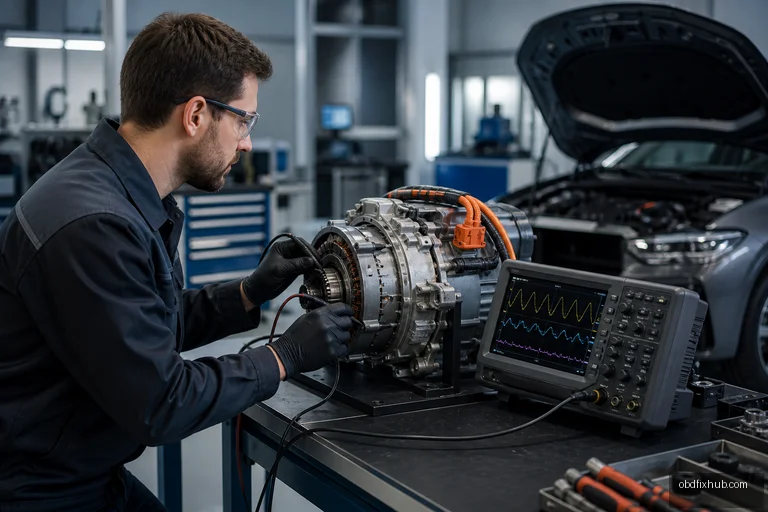
P2DCC Starter/Generator Position Sensor Correlation means the vehicle control system has detected an implausible relationship between the starter/generator position signal and the position it expects. The usual causes are a failed position sensor, damaged wiring or connector, incorrect rotor or timing reference, low-voltage problems, or an internal starter-generator fault. Because this system can be part of a hybrid or 48-volt powertrain, diagnosis should be methodical and high-voltage safety procedures must be followed.
What Does the P2DCC Code Mean?
The P2DCC diagnostic trouble code is associated with the starter/generator position-sensing system. In different vehicles, the unit may be called a belt-driven starter-generator, integrated starter-generator, motor-generator unit, or 48V starter-generator. Its position sensor tells the powertrain control module or hybrid control module where the rotor is and how fast it is turning.
The word correlation is important. The module is not simply checking whether a sensor has an electrical signal. It is comparing that signal with another reference, such as a second position signal, crankshaft position, rotor electrical angle, or the expected phase sequence from the motor-generator. If the signals do not agree within the calibrated time and angle range, P2DCC can set.
P2DCC Symptoms You May Notice
Some vehicles continue to drive with this code, while others disable the starter/generator and fall back to conventional engine operation. Symptoms depend on the vehicle design and whether the fault is intermittent or permanent.
- Check Engine Light, hybrid warning, or 48V system warning
- Engine cranks slowly, starts harshly, or fails to restart during stop-start operation
- Start-stop functionality becomes unavailable
- Reduced electric assist, regenerative braking, or charging performance
- Rough engine starts or a noticeable engagement clunk
- Reduced-power mode or a message instructing the driver to service the powertrain
- Additional codes for crankshaft position, motor position, inverter communication, or system voltage
An important diagnostic clue is whether the symptom occurs only when the engine is hot, during automatic restarts, or after driving over bumps. Heat-related failures often point toward an electronic sensor or connector problem, while bump-sensitive faults commonly involve terminal tension, wiring damage, or a loose ground.
Common Causes of P2DCC
1. Failed starter/generator position sensor
The sensor may develop an internal open circuit, distorted waveform, or intermittent dropout. Some units use a resolver or another angle-sensing device rather than a simple Hall-effect sensor, so the correct test procedure depends on the exact vehicle and component.
2. Wiring or connector damage
Oil contamination, water intrusion, corrosion, poor terminal tension, and harness chafing can change the sensor signal enough to create a correlation fault. Inspect the connector closely; a terminal can look clean externally while failing when the harness moves or the circuit is loaded.
3. Low system voltage or unstable power supply
A weak 12-volt battery, poor ground, discharged 48V battery, or DC-DC converter problem can cause unreliable sensor processing. Always check supply voltage and ground integrity before condemning an expensive starter-generator. A module reboot or voltage dip during cranking can create misleading correlation codes.
4. Mechanical or installation-related problems
A damaged reluctor, incorrect rotor position, loose pulley, belt slip, misaligned coupling, or starter-generator replacement installed without the required indexing procedure can produce a genuine position mismatch. On some systems, replacing the unit requires a learn, calibration, or rotor-position relearn with a factory-level scan tool.
5. Control module, inverter, or software issue
Less commonly, the hybrid control module, motor control inverter, or powertrain software may misinterpret a valid signal. Software updates and technical service bulletins should be checked after wiring, voltage, and sensor tests have passed.
How to Diagnose P2DCC Correctly
- Record all codes and freeze-frame data. Do not diagnose P2DCC in isolation. Note engine speed, vehicle speed, battery voltage, module temperature, and whether the code is current, pending, or history.
- Verify the battery and grounds. Load-test the 12-volt battery and inspect the engine, chassis, inverter, and control-module grounds. If the vehicle has a 48V system, follow the manufacturer’s procedure for testing it.
- Inspect the harness before replacing parts. Look for rubbing near the belt drive, oil-soaked loom, pinched wiring, pushed-back terminals, and signs of water entry. Perform a gentle wiggle test while monitoring live data.
- Check live sensor data. Compare starter/generator position, crankshaft position, engine speed, rotor speed, and synchronization status. A signal that freezes, jumps, or disagrees only during cranking is highly useful evidence.
- Use a wiring diagram and oscilloscope when required. A multimeter may show a normal resistance reading even when a sensor produces a poor waveform. Compare the signal during cold and hot operation if the problem is temperature-sensitive.
- Perform the required relearn or calibration. If the sensor or starter-generator has been replaced, complete the manufacturer-specified initialization. Clearing the code without completing this step can leave the fault active.
Do not probe orange high-voltage wiring or disconnect hybrid components casually. High-voltage systems can remain energized after the vehicle is switched off. A qualified technician should disable the system using the prescribed service disconnect and verify the absence of voltage with properly rated equipment.
How Is P2DCC Repaired?
The repair depends on the test results, not the code name alone. A corroded terminal may require connector repair and a harness pigtail. A failed sensor may be replaceable separately, but many starter-generator designs require replacement of the complete assembly. After repair, the system may need a position learn, software update, belt inspection, and a controlled road test involving several engine restarts.
When a starter-generator is replaced, compare the old and new units carefully. Check connector configuration, pulley or coupling alignment, part number supersession, mounting surfaces, and any required indexing marks. Replacing the unit without addressing a loose ground or low-voltage condition can result in the same P2DCC code returning immediately.
Can You Drive With P2DCC?
Short-distance driving may be possible if the vehicle starts normally and no high-voltage, charging, overheating, or reduced-power warning is present. However, continued driving can remove start-stop and regenerative functions, leave the vehicle unable to restart, or worsen an underlying belt, wiring, or charging fault. Stop driving and arrange professional diagnosis if the vehicle will not restart, displays a high-voltage warning, loses power, or produces unusual electrical or mechanical noises.
Key Takeaway
P2DCC is a position-synchronization fault, not proof that the starter-generator itself must be replaced. Begin with complete code data, battery and ground testing, connector inspection, and live-data comparison. Only after those checks should you test the waveform, perform a calibration, or replace the sensor or motor-generator assembly. For hybrid and 48V vehicles, use qualified equipment and follow the manufacturer’s high-voltage safety procedure.
Frequently Asked Questions
Can a weak 12-volt battery cause P2DCC?
Yes. Low or unstable 12-volt voltage can interrupt module operation or distort sensor interpretation during cranking. Test the battery under load and check charging voltage before replacing the starter-generator.
Does P2DCC always mean the position sensor is bad?
No. Wiring faults, connector corrosion, poor grounds, incorrect installation, rotor or coupling problems, software issues, and low system voltage can all create a correlation error.
Will clearing P2DCC fix the problem?
Clearing the code only resets the diagnostic memory. If the signal remains out of correlation, the code will return, often during the next start or automatic engine restart.
Is P2DCC related to the crankshaft position sensor?
It can be related because the control module may compare crankshaft position with starter/generator position. However, P2DCC does not automatically identify the crankshaft sensor as the failed component; both signals and their wiring must be tested.




