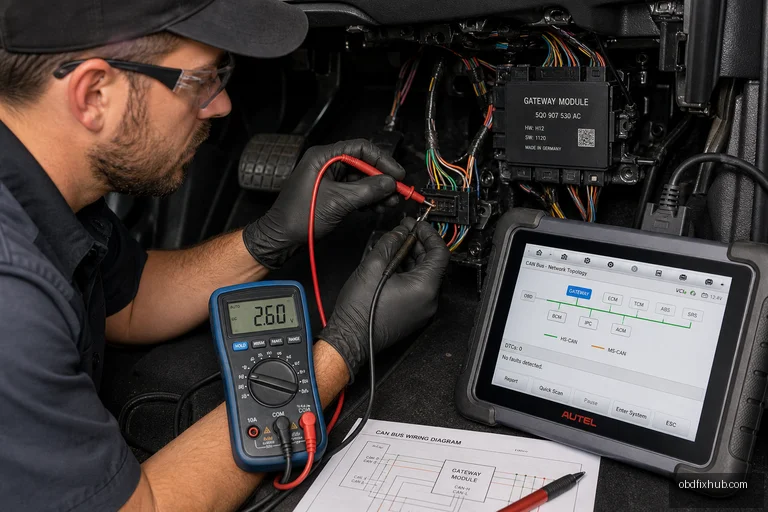
U0146 Lost Communication With Serial Data Gateway Module means one or more vehicle control modules can no longer exchange messages with the gateway responsible for routing serial data across the vehicle network. The code does not automatically prove that the gateway itself has failed. A weak battery, blown fuse, poor ground, damaged CAN wiring, water intrusion, or another module holding the network offline can produce the same diagnostic result.
This is an informational diagnostic search intent: the most useful solution is to understand what the code means, identify the symptoms, and test the communication network in the correct order before buying an expensive gateway module.
What Does U0146 Mean?
U0146 is a network communication trouble code. In practical terms, a control module expected a message from the serial data gateway module but did not receive it within the time allowed by the vehicle software. The exact naming may vary by manufacturer, including “gateway module,” “central gateway,” or “serial data gateway module.”
The gateway acts like a traffic controller between different CAN or other vehicle data networks. It may pass information between the engine computer, body control module, instrument cluster, ABS system, infotainment system, and diagnostic connector. If it stops communicating, several apparently unrelated systems can report faults at once.
Always check the service information for the exact vehicle. U0146 definitions, gateway locations, connector pinouts, and network architecture can differ between model years, even within the same brand.
Common Symptoms of U0146
Symptoms depend on which network is affected and whether the communication loss is intermittent or permanent. A vehicle may still start and drive normally, or it may enter a no-start condition when critical modules cannot exchange security or powertrain messages.
- Check Engine, ABS, airbag, traction control, or transmission warning lights
- Multiple communication or “lost communication” codes across several modules
- Instrument cluster warning messages, blank displays, or incorrect gauge readings
- Power windows, locks, lighting, climate control, or infotainment functions that stop working
- Intermittent no-start, crank-no-start, or security system activation
- Scan tool access to some modules but not others
- Battery drain when a module remains awake and continues transmitting on the network
- Random warning lights that appear after starting, jump-starting, or driving over bumps
A useful clue is the pattern of module access. If every module is unavailable, suspect a major power supply, ground, diagnostic connector, or network fault. If only modules on one branch disappear while others remain accessible, focus on that branch, its connector, or the gateway connection serving it.
Most Likely Causes of U0146
Low battery voltage or unstable power
Low voltage is one of the most frequently overlooked causes of communication codes. A battery that drops sharply during cranking, a failing alternator, or loose battery terminals can make several modules reset at the same time. Modern modules may log U0146 even though the original problem was a brief voltage event.
Measure battery voltage rather than relying only on how brightly the headlights operate. A healthy, fully charged battery is typically close to 12.6 volts with the engine off, while charging voltage is commonly around 13.5 to 14.8 volts, depending on the vehicle and charging strategy. Use the manufacturer’s specifications when available.
Blown fuse, missing ignition feed, or poor ground
The gateway usually has constant battery power, switched power, and one or more grounds. Check the gateway fuse under load, not just visually. A fuse can appear intact while a loose fuse-box terminal, corrosion, or an open circuit prevents current from reaching the module.
Voltage-drop testing is more reliable than simply measuring resistance. During the fault condition, place one meter lead at the battery negative terminal and the other at the gateway ground. More than a small voltage drop under load indicates a ground path problem that needs to be repaired.
CAN bus wiring or connector damage
CAN High and CAN Low wires can be damaged by water, aftermarket accessories, collision repairs, rodents, or excessive tension at a connector. A partially backed-out terminal may work on a dry day and fail when the vehicle body flexes or humidity rises.
Inspect connectors for green corrosion, pushed-back pins, moisture tracks, overheated terminals, and repairs made with twist-and-tape methods. Pay special attention to areas near the battery, windshield, kick panels, door sills, and any previous bodywork.
Another module is pulling the network down
The gateway may be healthy while another control unit creates a short or floods the CAN network with malformed messages. Infotainment units, telematics modules, ABS modules, and aftermarket remote starters are common suspects, but the correct component depends on the network layout.
Failed or unprogrammed gateway module
A failed gateway is possible, particularly after water intrusion, an incorrect jump-start, battery reversal, or a power surge. Replacement is not a plug-and-play repair on many vehicles. The module may require configuration, security access, software programming, and a vehicle-specific setup procedure before all systems communicate normally.
How to Diagnose U0146 Correctly
- Record every code. Perform a full vehicle scan, not just a powertrain scan. Note which modules respond and which show communication errors. Save freeze-frame data and the order in which codes were set.
- Check battery and charging voltage. Test the battery at rest and during cranking. Inspect terminals, grounds, and the engine-to-body ground strap. Clear the codes only after recording the evidence.
- Verify gateway power and ground. Use a wiring diagram and back-probe the circuits with the connector installed. Confirm constant power, ignition power, and ground integrity under load.
- Inspect the network physically. Look for water entry, damaged harnesses, aftermarket wiring, loose terminals, and signs of collision repair around the gateway and related modules.
- Test CAN resistance with the network asleep. With the ignition off and the battery disconnected according to the service procedure, resistance between CAN High and CAN Low is often approximately 60 ohms on a properly terminated network. This is not universal, so follow the manufacturer’s topology and test instructions. A reading near 120 ohms, very low resistance, or an unstable reading can indicate a missing termination, open circuit, or short.
- Check bus voltage and waveform when required. An oscilloscope can reveal a module that is disturbing the CAN signal when a basic multimeter cannot. A professional technician may isolate branches or disconnect modules one at a time to identify the device loading the network.
- Confirm communication after repair. Repair the wiring or power issue, reconnect the vehicle correctly, scan all modules again, and perform a road test. Some vehicles require a sleep cycle before communication codes can be evaluated accurately.
U0146 Fixes That Actually Address the Cause
The correct repair may be as simple as charging or replacing a weak battery, tightening a ground connection, replacing a blown fuse, or repairing a corroded CAN terminal. Harness repairs should use the correct wire type, splice method, shielding, and routing. Poorly made splices can create a second intermittent fault.
If a module is confirmed to be defective, replace it only after verifying its power, ground, communication lines, and network termination. After installation, follow the manufacturer’s programming and configuration procedure. On some vehicles, a used gateway cannot be installed without specialized programming or security synchronization.
Do not replace the gateway simply because it is named in the code. In real workshop diagnostics, a gateway replacement made before checking battery voltage and network integrity is one of the most common ways to turn a small wiring fault into an expensive, unfinished repair.
Can You Drive With U0146?
Driving may be reasonable only when the vehicle operates normally and no critical systems are affected. Do not continue driving if the ABS, airbag, steering, braking, transmission, or engine-control systems are unavailable, or if the vehicle has an intermittent no-start or stalling condition.
Because communication faults can disable safety features without obvious symptoms, arrange a proper scan as soon as possible. If the code appeared after water exposure, a jump-start, or electrical work, avoid repeated battery disconnections until diagnostic data has been saved.
Final Takeaway
U0146 identifies a communication failure involving the serial data gateway module, but it is a symptom rather than a guaranteed gateway failure. Start with battery voltage, fuses, grounds, full-module scanning, and CAN wiring inspection. Only replace and program the gateway after testing proves that the module itself is the source of the communication loss.
Next step: Save all current codes, verify the vehicle’s battery and gateway power supplies, then use the factory wiring diagram to test the affected network instead of guessing at parts.
Frequently Asked Questions
Is U0146 always caused by a bad gateway module?
No. Low voltage, a blown fuse, poor ground, damaged CAN wiring, water intrusion, or another module disrupting the network can all set U0146. The gateway should be condemned only after its power, grounds, and communication circuits pass testing.
Can a weak car battery cause U0146?
Yes. Low battery voltage during starting or a failed charging system can reset modules and interrupt network messages. Test the battery under load and check charging voltage before investigating expensive modules.
Will clearing U0146 fix the problem?
Clearing the code may remove a history code after a one-time voltage event, but it will not repair an active wiring, power, or module fault. If the code returns immediately or after a short drive, further diagnosis is required.
Does a replacement gateway need programming?
Often, yes. Many vehicles require configuration, software programming, security pairing, or module setup after gateway replacement. Installing a physically compatible used unit may not restore communication without the correct programming procedure.




