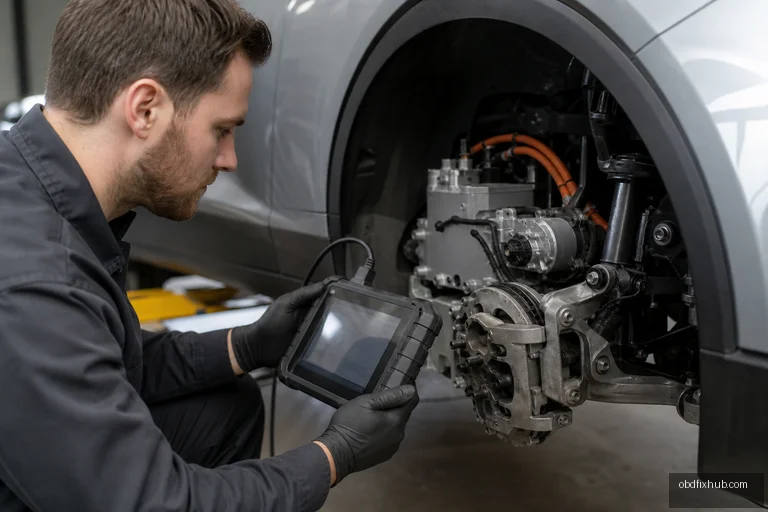
U01B3 Lost Communication With Brake Blending Actuator means another control module can no longer exchange data with the actuator that coordinates regenerative and friction braking. Because this system directly affects braking behavior, do not treat U01B3 as a harmless communication code: check the brake warning lamps and pedal feel first, then diagnose power, ground, wiring, CAN-bus communication, and actuator operation before replacing any module.
What Does U01B3 Mean?
U01B3 is a manufacturer-specific or less commonly supported network communication diagnostic trouble code. The exact description can vary by vehicle, but it generally identifies a lost data connection with the brake blending actuator. In hybrid and electric vehicles, this actuator helps blend regenerative braking from the drive motor with conventional hydraulic friction braking.
When communication stops, the vehicle may disable regenerative braking and rely on a backup hydraulic or friction-braking strategy. Some vehicles will still stop normally, while others may develop a hard pedal, reduced braking assistance, warning messages, or limited driving functions. The vehicle-specific service manual is essential because the actuator name, network architecture, and fail-safe strategy differ between manufacturers.
U01B3 Symptoms to Watch For
- ABS, brake, traction-control, hybrid-system, or stability-control warning lights
- A message such as Brake System Fault, Check Brake System, or Regenerative Braking Unavailable
- Regenerative braking that suddenly becomes weak or disappears
- A changed brake-pedal feel, including a hard, soft, delayed, or inconsistent pedal
- Reduced-power mode or a vehicle that refuses to select Drive
- Multiple U-codes stored in the ABS, powertrain, battery, or body modules
- Intermittent faults after rain, washing, deep water, or a weak 12-volt battery
If the red brake warning lamp is illuminated, the pedal travels unusually far, braking assistance is missing, or the car pulls during braking, stop driving and arrange a tow. A communication fault can be intermittent while the underlying braking problem is not.
Common Causes of U01B3
1. Low 12-volt battery voltage
A weak auxiliary battery is one of the most frequently overlooked causes. During startup, a voltage drop can make the brake actuator reset or disappear from the CAN network. Check the battery under load rather than relying only on an open-circuit reading. A healthy battery may show approximately 12.6 volts at rest, but the correct specification and test procedure depend on the vehicle.
2. Blown fuse, poor ground, or lost actuator power
The actuator may have separate ignition and constant-power feeds, plus more than one ground path. A fuse can look intact yet have no power on its output side. Voltage-drop testing under load is more reliable than simply checking continuity with the connector unplugged.
3. Damaged CAN wiring or connectors
CAN-H and CAN-L wires can be damaged near the wheel well, under the battery tray, or where the harness bends beside the brake actuator. Water intrusion, corrosion, loose terminals, rodent damage, and poorly installed accessories are common real-world causes. Do not probe or short CAN circuits with a test light; use the wiring diagram and a suitable meter or oscilloscope.
4. Software, calibration, or network configuration problems
A failed programming event, incorrect module configuration, or manufacturer software update can leave an actuator unable to communicate correctly. Some vehicles require a brake-system initialization, pressure calibration, steering-angle calibration, or regenerative-brake relearn after battery or actuator work.
5. Internal actuator or control-module failure
The actuator itself may have an internal electronic fault, failed motor, pressure-sensor problem, or damaged circuit board. Replacing it should be the final step, not the first one. Confirm that power, ground, network resistance, and connector integrity are correct before condemning an expensive brake component.
How to Diagnose U01B3 Correctly
- Check safety symptoms first. Verify pedal firmness, fluid level, warning lamps, and whether the vehicle can stop in a controlled manner.
- Scan every module. A basic engine-code reader may not access the brake actuator. Use a professional or manufacturer-level scan tool and record current, pending, and history codes before clearing anything.
- Look for companion codes. Codes for low voltage, CAN bus-off, ABS communication, gateway faults, or battery-management communication often identify the root cause more accurately than U01B3 itself.
- Test the 12-volt system. Check battery condition, charging voltage, grounds, and voltage during the moment the fault occurs.
- Inspect the actuator circuit. Follow the wiring diagram to test every power feed, ground, fuse, CAN line, connector pin, and harness section.
- Check network integrity. With the vehicle powered down as specified by the manufacturer, measure CAN resistance and inspect for shorts to power or ground. Some hybrid and EV systems require a waiting period before connectors are safe to handle.
- Perform required calibration. After a repair, use the scan tool for actuator initialization, brake-pressure bleeding, software programming, or other relearn procedures listed by the manufacturer.
A useful diagnostic clue is whether the code is current or historic. If U01B3 appears only after a discharged 12-volt battery and does not return after a proper battery test, the actuator may be healthy. If the module repeatedly disappears while driving, monitor live network status and voltage rather than repeatedly clearing the code.
How Do I Reset the Brake Control Module?
There is no universal button sequence that safely resets every brake control module. The correct repair is to fix the communication or power problem first, then use a bidirectional scan tool to clear the code and run the required brake-system initialization or calibration.
Disconnecting the 12-volt battery may erase temporary memory on some vehicles, but it does not repair a broken CAN wire, restore a failed actuator, or complete required calibration. It can also create additional steering-angle, window, security, or hybrid-system faults. On a hybrid or EV, never disconnect high-voltage components unless you are trained and equipped to follow the manufacturer’s isolation procedure.
What If the ABS Module Has Lost Communication?
If the ABS module has lost communication, inspect the ABS fuse, power supply, grounds, CAN wiring, and battery voltage before replacing the ABS module. Scan other modules to determine whether the ABS is the only unit offline or whether an entire section of the network has failed.
When several modules report communication loss at the same time, suspect a shared power, ground, gateway, or CAN-bus problem. If only the ABS or brake actuator is missing from the scan tool and its power and network circuits test correctly, internal module failure becomes more likely. Never install a used module without checking compatibility, coding, and required programming.
How Much Does It Cost to Fix an Anti-Lock Brake System?
Prices vary significantly by vehicle, region, and whether the fault is wiring or a complete actuator. Typical U.S. ranges are:
- Diagnostic scan and electrical testing: $100–$250
- Battery, fuse, terminal, or ground repair: $50–$300
- CAN wiring or connector repair: $150–$800
- ABS or brake-control module programming: $150–$500
- ABS module replacement and programming: $600–$2,000 or more
- Brake blending actuator replacement: often $1,000–$3,500 or more on hybrid and electric vehicles
These figures are estimates, not a quotation. Ask the repair shop whether the estimate includes bleeding, calibration, programming, software updates, and post-repair road testing. A low parts-only price can become expensive if the actuator requires manufacturer-level setup.
How Do I Fix Lost Communication With the TCM?
Lost communication with the TCM is usually associated with a different code, commonly U0101, rather than U01B3. However, both faults can appear together when a shared CAN circuit, gateway, ignition feed, or ground is failing.
To diagnose a TCM communication fault, test the TCM’s power and grounds, inspect transmission-area wiring, check CAN resistance and signal quality, and scan the gateway for network faults. Do not replace the transmission control module solely because it is not communicating; first prove that the module is receiving correct voltage and that the network is intact. After replacement, coding, immobilizer authorization, and transmission adaptation may be required.
Can You Drive With U01B3?
Only a qualified technician can determine whether the vehicle’s fail-safe braking remains reliable. If the car has a red brake warning, unusual pedal operation, reduced braking force, or multiple safety-system warnings, do not drive it to a workshop. If the only symptom is a stored historical code and the brakes operate normally, arrange prompt diagnosis anyway because an intermittent communication fault can return without warning.
Key Takeaway
U01B3 is a communication failure involving the brake blending actuator, not a diagnosis that automatically proves the actuator is defective. Start with safety, battery voltage, fuses, grounds, connectors, and CAN-bus testing; then perform the vehicle-specific calibration and programming procedures. If braking performance has changed, stop driving and use a qualified brake or hybrid/EV technician rather than repeatedly clearing the code.
Frequently Asked Questions
Is U01B3 the same as U0129?
No. U01B3 identifies a lost connection with a brake blending actuator, while U0129 generally refers to lost communication with a brake system control module. The exact definitions can vary by manufacturer, so always verify the code with vehicle-specific service information.
Will replacing the 12-volt battery clear U01B3?
It may prevent the code from returning if low voltage caused the fault, but it will not fix damaged wiring or a failed actuator. The battery and charging system should be tested before and after replacement.
Can a generic OBD scanner diagnose U01B3?
Many inexpensive scanners can read the code but cannot access the brake actuator, view network status, program modules, or perform calibration. A professional or manufacturer-level tool is usually needed for complete diagnosis.
Is it safe to disconnect the battery to reset the brake module?
Battery disconnection is not a reliable repair and may create additional faults. Follow the manufacturer’s procedure and use a suitable scan tool to clear codes and complete any required brake-system relearn.




