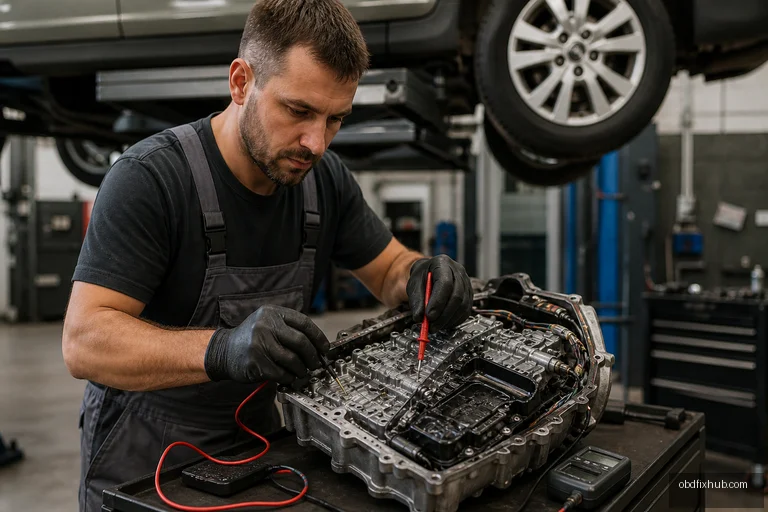
U01BA Lost Communication With Park Lock and Pawl Module means another control module can no longer exchange data with the electronic system that manages the transmission park-lock mechanism. Do not treat it as a simple check-engine light: a vehicle may refuse to shift out of Park, display a transmission warning, or fail to secure itself reliably. The safest first steps are to confirm the code with a full-system scan, check battery voltage and grounds, and avoid forcing the shifter or driving until the parking function has been verified.
What Does the U01BA Code Mean?
The U01BA diagnostic trouble code identifies a communication failure involving the Park Lock and Pawl Module. This module, used on some electronically controlled transmissions, supervises or commands the mechanical parking pawl that locks the transmission output shaft when Park is selected. Depending on the vehicle, it may communicate with the transmission control module, body control module, gateway, or powertrain controller over CAN bus wiring.
The code does not automatically prove that the pawl itself is broken. It only confirms that the expected messages are missing, invalid, or unavailable. A weak battery, damaged CAN wire, blown power supply fuse, water intrusion, or a failed module can all create the same stored fault.
Common Symptoms of U01BA Lost Communication
Symptoms vary by vehicle design and by whether the fault is intermittent or permanent. In my diagnostic experience, communication faults often begin as occasional warning messages after a low-voltage event and become permanent after corrosion spreads through a connector.
- “Service Transmission,” “Park Assist,” or “Shift to Park” warnings
- The shifter remains locked in Park or will not recognize Park correctly
- The vehicle starts only intermittently, or will not start because Park or Neutral is not confirmed
- A flashing transmission-range indicator or missing gear display
- Multiple U-codes stored in the TCM, BCM, ABS, or gateway module
- The electronic parking or park-lock actuator operates noisily, slowly, or not at all
- Battery drain if the affected module stays awake on the network
If the vehicle is parked on an incline, apply the parking brake and use wheel chocks before testing. A communication problem can prevent the pawl from applying even though the selector shows Park.
Most Likely Causes of the U01BA Code
- Low system voltage: A battery below approximately 12.2 volts at rest, poor charging voltage, or a voltage drop during cranking can shut down network modules.
- Blown fuse or lost module power: Check both ignition-switched and constant-battery feeds. A fuse can appear intact while its socket has heat damage.
- Bad ground connection: Rust at a body ground or transmission ground strap can create a communication fault without completely disabling the module.
- CAN bus wiring damage: Open circuits, shorted CAN High or CAN Low wires, crushed harnesses, and aftermarket splices are frequent causes.
- Connector corrosion or water entry: Transmission-area connectors are exposed to road salt, oil, splash water, and temperature cycling.
- Failed Park Lock and Pawl Module: Internal actuator, circuit-board, or software failure is possible, but it should be diagnosed only after power, ground, and network integrity are proven.
- Incorrect programming or a recent module replacement: A replacement module may need configuration, calibration, or security pairing before other controllers will accept it.
How to Diagnose U01BA Correctly
1. Scan every module, not just the engine computer
A basic code reader may show U01BA but cannot identify which controller first reported the failure. Use a scan tool capable of accessing the TCM, BCM, gateway, ABS, and Park Lock module. Record every code and note whether each fault is current, pending, or history.
The module that reports another controller as “offline” is not necessarily the failed part. For example, an ABS module may report lost communication with the park-lock module because the latter has lost its own power feed.
2. Test the battery and charging system first
Measure battery voltage after the vehicle has been sitting, then monitor voltage during cranking. A healthy system normally remains above roughly 10 volts while cranking and charges near 13.5 to 14.8 volts, although exact specifications depend on the vehicle. Clear the codes only after correcting a low-voltage condition, then perform a complete rescan.
3. Verify power, ground, and CAN network resistance
Use the wiring diagram for the specific vehicle to test the module’s battery feed, ignition feed, and ground under load. A voltage reading with no load can be misleading; a test lamp or voltage-drop test often exposes a weak connection.
With the ignition off and the network asleep, many properly terminated CAN systems measure close to 60 ohms between CAN High and CAN Low. An open termination, short circuit, or unusual resistance requires further circuit testing. Do not probe connector terminals carelessly, because damaged terminals can create a second fault.
4. Inspect the harness at movement and heat points
Pay particular attention to wiring near the transmission case, shift mechanism, underbody shields, battery tray, and exhaust heat. Look for green corrosion, stretched wires, water tracks, and previous repair joints. Gently flexing the harness while watching live communication status can reveal an intermittent open, but keep hands clear of moving components.
5. Confirm the repair with a functional test
After repairing a wire, ground, fuse, or connector, clear all related codes and cycle the ignition several times. Confirm that Park is recognized, the vehicle starts normally, the selector displays the correct range, and the parking brake or wheel chocks are no longer needed to compensate for an uncertain park-lock condition. Some vehicles require a module setup, actuator relearn, or software update with factory-level equipment.
How Is U01BA Repaired?
The repair depends on the failed part. A discharged battery may require charging or replacement, while a corroded ground may need cleaning, a new terminal, and protective treatment. Damaged CAN wiring should be repaired with the correct wire type and sealed splices rather than twisted wires and household tape.
If the Park Lock and Pawl Module has correct power, ground, and network signals but remains offline, replacement may be necessary. Always check technical service bulletins and software updates before installing a module. Many systems require programming and position calibration; installing a new unit without configuration can leave the original symptom unchanged.
What If the ABS, HVAC, or TCM Has Lost Communication?
ABS module
If the ABS module has lost communication, check battery voltage, ABS fuses, grounds, wheel-well harness damage, and the CAN network. Do not assume the ABS hydraulic unit is defective simply because the code is stored in another module. Until communication and warning lights are resolved, avoid driving at speed because ABS, traction control, and stability functions may be disabled.
HVAC module
For a lost HVAC communication fault, inspect the HVAC fuse, blower-control wiring, dashboard connectors, and network gateway. If the blower works but the scan tool cannot access the HVAC module, the problem is more likely power, ground, CAN wiring, or the module itself than a refrigerant issue.
TCM
When communication with the TCM is lost, verify transmission power and grounds, inspect the transmission connector for oil or water, and scan for engine, gateway, and immobilizer codes. Do not replace the TCM before checking voltage drop and CAN resistance. A TCM replacement commonly requires programming, configuration, and sometimes a transmission pressure or clutch relearn.
What Does U012A Mean in a Car?
U012A is not the same code as U01BA. U-series definitions can vary by manufacturer, model year, and network architecture, so a generic scanner description should not be treated as a complete diagnosis. U012A is a separate lost-communication code in some applications and may refer to a different control module than the Park Lock and Pawl Module. The correct meaning must be confirmed with the vehicle’s factory service information or a scan tool that displays the manufacturer-specific definition.
Before replacing any component for U012A, record the vehicle identification number, all module names shown by the scan tool, and whether the code is current or historical. This prevents a common mistake: ordering a park-lock module when the actual fault concerns another controller or a shared CAN power supply.
Can You Drive With U01BA?
Driving is not recommended if the vehicle cannot reliably confirm Park, refuses to shift normally, or shows a transmission warning. If the code is history-only and all functions operate correctly, a short trip to a repair facility may be reasonable after confirming the vehicle is secured. Keep the parking brake applied and never rely on the selector position alone on an incline.
Final Takeaway
U01BA points to a communication failure with the Park Lock and Pawl Module, not automatically to a failed parking actuator. Start with battery voltage, fuses, grounds, connectors, and CAN wiring; then test the module itself and complete any required programming or calibration. If the vehicle cannot prove that Park is engaged, secure it with the parking brake and wheel chocks and arrange professional diagnosis rather than forcing the shifter.
Frequently Asked Questions
Can a weak battery cause U01BA?
Yes. Low voltage during starting can make the Park Lock and Pawl Module drop off the CAN network. Test the battery and charging system before replacing communication modules.
Is U01BA the same as U0128?
No. U01BA concerns the Park Lock and Pawl Module on applicable vehicles. U0128 is a separate code commonly associated with lost communication with a parking-brake control module, although exact descriptions should be verified for the vehicle.
Will clearing U01BA fix the problem?
Clearing the code only removes the stored record temporarily. If the power, ground, wiring, or module fault remains, U01BA will return as soon as the network performs another communication check.
Does replacing the module require programming?
Often, yes. A replacement may require configuration, security pairing, actuator calibration, or a software update. Follow the manufacturer’s procedure after installation.
What is the safest first action when the vehicle is stuck in Park?
Keep the parking brake applied, chock the wheels, and avoid forcing the selector. Check the battery condition and have the vehicle scanned with a full-system diagnostic tool before attempting movement.




