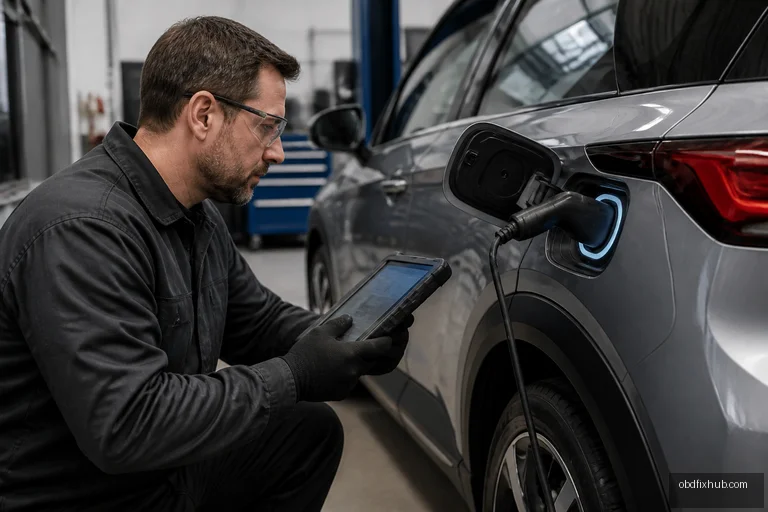
U027C Lost Communication With Off-Board Charger Module: Meaning, Causes, Symptoms & Fix
U027C Lost Communication With Off-Board Charger Module means another vehicle control unit has stopped receiving valid network messages from the charger-related module. On an electric vehicle or plug-in hybrid, the fault may prevent AC charging, interrupt charging communication, trigger warning lights, or appear alongside high-voltage system codes. The code does not automatically prove that the charger itself has failed; wiring, power supply, software, and the charging connector can create the same result.
What Does U027C Mean?
U027C is a standardized network communication diagnostic trouble code. The “U” identifies a communication-related fault, while the remaining characters identify the particular module that other controllers can no longer reach. In this case, the missing messages come from the off-board charger module, although the exact module name and function can vary by manufacturer.
Some vehicles use this module to manage communication with an external charging station, while others use similar terminology for a charging interface or a dedicated electric-vehicle charging controller. Always check the factory service information for the specific VIN. A generic scan tool may display the standardized description but not the manufacturer’s more precise module designation.
Why Is Communication Necessary in an EV Charging System?
The purpose of communication is to let electronic control units exchange information, agree on operating conditions, and respond safely to changing events. During charging, the vehicle must determine whether a station is connected, what charging current is available, whether the battery is ready, and whether high-voltage contactors may close.
Without that exchange, the vehicle cannot safely assume that the charging source, battery, and safety systems are synchronized. The control system may therefore refuse to start charging even when the charging cable and wall outlet appear normal.
What is communication and what are its types?
Communication is the transfer of information between a sender and a receiver so that both sides can interpret the message. In automotive electronics, communication is not a conversation between people; it is a timed exchange of digital data between modules.
- Wired communication: CAN bus, LIN bus, Ethernet, and other vehicle networks carry data through dedicated electrical conductors.
- Charging communication: The vehicle and charging equipment exchange control and status information through the charging inlet and its control circuits.
- Diagnostic communication: A scan tool requests fault data, live values, identification information, and test commands from vehicle modules.
- Wireless communication: Wi-Fi, Bluetooth, or cellular connections may support charging apps and remote services, but they are not usually the direct cause of a U027C network fault.
In practical terms, three useful definitions of communication are: the transfer of data, the exchange of information, and the creation of shared meaning between connected devices. For U027C, effective communication means that the correct module has power, remains connected to the network, transmits messages at the expected rate, and receives valid responses from other controllers.
Common Causes of U027C
Experience with EV charging faults shows that communication codes are often caused by a simple interruption rather than an internally failed module. The most likely causes include:
- A weak 12-volt battery or low system voltage during vehicle wake-up.
- Blown fuse, failed relay, poor ground, or missing power supply at the charger module.
- Open, shorted, corroded, or damaged CAN wiring.
- Loose terminals, pushed-back pins, water intrusion, or rodent damage near the charging inlet.
- A damaged charge-port assembly or control-pilot circuit.
- Software corruption, interrupted programming, or a module that requires configuration after replacement.
- Failure inside the off-board charger or charging control module.
- A problem with a charging station or cable that causes the vehicle to report related communication faults.
A low 12-volt battery deserves particular attention. Many EV modules boot from the 12-volt system even though the traction battery is fully charged. A vehicle can display U027C after sitting overnight, then appear normal after the 12-volt battery is charged or replaced.
Symptoms You May Notice
U027C symptoms depend on which controller lost communication and whether the fault is constant or intermittent. Common signs include:
- AC charging will not start or stops shortly after connecting the cable.
- The instrument cluster displays “Check EV System,” “Charging System Fault,” or a similar warning.
- The charge-port indicator flashes an error color or does not illuminate.
- Reduced charging power, delayed charging, or an inability to schedule charging.
- Multiple U-codes or charging-related codes stored in several modules.
- The vehicle refuses to enter READY mode in severe cases.
- Public charging works but home charging fails, or the reverse.
If the vehicle smells overheated, shows visible damage at the charging inlet, reports a high-voltage isolation fault, or will not shift into a safe operating mode, stop testing and arrange professional EV service. Do not open high-voltage components based on a generic repair guide.
How to Diagnose U027C Correctly
Replacing the charger module immediately is an expensive and common mistake. A proper diagnosis should establish whether the module is unpowered, disconnected, electronically silent, or simply unable to communicate with a particular charging source.
- Record every code. Scan all available modules, not just the powertrain controller. Note which codes are current, history, or pending and identify the first code that appeared.
- Check the 12-volt battery. Test it at rest and under load. Inspect battery terminals and grounds. Voltage that collapses during vehicle wake-up can create misleading network faults.
- Verify fuses and module power. Use the wiring diagram and test for power on both sides of the relevant fuse. A visual inspection alone cannot confirm a fuse circuit is supplying the module under load.
- Inspect the charging area. Look for bent inlet pins, moisture, corrosion, damaged seals, loose connectors, and signs of overheating. Do not probe high-voltage terminals with ordinary test equipment.
- Test the communication network. With the vehicle safely powered down according to the manufacturer’s procedure, a trained technician can check CAN resistance, continuity, shorts to ground or power, and network voltage behavior. The correct values and test conditions vary by vehicle.
- Attempt module communication with factory-level equipment. If the scan tool cannot identify the module at all, check its power, ground, network wiring, and gateway routing before condemning it.
- Check software and configuration. Some charging modules need a software update, initialization, or VIN-specific programming after replacement or a low-voltage event.
- Clear codes and perform a controlled charging test. Test with a known-good cable and, when possible, a second charging station. Confirm that charging begins, current remains stable, and the code does not return.
How to Fix U027C
The correct repair depends on the failed point in the circuit. A weak 12-volt battery should be charged or replaced, then the vehicle should be retested. A blown fuse should never be replaced repeatedly without finding the short or overloaded component that caused it.
Wiring repairs may involve cleaning corrosion, tightening a terminal, repairing a broken CAN conductor, or replacing a damaged connector. Use the manufacturer’s wiring repair procedures; twisting wires together without preserving the correct shielding, pairing, and terminal integrity can create a second communication fault.
If the charger module has proper power, ground, network access, and correct software but remains offline, module replacement may be justified. Many EV modules require programming, pairing, or calibration after installation. A replacement that is not configured can leave the original symptom unchanged.
Can You Drive With U027C?
Sometimes the vehicle can be driven if the only symptom is failed charging and the car enters READY normally. However, that does not make the fault harmless. A communication failure can worsen, leave you unable to charge away from home, or be accompanied by a high-voltage safety problem that a basic scanner does not fully explain.
Arrange diagnosis promptly, keep the vehicle away from damaged charging equipment, and avoid repeatedly connecting a cable that produces arcing, heat, or a burning smell. High-voltage battery and charging repairs should be handled by a technician trained for the specific EV system.
What Is Effective Communication in Vehicle Diagnostics?
Effective communication is accurate, timely, complete, and understood by the receiver. In a vehicle network, a module that sends occasional corrupted messages is not communicating effectively even if a scan tool sees it briefly. That is why an intermittent U027C should be investigated with live data, wiring movement tests where permitted, event history, and charging tests rather than cleared and ignored.
The same principle applies when describing the fault to a repair shop. Provide the exact code, when it occurs, whether the car charges on another station, the 12-volt battery age, recent repairs, and any exposure to water or accident damage. Those details can separate a station problem from a vehicle network problem before parts are ordered.
Summary: The Best Next Step for U027C
U027C identifies a lost communication path with an off-board charger module; it is not a guaranteed charger replacement diagnosis. Start with a complete scan, 12-volt battery testing, fuses, grounds, connectors, charging-inlet condition, and CAN circuit checks. If those pass, investigate software, configuration, and the module itself using factory-level information. Because EV charging circuits can contain lethal voltage, leave high-voltage disassembly and module replacement to qualified professionals.
Frequently Asked Questions
What does U027C mean on an electric vehicle?
It means another control unit has lost communication with the off-board charger module. The cause may be low 12-volt voltage, wiring, a connector, software, the charging inlet, or the module itself.
Can a weak 12-volt battery cause U027C?
Yes. A weak 12-volt battery can prevent charging-related modules from booting correctly or maintaining network communication. Test the battery under load before replacing expensive EV components.
Will clearing U027C fix the charging problem?
Clearing the code may remove a stored warning temporarily, but it will not repair an open circuit, failed power supply, software issue, or defective module. If the communication fault remains, it will return.
Is U027C safe to diagnose at home?
Basic checks such as reading all codes, inspecting the 12-volt battery, and looking for visible connector damage may be appropriate. Do not access orange high-voltage wiring or dismantle the charger unless you have the required training and equipment.
Does U027C always mean the charger module must be replaced?
No. Power, ground, CAN wiring, charging-station compatibility, water intrusion, and software problems can all produce the code. Module replacement should follow electrical and network testing, not precede it.




