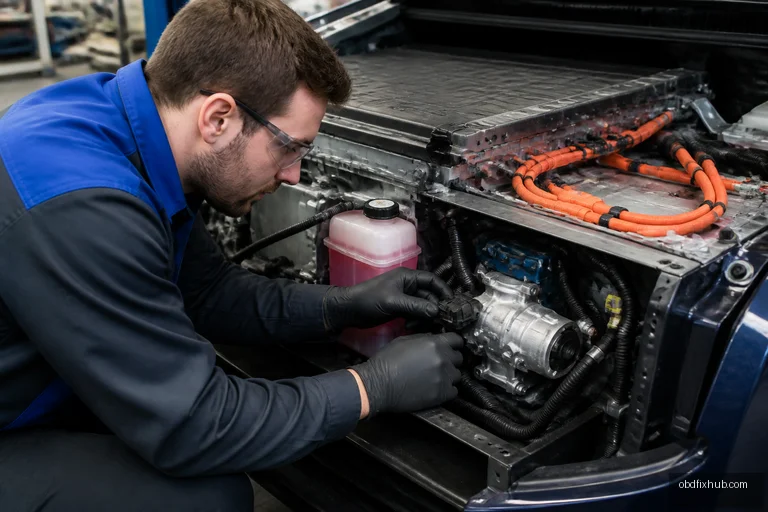
U02AE Lost Communication With Hybrid Battery Coolant Pump means the vehicle’s control modules cannot reliably communicate with the electric pump that circulates coolant through the hybrid battery thermal-management system. The code does not automatically prove that the pump itself has failed. A weak 12-volt battery, blown fuse, damaged wiring, poor connector contact, CAN-bus fault, or a defective pump controller can produce the same warning.
Because hybrid battery temperature directly affects performance, charging, and safety, U02AE should be diagnosed promptly. Avoid clearing the code repeatedly and continuing to drive without finding the cause, especially if the vehicle also shows a hybrid-system warning, reduced power, or overheating symptoms.
What Does U02AE Mean?
U02AE is a network communication diagnostic trouble code. The hybrid control system, battery control module, or another supervisory module expects status messages from the hybrid battery coolant pump. When those messages stop, become invalid, or fail to meet the expected timing, the vehicle stores U02AE.
The pump is usually an electrically driven coolant pump rather than a belt-driven mechanical water pump. It may run at different speeds according to battery load, ambient temperature, charging conditions, and state of charge. Its job is to move coolant through the battery cooling circuit so heat can be removed during driving, regenerative braking, and charging.
One important diagnostic point is that U02AE identifies a communication problem, not a single failed component. Replacing the pump immediately can waste money if the real fault is a corroded connector or low system voltage.
Common Symptoms of U02AE
Some vehicles continue to drive almost normally when the code first appears. Others limit hybrid operation as a protective measure. Symptoms depend on the vehicle design, how long communication has been lost, and whether the battery is actually overheating.
- Hybrid system, check-engine, or battery warning light
- Reduced electric-power assistance or limited regenerative braking
- Reduced-power or fail-safe operation
- Cooling fan running more often or loudly
- Charging interrupted or refused, particularly after the battery becomes warm
- Abnormally high battery-temperature readings
- Multiple U-codes or communication codes stored in different modules
- Intermittent warnings that disappear after the vehicle is switched off and restarted
An intermittent warning after a long drive is especially useful evidence. Heat and vibration can open a marginal connector or expose an internal pump-controller fault, while the system may appear normal again after cooling down.
Most Likely Causes of U02AE
1. Low or unstable 12-volt power
Hybrid vehicles still depend heavily on the 12-volt battery to wake up control modules and power communication networks. A battery with low resting voltage, loose terminals, or excessive voltage drop during startup can create several unrelated-looking communication codes, including U02AE. Test the 12-volt battery under load rather than relying only on its open-circuit voltage.
2. Blown fuse or power-supply problem
The coolant pump may have a dedicated fuse, relay, or electronic power feed. A blown fuse can be caused by a shorted pump, damaged wiring, or a temporary overload. Replacing the fuse without checking current draw is risky; if it fails again, the circuit needs to be isolated before another fuse is installed.
3. Damaged wiring or poor connector contact
Inspect the pump connector, power wires, ground circuit, and communication wires. Look for water intrusion, green corrosion, pushed-back terminals, rodent damage, insulation rubbed through against a bracket, and wiring stretched near the pump. A connector can look clean externally while a terminal has lost tension and makes contact only intermittently.
4. Failed hybrid battery coolant pump
The pump’s motor, internal electronics, or communication circuitry can fail. Common clues include no pump operation during an active command, excessive current draw, an internal pump fault, or a code that returns immediately after the wiring and power supply test correctly.
5. CAN communication fault or control-module issue
U02AE can result from an open, shorted, or electrically noisy CAN network. If several modules report lost communication at the same time, investigate the shared network before condemning the pump. A recent collision repair, water leak, aftermarket accessory, or module replacement can be highly relevant.
6. Software or configuration problem
Some vehicles require a control-module software update, initialization, or configuration procedure after a pump or battery-related module is replaced. This is vehicle-specific, so the factory service information should be checked before assuming the new component is defective.
How to Diagnose U02AE Properly
- Record all codes and freeze-frame data. Scan every available module, not just the engine computer. Note battery voltage, coolant temperature, vehicle speed, and whether the code is current or history.
- Check the 12-volt system first. Inspect terminals and grounds, then perform a proper battery and charging-system test. Correct low voltage before chasing network faults.
- Verify fuses and pump power. Use a wiring diagram and test for voltage under load. A voltage reading with no load may disappear when the pump is commanded on.
- Inspect the harness and connectors. Check both power and communication circuits. Do not probe hybrid high-voltage terminals with ordinary test equipment.
- Command the pump with a capable scan tool. Listen for operation, monitor pump speed or feedback if available, and compare commanded versus actual status. A basic code reader usually cannot perform this test.
- Test the communication circuit. Follow the manufacturer’s resistance, continuity, and voltage procedures. Network measurements must be made with the system powered down when specified, because incorrect testing can damage modules.
- Clear the code and perform a controlled road test. Recheck during charging or after the battery reaches operating temperature if that is when the fault normally returns.
Hybrid systems contain high-voltage components that may remain energized after the vehicle is switched off. Orange cables, the battery pack, inverter, and related terminals should be serviced only by a technician trained in the manufacturer’s high-voltage safety procedures. The coolant pump circuit may be low voltage, but its location can be near high-voltage equipment.
U02AE Repair: What Usually Fixes It?
The correct repair depends on the test results. Typical repairs include replacing a weak 12-volt battery, repairing a ground, replacing a fuse after correcting a short, cleaning or replacing a damaged connector, repairing CAN wiring, or installing the correct hybrid battery coolant pump.
After pump replacement, the system may need coolant bleeding, pump activation with a scan tool, a leak check, and a module initialization or calibration. Air trapped in the cooling circuit can reduce circulation and cause a new temperature-related fault even though the electrical repair was successful.
Do not bypass the pump, wire it permanently on, or substitute an unapproved universal pump. The original system may use pump-speed feedback and specific electrical characteristics. An incorrect replacement can create additional communication or battery-temperature problems.
Can You Drive With U02AE?
Short, gentle driving may be possible if there are no overheating warnings, no power limitation, and the code is intermittent. However, avoid long trips, heavy acceleration, steep grades, and prolonged charging until the fault is diagnosed. Stop driving and arrange professional inspection if the hybrid warning flashes, power drops sharply, the battery temperature rises, or the vehicle refuses to enter ready mode.
Frequently Asked Questions
Is U02AE caused by a bad hybrid battery?
Not necessarily. U02AE concerns communication with the hybrid battery coolant pump. A failed pump can endanger battery temperature control, but the code itself does not prove that the battery pack is defective.
Can a weak 12-volt battery cause U02AE?
Yes. Low or unstable 12-volt voltage can prevent the pump or its control module from starting correctly and can disrupt network communication. Always test the 12-volt system before replacing expensive hybrid components.
Will clearing U02AE fix the problem?
No. Clearing the code only erases the stored record. If the communication fault remains, U02AE will return, often when the pump is commanded on or the battery becomes warm.
Does the hybrid battery coolant pump need to run all the time?
No. Pump operation is usually controlled according to battery temperature and operating conditions. A technician should use the correct scan-tool command and service specifications rather than judging the pump only by whether it runs immediately after startup.
Should I replace the pump as soon as U02AE appears?
No. Confirm power, ground, wiring, connector condition, and network communication first. Replacing the pump without those tests is one of the most common and costly mistakes with this code.
Final Takeaway
U02AE means the vehicle has lost reliable communication with the hybrid battery coolant pump, but the pump is only one possible cause. Start with the 12-volt battery, fuses, grounds, connectors, and wiring; then verify pump operation and CAN communication with a suitable scan tool. Because the fault can affect battery temperature control, have it diagnosed by a hybrid-qualified technician rather than repeatedly clearing the warning.




