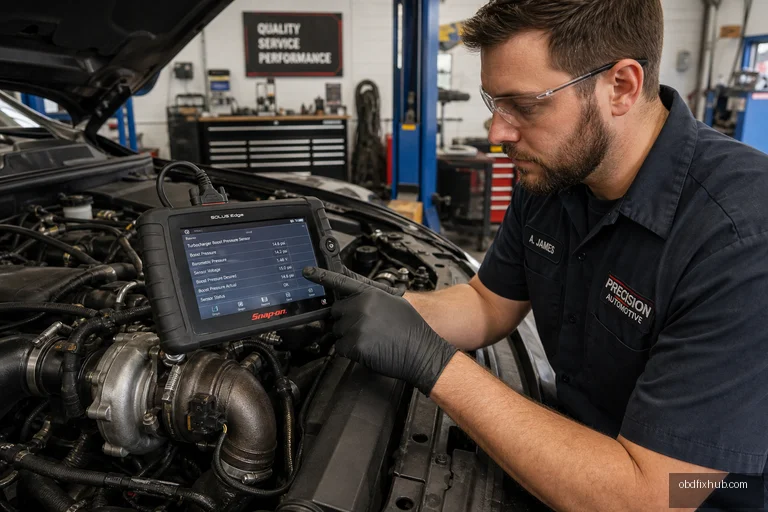
U02B0 Lost Communication With Turbo Boost Position Sensor means the engine or powertrain control module cannot receive a valid signal from the turbocharger boost position sensor or its control circuit. The fault is usually caused by damaged wiring, a poor connector, missing power or ground, a failed sensor, or a turbo actuator problem—not automatically a failed turbocharger. Correct diagnosis starts with identifying the exact sensor and checking its communication circuit before replacing expensive parts.
What Does the U02B0 Code Mean?
U02B0 is a communication-related diagnostic trouble code. The “U” category covers network and module communication faults, while the exact description can vary between manufacturers. Some vehicles refer to the component as a turbo boost position sensor, turbocharger vane position sensor, electronic wastegate position sensor, or turbo actuator feedback sensor.
This sensor reports the actual position of a variable-geometry turbocharger vane mechanism or electronic wastegate. The engine computer compares the commanded position with the measured position to control boost accurately. If communication stops, becomes intermittent, or contains implausible data, the module may store U02B0 and limit turbocharger operation.
Symptoms of a Bad Turbo Boost Sensor
The symptoms depend on whether the sensor itself has failed or whether its network connection has been interrupted. A vehicle with U02B0 may still drive normally at light throttle, making the fault easy to overlook until the engine is loaded or the turbo is needed.
- Check Engine Light or a turbocharger warning message
- Reduced engine power or limp-home mode
- Slow acceleration, especially uphill or during towing
- Underboost or overboost symptoms
- Surging, hesitation, or inconsistent boost delivery
- Hard starting or stalling on some diesel applications
- Increased fuel consumption and, in some cases, excessive smoke
- Turbo actuator clicking, hunting, or failing to complete its self-test
A useful clue is the timing of the failure. If the engine loses power immediately after starting, suspect a power, ground, connector, or communication problem. If the fault appears only under acceleration, also inspect the actuator mechanism, boost-control linkage, and the sensor’s live-data accuracy.
Common Causes of U02B0
1. Damaged wiring or connectors
Turbocharger wiring operates in a harsh environment. Heat from the exhaust manifold, vibration, oil contamination, and water intrusion can harden insulation or loosen terminals. A wire may look intact but open internally when the engine moves on its mounts or when the harness becomes hot.
2. Poor power or ground supply
Many position sensors require a stable reference voltage, power feed, and ground. A corroded ground eyelet or high-resistance terminal can create a communication fault even when the sensor itself is functional. Measure voltage under load rather than relying only on a visual inspection.
3. Failed turbo actuator or position sensor
On some turbochargers, the position sensor is integrated into the electronic actuator. In that design, the sensor may not be replaceable separately. A defective actuator motor, internal gear, or feedback circuit can produce U02B0 and may require actuator calibration after replacement.
4. Sticking variable vanes or wastegate hardware
Carbon buildup, rust, or mechanical damage can prevent the turbo mechanism from reaching the commanded position. The control module may interpret the resulting feedback as a sensor or communication problem. Do not condemn the sensor until the linkage moves smoothly and freely.
5. CAN-bus or module communication problems
Some turbo actuators communicate digitally with the vehicle network rather than sending a simple analog voltage. A shorted CAN wire, incorrect termination resistance, software issue, or another faulty module can interrupt the signal. Scan for additional U-codes; they often reveal whether U02B0 is part of a wider network failure.
How to Diagnose and Fix U02B0
Use the vehicle’s service information because pin assignments, sensor design, and calibration procedures differ. Never apply battery voltage to a sensor terminal unless the wiring diagram specifically identifies it as a power input.
- Record all codes and freeze-frame data. Note engine speed, temperature, battery voltage, and whether the code is current or stored. Scan every module, not only the engine computer.
- Inspect the turbo sensor harness. Follow the wiring from the turbocharger toward the main harness. Look for melted insulation, chafing against brackets, oil inside the connector, bent pins, and terminals pushed backward.
- Check battery voltage, power, and ground. A weak battery or charging fault can create misleading communication codes. Perform a voltage-drop test on the ground circuit while the system is active.
- Verify the communication circuit. If the sensor uses CAN communication, compare CAN-high and CAN-low readings with the manufacturer’s specifications. With the vehicle powered down, network resistance is commonly checked across the bus, but the correct value depends on the vehicle architecture.
- Use scan-tool live data and actuator tests. Compare commanded turbo position with actual position. A fixed reading, an implausible value, or a position that stops at one point suggests an electrical or mechanical fault.
- Check mechanical movement. With the actuator removed only when the service procedure allows it, confirm that the wastegate or variable-vane lever is not seized. Do not force the shaft or apply compressed air to an electronic actuator.
- Repair, calibrate, and retest. After wiring or actuator replacement, clear the code and perform the specified turbo actuator learn, adaptation, or basic-setting procedure. A repair is incomplete if calibration is skipped.
Can You Clean a Boost Pressure or Position Sensor?
Sometimes, but cleaning is not a universal fix for U02B0. A conventional boost pressure sensor may become contaminated with oil mist or soot, and a manufacturer-approved sensor cleaner can sometimes restore a distorted pressure reading. Remove it first, spray only the sensing area, and allow it to dry completely.
Do not scrape the sensing element, use brake cleaner unless approved, or spray cleaner into a sealed electronic actuator. A turbo position sensor is often enclosed inside the actuator and cannot be cleaned externally. If the connector has corrosion, repair the terminals rather than flooding the connector with lubricant and hoping the fault disappears.
How to Test a Turbo Speed Sensor
A turbo speed sensor is different from a turbo boost position sensor. The speed sensor measures turbocharger shaft speed, while the position sensor reports vane or wastegate position. Confusing these components can lead to an unnecessary turbocharger replacement.
- Identify the sensor type and wiring from the service manual.
- Check its supply voltage and ground with a digital multimeter.
- Observe the signal while raising engine speed only under safe, controlled conditions.
- Use an oscilloscope when the sensor produces a frequency or digital waveform; a multimeter may miss intermittent dropouts.
- Compare live turbo-speed data with the manufacturer’s expected range and with commanded engine load.
Some turbo speed sensors generate a frequency signal, while others use a digital protocol. There is no single resistance value that proves every turbo sensor is good. If the signal disappears only when the harness is moved or the turbo reaches operating temperature, perform a wiggle test and heat-related inspection rather than replacing the sensor immediately.
What Is the Role of a Sensor in Airflow?
Airflow sensors provide the engine computer with information about how much air enters the engine and how densely that air is packed. The mass airflow sensor measures incoming air mass, the manifold absolute pressure sensor measures intake pressure, and the turbo position sensor tells the controller how effectively the turbocharger is regulating that airflow.
These signals work together. The computer uses them to calculate fuel delivery, control exhaust-gas recirculation, manage turbo vane or wastegate position, and protect the engine from excessive boost. When the position signal is lost, the system often chooses a conservative fail-safe strategy, which explains the sudden loss of power.
When Is It Safe to Drive With U02B0?
Short, gentle driving to a repair facility may be reasonable if the engine runs smoothly, there is no severe smoke, no unusual turbo noise, and the temperature remains normal. Avoid towing, hard acceleration, high speeds, and extended uphill driving because boost control may be unavailable.
Stop driving if you hear siren-like turbo noise, see heavy smoke, experience runaway engine behavior, notice oil consumption, or encounter severe power loss in traffic. Those signs can indicate a mechanical turbo failure rather than a simple electrical communication fault.
Final Takeaway
U02B0 points to lost communication with the turbo boost position sensor, but the root cause may be wiring, power supply, CAN communication, a failed actuator, or a seized turbo mechanism. Start with a complete scan and a careful harness inspection, then confirm voltage, ground, signal behavior, and mechanical movement. Replace the sensor or actuator only after testing identifies the failed component, and complete the required calibration after repair.
Frequently Asked Questions
What are the symptoms of a bad turbo boost sensor?
Common symptoms include a Check Engine Light, reduced power, limp mode, unstable boost, hesitation, poor acceleration, and sometimes excessive smoke or fuel consumption. The exact symptoms depend on whether the sensor or its communication circuit has failed.
Can I clean a boost pressure sensor?
Yes, a removable boost pressure sensor may sometimes be cleaned with an approved electronics or sensor cleaner. A sealed turbo position sensor or actuator should not be opened or sprayed, and cleaning will not repair damaged wiring or an internal electronic failure.
How do I test a turbo speed sensor?
Identify whether it uses a frequency or digital signal, then check its power, ground, and output with the correct wiring diagram. An oscilloscope is often more reliable than a multimeter for detecting intermittent or high-frequency signal dropouts.
Can U02B0 be caused by a bad turbocharger?
Yes, but not necessarily. A seized vane mechanism or damaged actuator can cause the code, while many cases are caused by heat-damaged wiring, corroded terminals, low voltage, or a network communication fault.




