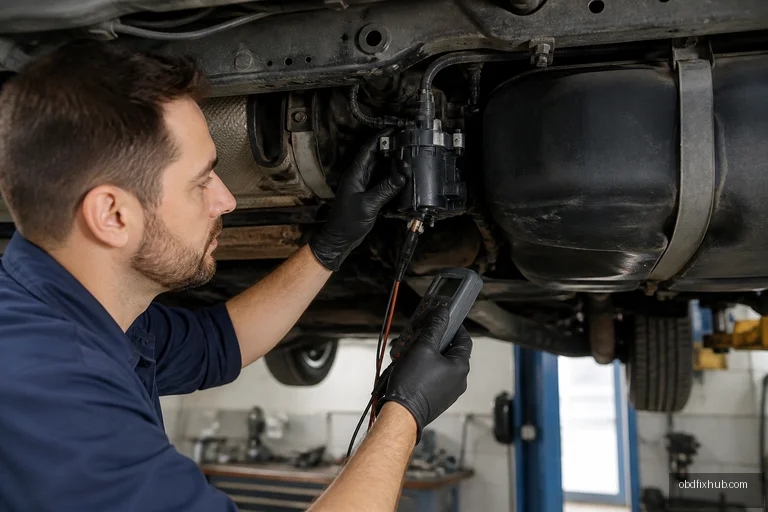
U02BB Lost Communication With EVAP Purge Pump: Meaning, Causes, Symptoms & Fix
U02BB Lost Communication With EVAP Purge Pump means the vehicle’s main computer cannot communicate correctly with the EVAP pump or leak-detection pump over the communication network. The problem is usually electrical—a failed pump module, damaged wiring, poor power or ground, or a CAN-bus fault—not simply a loose fuel cap. You can often drive the vehicle briefly if it runs normally, but the code should be diagnosed before an emissions test or long trip.
What Does U02BB Mean?
U02BB is a network communication diagnostic trouble code. It indicates that the engine control module, or another emissions-related control module, has stopped receiving valid messages from the EVAP purge or leak-detection pump assembly.
The exact component name varies by manufacturer. Some vehicles use a smart EVAP pump that contains its own electronics and communicates digitally. Others use a conventional purge valve plus a separate leak-detection pump. That distinction matters: replacing the purge solenoid will not repair a failed communication circuit.
What the EVAP pump does
The EVAP system stores gasoline vapors in a charcoal canister and later sends them into the engine to be burned. The pump, pressure sensor, and valves help the vehicle test the system for leaks. A communication failure prevents the control module from commanding or monitoring that test accurately.
Common Causes of U02BB
- Failed EVAP leak-detection or purge pump electronics
- Blown fuse or missing ignition power at the pump
- Corroded, loose, or fuel-contaminated electrical connector
- Broken wiring near the fuel tank, charcoal canister, or rear subframe
- Poor ground caused by rust, paint, or a loose ground eyelet
- Open, shorted, or disturbed CAN communication wiring
- Low system voltage after a weak battery or failed charging system
- Water intrusion inside the pump or its connector
- Software or module configuration problems after a control-module replacement
On vehicles where the EVAP pump is mounted near the fuel tank, road salt and water are frequent contributors. A visual inspection should include the top of the tank, not only the easily visible hoses in the engine bay.
Symptoms You May Notice
The most common symptom is an illuminated check-engine light with no obvious drivability problem. Because EVAP faults usually affect emissions rather than combustion, the car may start, idle, and accelerate normally.
- Check-engine light or emissions warning
- Failed emissions or readiness inspection
- Several EVAP-related codes stored at the same time
- Fuel odor near the rear of the vehicle
- Occasional hard starting after refueling if a valve is also stuck
- Unusual clicking or buzzing from the EVAP pump during a self-test
A U02BB code by itself does not prove that the fuel system has a dangerous leak. However, a strong fuel smell, wet fuel, or visible damage requires immediate attention.
How to Diagnose and Fix U02BB
Do not begin by replacing the pump solely because the code mentions it. A competent diagnosis confirms power, ground, communication, and the pump’s response in that order.
- Scan every module. Record U02BB and any companion codes, including low-voltage, CAN-bus, EVAP pressure, or fuse-related faults. Network codes stored by several modules can point to a broader communication problem.
- Check battery voltage. A healthy battery should generally measure about 12.4–12.7 volts with the engine off and roughly 13.5–14.8 volts while running. Correct low voltage before condemning an EVAP component.
- Inspect the fuse and connector. Look for green corrosion, pushed-back terminals, moisture, rodent damage, and wires stretched tight against the tank or body.
- Test power and ground under load. A circuit can show voltage with a multimeter yet fail when the pump operates. A voltage-drop test is more reliable than a quick continuity check.
- Test the communication lines. A technician can check CAN resistance and signal behavior with a wiring diagram and oscilloscope or appropriate scan-tool functions. Never apply battery voltage directly to a CAN wire.
- Command the pump with a bidirectional scan tool. If power, ground, and network wiring are correct but the module will not respond, the pump or its integrated electronics is the likely failure.
- Repair, then verify. After replacing a component, clear the code, perform the manufacturer’s EVAP leak test, and complete a drive cycle. Some systems also require pump initialization or software updates.
How to Fix EVAP System Incorrect Purge Flow
An “incorrect purge flow” code—often P0441—is different from U02BB. It means the expected amount of vapor did not flow when the purge system was commanded. Common causes include a stuck-open purge valve, blocked vapor line, cracked hose, saturated charcoal canister, faulty tank-pressure sensor, or an EVAP leak.
Start by testing whether the purge valve holds vacuum when it is closed. Inspect the hose between the valve and intake manifold, then compare commanded and actual tank pressure with a scan tool. Smoke testing is useful for leaks, but it will not identify every electrical or flow-control fault.
What Does DTC P2401 Mean in a Lexus?
On Lexus and Toyota vehicles, P2401 generally means EVAP leak detection pump control circuit low. The control module is seeing lower-than-expected voltage in the leak-detection pump control circuit. Typical causes include a failed pump, shorted wiring, poor power supply, or a bad ground.
P2401 is not the same code as U02BB, although both can involve the EVAP pump assembly. Use the exact wiring diagram for the model and year because pump location and circuit design differ between Lexus platforms.
Repair Cost for a Very Small EVAP Leak
A very small leak, commonly associated with P0456, may cost approximately $50–$150 if the cause is a loose or damaged fuel cap. A smoke test typically adds about $100–$250, depending on labor rates and location. Replacing a cracked hose or seal may bring the total to $150–$400.
If the leak-detection pump, charcoal canister, fuel-filler neck, or tank seal is damaged, the repair can reach $400–$1,200 or more. These are broad estimates; luxury vehicles, difficult tank access, and dealer labor can substantially increase the final bill.
Can You Still Drive With a P043E Code?
In most cases, yes—you can drive short distances with P043E if the engine runs normally and there is no fuel smell, fuel leakage, stalling, or hard starting. P043E generally indicates a problem with the EVAP system reference-orifice flow or related leak-detection operation. It is usually an emissions fault rather than an immediate engine-damage warning.
Arrange a repair soon, avoid repeatedly topping off the fuel tank, and do not ignore a strong gasoline odor. Driving should stop if you see liquid fuel, the vehicle runs poorly, or additional fuel-system warnings appear.
Final Takeaway
U02BB points to a communication problem with an electronically monitored EVAP pump, so the best repair begins with a full-module scan and electrical testing—not automatic parts replacement. Check battery voltage, fuses, grounds, connectors, wiring, and CAN communication before installing a pump. If the code returns after those circuits test correctly, the pump assembly or its integrated control electronics is the likely culprit.
Practical next step: save all stored codes and freeze-frame data, inspect the EVAP pump connector near the tank, and have the circuit tested with a wiring diagram before approving an expensive repair.
Frequently Asked Questions
Is U02BB the same as a bad purge valve?
No. U02BB is a communication fault involving an EVAP pump or smart leak-detection assembly. A purge valve fault usually produces a P0441, P0443, or related code.
Will replacing the gas cap fix U02BB?
Usually not. A loose gas cap can trigger a small-leak code such as P0456, but it normally does not cause a lost-communication code. Inspect the cap, but test the pump circuit as well.
Can a weak battery cause U02BB?
Yes. Low voltage can make EVAP and network modules stop communicating. Battery and charging-system tests should be completed before replacing the pump.
How long can I drive with an EVAP communication code?
Short-term driving is generally acceptable when the car runs normally and there is no fuel smell or visible leak. Prompt diagnosis is still important because the vehicle may fail emissions testing and the underlying wiring damage can worsen.




