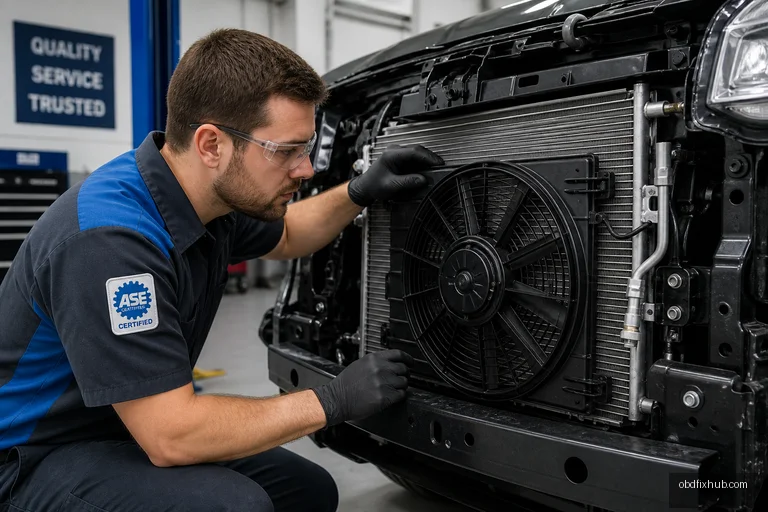
B3A0F A/C condenser efficiency below threshold means the vehicle’s HVAC or body control system has detected that the air-conditioning condenser is not rejecting heat as effectively as expected. The fault does not automatically mean the condenser must be replaced. Restricted airflow, a weak cooling fan, incorrect refrigerant charge, inaccurate pressure or temperature data, and control-system problems can all trigger the same code.
This is usually a manufacturer-specific diagnostic trouble code, so the exact definition and test procedure can vary by vehicle. Before buying parts, confirm the code with a scan tool that can access the HVAC module and check the vehicle’s service information for the correct B3A0F description.
What Does B3A0F A/C Condenser Efficiency Below Threshold Mean?
The A/C condenser sits at the front of the vehicle, normally ahead of the radiator. It receives hot, high-pressure refrigerant vapor from the compressor and releases that heat into outside air, converting the refrigerant into a high-pressure liquid.
When the control module sees inadequate temperature reduction, abnormal pressure behavior, or an implausible relationship between refrigerant pressure and condenser temperature, it may record B3A0F. In practical terms, the system is saying that the condenser is not performing within its expected operating range.
Some vehicles calculate condenser performance from pressure sensors and temperature sensors rather than directly measuring efficiency. That distinction matters: a faulty sensor or cooling fan can create a condenser-efficiency code even when the condenser core itself is serviceable.
Common Causes of B3A0F
- Blocked condenser airflow: Leaves, plastic bags, insects, bent fins, or dirt between the condenser and radiator can prevent heat from escaping.
- Cooling fan failure: A failed fan motor, blown fuse, bad relay, damaged wiring, or fan control module can cause high A/C pressures, especially at idle.
- Incorrect refrigerant charge: Both overcharging and undercharging can produce abnormal pressure readings. Adding refrigerant without measuring the system can make the fault worse.
- Condenser restriction: Internal contamination, corrosion, or debris from a failed compressor may restrict refrigerant flow.
- Faulty pressure or temperature sensor: A sensor reporting pressure or temperature incorrectly can make the control module calculate poor condenser performance.
- Air or moisture in the refrigerant circuit: Poor evacuation after a repair can create unstable pressures and inefficient heat transfer.
- Airflow-control problems: Active grille shutters, duct seals, or cooling-air flaps may be stuck or incorrectly commanded.
- Compressor or expansion-device faults: Incorrect compressor displacement, a sticking expansion valve, or a restriction elsewhere in the circuit can mimic a condenser problem.
- Electrical or module issues: Low system voltage, corroded connectors, software faults, or communication problems may interfere with fan and A/C control.
Symptoms You May Notice
B3A0F may appear with obvious A/C complaints, but not always. The module can store the code during a single high-load event while the cabin still feels reasonably cool during mild weather.
- Weak or warm air from the vents, particularly at idle
- A/C that becomes colder while driving and warmer in traffic
- Cooling fan running at maximum speed or not running at all
- Intermittent A/C operation or compressor shutdown
- High-side refrigerant pressure that rises unusually quickly
- Clicking, humming, or rattling from the condenser fan area
- Reduced engine performance when the A/C is switched on
- Additional HVAC, fan-control, pressure-sensor, or refrigerant-related codes
How to Diagnose B3A0F Correctly
A professional diagnosis should begin with the complete fault-code report, not with refrigerant recovery or condenser replacement. Record freeze-frame data, ambient temperature, engine speed, A/C request status, fan command, refrigerant pressure, and any related codes.
1. Verify the code and operating conditions
Clear the code only after saving the data. Confirm whether B3A0F is current, pending, or stored, then reproduce the condition with the engine warm and the A/C operating. A code that appears only at idle points strongly toward airflow or fan control rather than a simple blocked condenser.
2. Inspect the condenser and airflow path
Use a light to inspect the front and rear faces of the condenser. A surface that looks clean from the front may be packed with dirt between the condenser and radiator. Bent fins can sometimes be straightened carefully with a fin comb, but aggressive pressure washing can fold fins further or damage nearby components.
3. Test the cooling fan under command
Use the scan tool’s active test function to command low- and high-speed fan operation. Do not rely only on whether the fan spins; a motor may run slowly, draw excessive current, or fail once it becomes hot. Check the fuse, relay or fan module, power supply, ground, and voltage drop under load.
4. Compare pressure and temperature data
With suitable A/C service equipment, compare high-side and low-side pressures with ambient temperature and vent temperature. The condenser inlet should be substantially hotter than the outlet during normal operation. A professional may also compare scan-tool pressure data with a manifold gauge reading to identify a biased pressure sensor.
Pressure readings must be interpreted carefully. A high-side pressure that climbs mainly at idle suggests insufficient airflow, while abnormal pressure on both sides may indicate incorrect charge, compressor problems, or a restriction. There is no safe universal pressure number because readings change with refrigerant type, ambient temperature, humidity, and engine speed.
5. Check the refrigerant charge properly
Recover and weigh the refrigerant rather than guessing from gauge pressure. The system should be evacuated with a suitable vacuum pump and recharged by the manufacturer-specified mass. Refrigerant handling should be performed with approved equipment; venting refrigerant is unsafe and illegal in many jurisdictions.
Repair Options
The correct repair depends on the test result. Clean the condenser and restore airflow when external blockage is the cause. Replace a failed fan motor, fuse, relay, fan control module, or damaged wiring after confirming the electrical fault rather than installing parts by guesswork.
If the condenser is internally restricted, leaking, badly corroded, or contaminated by compressor debris, replacement may be necessary. A contaminated system may also require flushing of permitted components, replacement of the receiver-drier or accumulator, and an expansion valve or orifice tube inspection.
When sensor data is implausible, test the reference voltage, ground, signal circuit, connector condition, and live-data response before replacing the sensor. If all hardware checks pass, look for software updates, technical service bulletins, HVAC module communication faults, and manufacturer-specific calibration procedures.
Can You Keep Driving With B3A0F?
Driving is often possible if the engine is not overheating and the vehicle has no severe refrigerant-pressure symptoms. However, continued operation with excessive A/C pressure can damage the compressor, trigger repeated thermal shutdowns, or place unnecessary load on the drive belt. Stop using the A/C if the cooling fan is not operating, the high-side pressure is excessive, unusual compressor noise is present, or the engine temperature begins to rise.
Practical Tips That Prevent Misdiagnosis
- Do not replace the condenser before testing fan operation and checking the pressure sensor.
- Do not judge refrigerant charge by vent temperature alone.
- Inspect the radiator and condenser as a pair because blockage between them is easy to miss.
- Compare live data with an independent measurement when a sensor reading seems doubtful.
- After repairs, clear the code, run the A/C through idle and road-speed conditions, and confirm that the fault does not return.
Summary
B3A0F A/C condenser efficiency below threshold identifies a heat-rejection or monitoring problem in the air-conditioning system. The most common real-world causes are poor condenser airflow, cooling-fan faults, incorrect refrigerant charge, and inaccurate sensor data. A disciplined diagnosis using fan commands, visual inspection, measured refrigerant quantity, pressure comparison, and live temperature data will prevent unnecessary condenser replacement.
If the code is active, have the HVAC system tested before adding refrigerant or continuing to use the A/C heavily. The fastest repair is usually the one based on measured evidence rather than the code description alone.
Frequently Asked Questions
Is B3A0F always caused by a bad A/C condenser?
No. The code describes poor detected condenser performance, not necessarily a failed condenser. Fan problems, blocked airflow, refrigerant errors, and pressure-sensor faults are common alternatives.
Why does the A/C get warmer at idle with B3A0F?
At road speed, air naturally moves through the condenser. At idle, the electric cooling fan must provide that airflow. If the fan is weak or inoperative, condenser pressure rises and the A/C may become warm.
Can low refrigerant cause condenser efficiency below threshold?
Yes. An undercharged system may not deliver the expected pressure and temperature relationship. However, low refrigerant usually indicates a leak, so the leak should be found and repaired rather than simply topping up the system.
Will clearing B3A0F fix the problem?
Clearing the code only removes the stored fault temporarily. If the underlying airflow, pressure, sensor, or refrigerant problem remains, the code will return when the system repeats the monitoring conditions.
Should I replace the condenser and compressor together?
Not automatically. Replace both only when testing confirms compressor damage or system contamination that requires it. Unnecessary parts replacement increases cost and can introduce new leaks into the refrigerant circuit.




