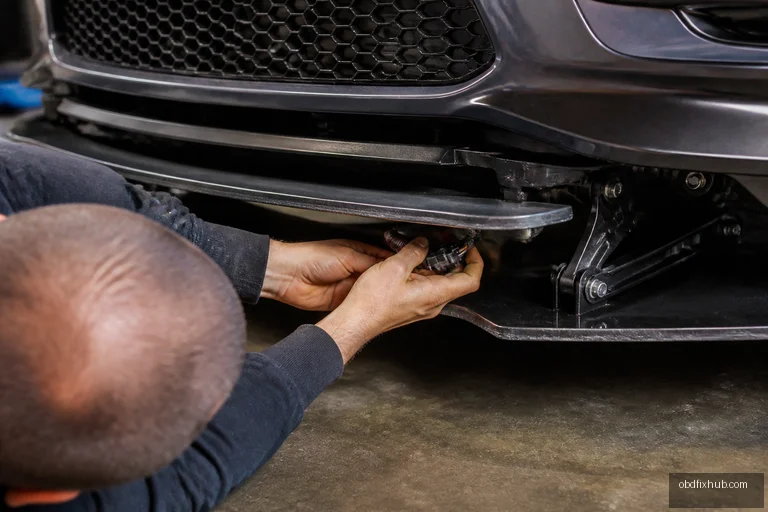
C0601 Active Air Dam Control Circuit/Open means the vehicle’s control module has detected a missing, interrupted, or implausible electrical signal from the active air dam system. The fault may be caused by a damaged actuator, broken wiring, a blown fuse, water or road-debris intrusion, a failed position sensor, or—on some vehicles—a control-module or communication problem. Because C0601 is not defined identically across every manufacturer, the exact factory service information for your make, model, year, and engine is essential before replacing parts.
What Is an Active Air Dam?
An active air dam is an electronically controlled panel or set of shutters fitted behind or beneath the front bumper. At higher speeds, it can close or change position to reduce aerodynamic drag. In other conditions, it may open to improve airflow through the radiator, intercooler, battery cooling system, or brake area.
The system normally includes an electric actuator, position feedback, wiring, connectors, a fuse or relay, and a body, engine, or powertrain control module. Some designs communicate through a dedicated control wire, while others use LIN, CAN, or a manufacturer-specific network. That is why a generic code description alone cannot identify the failed component.
C0601 Active Air Dam Control Circuit/Open: What “Open” Really Means
In diagnostic language, “open” usually means the module cannot see the expected electrical path. It does not automatically mean the air dam itself is stuck open. The fault may be an open power wire, a broken ground, a disconnected connector, a failed actuator winding, or an internal break in the feedback circuit.
On certain vehicles, C0601 may be manufacturer-specific and may not refer to the active air dam at all. Always verify the code description with a professional scan tool or the manufacturer’s database. If a basic code reader displays only “C0601,” scan every module and record the vehicle identification details before beginning repairs.
Common Symptoms
Some drivers notice only a warning lamp, while others see clear evidence that the front aerodynamic system is not completing its self-test. Typical symptoms include:
- Check Engine, Service Vehicle, or aerodynamic-system warning light
- Active air dam or grille shutters remaining open, closed, or halfway positioned
- A clicking, buzzing, or repeated actuator noise behind the front bumper
- Reduced fuel economy at highway speed
- Cooling fans running more often than expected
- Reduced engine, hybrid, or EV thermal-management performance
- A stored code that returns immediately after clearing
A fixed-open air dam is often safer than a fixed-closed one because it allows airflow, but it can still affect efficiency. A closed shutter that prevents cooling is more urgent, particularly during towing, hot weather, or extended highway driving.
Most Likely Causes of C0601
- Damaged actuator: A small electric motor or its internal position sensor can fail after water exposure, excessive load, or repeated ice operation.
- Broken or pinched wiring: The harness is vulnerable near the lower bumper, where it can contact splash shields, a curb, or a loose undertray.
- Corroded connector: Green corrosion, pushed-back terminals, and water inside the plug can interrupt power or feedback.
- Blocked air dam: Stones, mud, snow, or a damaged bumper can prevent movement and overload the actuator.
- Blown fuse or poor ground: A fuse may be the result of a shorted motor rather than the original problem.
- Communication or module fault: A network fault, software issue, or failed control module can imitate an actuator circuit failure.
- Incorrect calibration: After bumper replacement, actuator replacement, or a low-voltage event, the system may require initialization.
How to Diagnose C0601 Correctly
Do not begin by ordering an expensive air dam assembly. A careful diagnosis can often separate a wiring fault from a mechanical obstruction in less than an hour.
- Confirm the code and conditions. Record all stored, pending, and history codes, along with freeze-frame data. Low system voltage and communication codes should be addressed first.
- Inspect the air dam physically. With the ignition off, look for broken mounting tabs, impact damage, packed snow, stones, loose splash shields, and signs that the panels have been forced.
- Check the connector and harness. Follow the wiring from the actuator into the bumper area. Look for abrasion, stretched wires, water intrusion, and terminals pushed backward inside the connector.
- Test the fuse and power supply. Use a test light or multimeter on both sides of the fuse with the circuit loaded. A fuse that looks intact can still have a poor supply or an intermittent fault.
- Test ground and voltage under load. A voltage reading with the connector unplugged may look normal. Voltage-drop testing while the actuator is commanded is more revealing.
- Use bidirectional controls. A capable scan tool should be able to command the air dam open and closed. Compare the commanded position with the reported position and listen for abnormal motor operation.
- Check mechanical travel and calibration. If the actuator moves but the module does not recognize the position, inspect the feedback circuit and perform the specified relearn procedure.
A useful workshop technique is a controlled wiggle test. Monitor actuator position or circuit voltage while gently moving the harness near the bumper and connector. If the reading changes, the problem is likely an intermittent conductor or terminal—not a bad control module.
Repair Options
The correct repair depends on the failed section. Minor harness damage should be repaired with automotive-grade wire, sealed splices, and proper strain relief. Do not leave twisted wires covered only with household electrical tape; splash-zone repairs need heat-shrink protection and secure routing.
Replace the actuator when its motor, gear train, or position sensor fails and the wiring tests correctly. On some vehicles, the actuator is sold separately; on others, the complete air dam or shutter assembly is the service part. If the panel is bent or binding, replacing only the motor may cause the new unit to fail again.
After repair, clear the code and carry out the manufacturer’s initialization or calibration procedure. Then perform a road test and rescan for current and pending faults. A code that disappears after clearing but returns during the next active test usually indicates an unresolved circuit, position, or communication problem.
Can You Drive With C0601?
Short, gentle driving is often possible when the air dam is stuck open and the engine temperature remains normal. Avoid towing, prolonged high-load operation, and aggressive driving until the fault is diagnosed. Stop driving and investigate immediately if the temperature gauge rises, cooling fans behave abnormally, a red temperature warning appears, or the air dam is stuck closed.
Do not manually force electrically controlled shutters into position. The gears and position sensors can be damaged, and the module may lose its learned reference position.
Final Takeaway
C0601 is best treated as a circuit and system diagnosis, not a guaranteed “replace the active air dam” code. Start with the exact manufacturer definition, inspect the bumper-area wiring and connector, test power and ground under load, and use bidirectional controls when available. Repair the underlying electrical or mechanical fault, complete calibration, and verify the result with a final scan and road test.
Frequently Asked Questions
Is C0601 the same on every vehicle?
No. C0601 can be manufacturer-specific, and its description may vary by vehicle. Confirm the code with a scan tool that supports the car’s factory modules and consult the correct service manual.
Can a blown fuse cause C0601?
Yes, an open fuse or missing power supply can trigger the code. However, determine why the fuse failed; a shorted actuator or damaged harness may blow a replacement fuse immediately.
Will C0601 reduce fuel economy?
It can, especially if the air dam remains open during highway driving. The bigger concern is an air dam stuck closed, which may restrict cooling under heavy load.
Do I need to replace the entire active air dam assembly?
Not always. Some vehicles allow actuator, wiring, or connector repair separately. Others require the complete assembly, so parts availability and the manufacturer’s repair procedure must be checked first.
Can clearing the code fix the problem?
Clearing the code only removes the stored warning temporarily. If the electrical fault, obstruction, or failed position feedback remains, C0601 will return during the next self-test.




