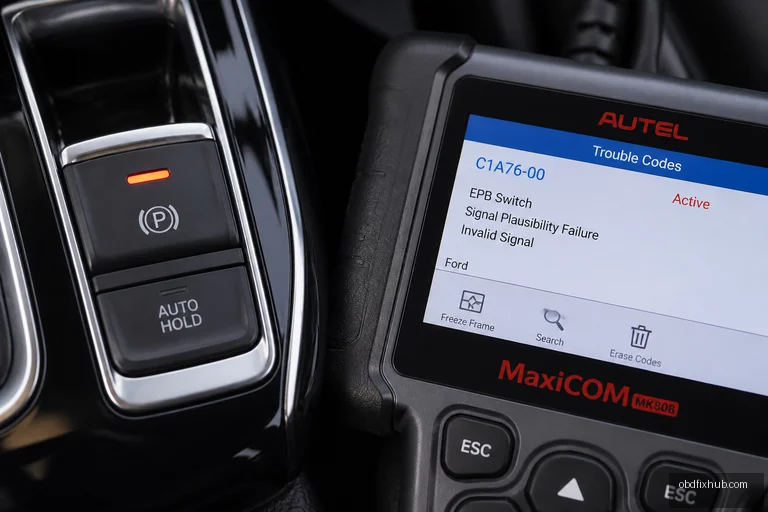
C060A Park Brake Switch Stuck means the electronic parking brake system has detected a park brake switch signal that remains active, inactive, or implausible for too long. The fault may be caused by a physically jammed switch, damaged wiring, a faulty parking brake control module, low system voltage, or a calibration issue—not necessarily by the brake caliper itself.
This is an information-focused fault code, so the best repair starts with diagnosis rather than replacing the switch immediately. Because C060A definitions can vary slightly between manufacturers, always confirm the exact description and test procedure for your vehicle using its factory service information.
What Does C060A Park Brake Switch Stuck Mean?
On vehicles equipped with an electronic parking brake (EPB), the driver’s switch sends a request to the parking brake control module. The module then commands the rear actuators or integrated brake calipers to apply or release the brake. C060A is set when the module sees a switch input that does not behave as expected.
For example, the module may detect that the apply side of the switch is continuously pressed even after the driver releases it. In other cases, the switch signal may stay open, change too slowly, or disagree with the position reported by another circuit. The exact logic depends on the vehicle’s electrical architecture.
Common Causes of C060A
- Stuck or contaminated parking brake switch: Dirt, spilled drinks, trim damage, or a broken internal spring can hold the switch in one position.
- Damaged wiring or terminals: A loose connector, corroded pin, pinched wire, or poor ground can make a normal switch appear stuck.
- Low battery voltage: A weak battery or voltage drop during starting can cause the EPB module to log a false or secondary fault.
- Incorrect switch installation: A replacement console switch may be misaligned, trapped by surrounding trim, or connected incompletely.
- EPB module software or calibration problems: Some models require a relearn, initialization, or software update after battery, brake, or module work.
- Brake system or actuator faults: A motor, caliper actuator, position sensor, or mechanical parking brake component can produce related codes alongside C060A.
A useful diagnostic clue is whether the code returns immediately after clearing. An instant return with the ignition on usually points toward a live switch circuit, wiring, or module input problem. A code that returns only when the vehicle is driven or the parking brake is operated may require actuator feedback or calibration testing.
Symptoms You May Notice
The symptoms depend on whether the system is stuck in the applied or released state. Some vehicles display a red parking brake warning lamp, an amber EPB warning, or a message such as “Service Park Brake.” Others may store C060A without an obvious dashboard warning until the system is commanded.
- The electronic parking brake will not apply or release.
- The parking brake applies by itself or remains partially applied.
- The switch indicator flashes instead of staying illuminated normally.
- A warning chime or “Park Brake Fault” message appears.
- The vehicle rolls slightly after the brake is commanded, creating a serious safety risk.
- Rear brakes become hot, smell overheated, or wear unevenly if an actuator remains engaged.
Do not continue driving if the rear wheels are dragging, the vehicle will not hold securely on an incline, or one brake rotor is substantially hotter than the other. C060A can be an electrical code, but a stuck command can create real mechanical brake damage.
How to Diagnose C060A Properly
1. Check battery voltage and related codes
Begin with the battery, charging system, and grounds. EPB motors draw significant current, and a weak battery can create several communication or actuator codes at once. Scan every module, not just the engine computer, and record codes before clearing them.
2. Inspect the parking brake switch
Look for a switch that feels loose, remains depressed, fails to spring back, or has liquid contamination around it. With the vehicle safely parked, operate the switch while watching the EPB or body-control module’s live data. The switch status should change cleanly and return to its resting value as soon as the lever or button is released.
This live-data check is more reliable than simply listening for a click. A switch can click mechanically while its internal contacts remain electrically closed. If the scan tool shows “Apply,” “Release,” or “Pressed” continuously, unplugging the switch according to the service procedure can help separate a switch fault from a harness fault.
3. Inspect connectors and wiring
Check the switch connector, wiring under the center console, and the EPB module connector for moisture, bent terminals, corrosion, or tension on the harness. Pay special attention to areas disturbed during stereo installation, console removal, battery replacement, or interior trim repairs.
Do not bridge terminals with a test light or randomly apply battery power to an EPB circuit. Many systems use low-current reference signals or multiplexed inputs, and an incorrect jumper can damage the body or parking brake module. Use a wiring diagram and a digital multimeter according to the manufacturer’s test values.
4. Test the circuit, not just the component
With the battery disconnected when required by the service manual, test for continuity, short-to-ground, short-to-power, and excessive resistance. A wire may pass a basic continuity test yet fail under movement or load because of internal corrosion. A wiggle test around the console and connector should be performed carefully while monitoring live data.
5. Check EPB operation and calibration
If the switch signal is correct but C060A returns, use a capable scan tool to command the parking brake and read actuator position. Some systems need an EPB initialization after rear brake service, actuator replacement, battery disconnection, or control-module programming. Follow the exact sequence: many vehicles require the brake pedal to be pressed, the transmission in Park, and a stable battery maintainer connected.
Repair Options for C060A
The correct repair depends on the failed test. A contaminated switch may need cleaning only if the manufacturer permits it; otherwise, replacing the switch assembly is usually more dependable. If the switch is good, repair damaged wires with the correct automotive terminals and sealing methods rather than twisting wires together or using household connectors.
Corroded connectors may require terminal replacement, not just contact spray. If the EPB module or actuator is suspected, confirm power, ground, communication, and switch input first. Replacing an expensive control module before proving those circuits are correct is a common and avoidable diagnostic mistake.
After the repair, clear the code, cycle the parking brake several times, and rescan all modules. Confirm that the brake applies and releases fully, the warning lamps remain off, and both rear wheels rotate freely when the brake is released. On some vehicles, a road test and an EPB relearn are mandatory before the repair is complete.
Can You Drive With C060A?
Only drive a short distance for diagnosis if the parking brake is fully released, the warning does not indicate a hydraulic brake problem, and the vehicle holds safely. Stop immediately if you smell hot brakes, feel resistance, hear grinding, or see smoke from a rear wheel. Never rely on an electronic parking brake that has failed to hold the vehicle on a slope; use wheel chocks and arrange professional repair.
Key Takeaway
C060A does not automatically mean the parking brake actuator or caliper must be replaced. Start with battery voltage, scan-tool live data, switch movement, and connector inspection. Once the switch signal is proven correct, move methodically through wiring, module communication, actuator operation, and calibration. That approach is faster, safer, and far less expensive than guessing at parts.
Frequently Asked Questions
Can a weak battery cause C060A?
Yes. Low voltage during starting or EPB operation can create false switch, actuator, and communication faults. Test the battery and charging system before replacing the parking brake switch, especially if several unrelated warning lights appeared together.
Does C060A always mean the park brake switch is bad?
No. The switch is one possibility, but wiring faults, connector corrosion, low voltage, calibration errors, and EPB module problems can produce the same code. Live data and circuit testing are needed to identify the actual cause.
Can I clear C060A with a basic OBD2 scanner?
Usually not reliably. Many basic scanners read engine emissions codes only and cannot access the EPB or body-control module. Use a scan tool with manufacturer-level parking brake functions and confirm the code after a repair.
Is it safe to keep driving when the parking brake warning is on?
It depends on the symptoms, but caution is essential. Do not drive if the brake is dragging, will not release, or fails to hold the vehicle. Have the system inspected promptly, because an electrical fault can leave the parking brake unavailable or partially applied.




