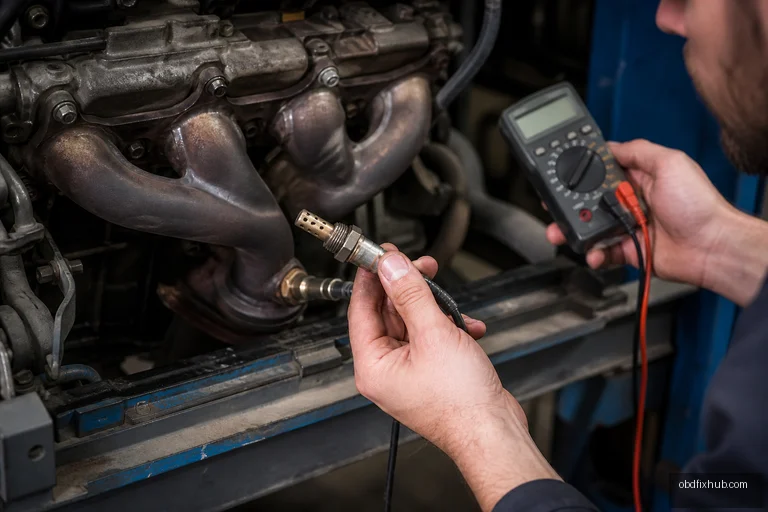
Search intent: Informational. Drivers searching for P0134 usually want to know whether the code points to a failed oxygen sensor, whether the vehicle is safe to drive, and how to diagnose it without replacing parts unnecessarily.
P0134 O2 Sensor Circuit No Activity Detected Bank 1 Sensor 1: Meaning, Causes, Symptoms & Fix
P0134 means the engine computer is not detecting a changing signal from Bank 1 Sensor 1, the upstream oxygen sensor. The sensor may be defective, but an open wire, poor ground, blown heater circuit, exhaust leak, fuel-control problem, or connector issue can create exactly the same code. Testing the circuit and live data before buying a sensor is the reliable way to find the real fault.
What Does P0134 Mean?
P0134 is a generic OBD-II diagnostic trouble code defined as O2 Sensor Circuit No Activity Detected (Bank 1, Sensor 1). “Bank 1” is the side of the engine containing cylinder number one. “Sensor 1” means the sensor located before the catalytic converter, commonly called the upstream or air-fuel-ratio sensor.
The engine control module expects this sensor to respond as the mixture changes from rich to lean. On a conventional narrowband oxygen sensor, a warmed-up signal commonly moves between approximately 0.1 and 0.9 volts. P0134 is set when that signal remains static, stays near a fixed value, or never becomes usable within the monitor’s expected time.
Not every vehicle uses a traditional narrowband sensor. Some engines use a wideband air-fuel-ratio sensor with different voltage and current behavior, so its signal should not be judged by the usual 0.1-to-0.9-volt rule. Always use the wiring diagram and service data for the specific vehicle.
P0134 O2 Sensor Circuit No Activity Detected: Common Causes
- Failed upstream oxygen or air-fuel-ratio sensor
- Open, shorted, melted, or chafed sensor wiring
- Loose, corroded, contaminated, or pushed-back connector terminals
- Blown fuse or failed power supply to the sensor heater
- Engine exhaust leak near the exhaust manifold or sensor
- Vacuum leak, intake leak, or severe unmetered air entering the engine
- Fuel injector, fuel-pressure, ignition, or mass-airflow problems
- Incorrect sensor installation or a contaminated replacement sensor
- Rarely, a power, ground, or driver fault inside the engine computer
A particularly common real-world mistake is condemning the sensor after seeing a flat scan-tool graph. If the sensor heater never brings the component to operating temperature, the sensor may appear inactive even though its sensing element is not the original problem.
Symptoms of P0134
Some vehicles show only a check engine light because the computer can temporarily substitute a calculated fuel strategy. Others develop noticeable drivability problems, especially after the engine reaches operating temperature.
- Check engine light or malfunction indicator lamp
- Rough idle or hesitation during acceleration
- Hard starting, particularly when warm
- Increased fuel consumption
- Fuel odor from an overly rich mixture
- Higher emissions or failure of an emissions inspection
- Reduced performance or occasional stalling
When P0134 appears with codes such as P0171, P0172, misfire codes, or mass-airflow codes, the oxygen sensor may be reporting the result of another engine problem. Diagnose the related codes together rather than replacing the sensor automatically.
Is It Safe to Drive With P0134?
Short trips are often possible if the engine runs smoothly, the check engine light is steady, and there is no strong fuel smell. However, driving for weeks with incorrect fuel control can increase fuel consumption and overheat or damage the catalytic converter, particularly if the engine is running rich.
Stop driving and investigate promptly if the check engine light is flashing, the engine is misfiring, power is severely reduced, or raw fuel is noticeable. A flashing light generally indicates an active misfire that can damage the catalytic converter.
How to Diagnose P0134 Correctly
1. Confirm the code and operating conditions
Use a scan tool to record all stored, pending, and manufacturer-specific codes, along with freeze-frame data. Note coolant temperature, engine speed, load, fuel trims, and vehicle speed when P0134 was set. A code triggered during cold start points toward heater or warm-up issues, while one appearing after a long drive may point toward wiring, exhaust leakage, or fuel-control faults.
2. Check live sensor data
Warm the engine fully and monitor Bank 1 Sensor 1. A conventional upstream sensor should show a changing signal once the system enters closed loop. A signal that remains fixed near one value, does not respond to a controlled mixture change, or never becomes active confirms the complaint—but it does not yet identify the cause.
Compare the upstream sensor with fuel-trim behavior and, where appropriate, the downstream sensor. The downstream sensor is not a direct substitute for the upstream signal, but an unusual pattern can reveal a broader mixture or exhaust issue.
3. Inspect the sensor and wiring
Follow the harness from the sensor to its connector. Look for wiring melted against the exhaust, insulation rubbed through on a bracket, oil or coolant contamination, and terminals that have spread or backed out. Many intermittent P0134 repairs are solved at this stage, especially on vehicles where the harness passes close to the manifold.
4. Test the heater circuit
With the ignition off, inspect the relevant fuse and measure heater resistance only according to the manufacturer’s specification. With the ignition on, verify that the heater receives the required power and ground. Do not assume a heater wire has battery voltage without checking the wiring diagram; some systems switch the ground through the engine computer.
5. Check for exhaust and intake leaks
An exhaust leak before the upstream sensor can draw outside oxygen into the exhaust stream and distort the reading. Inspect manifold gaskets, flex-pipe joints, and cracks near the sensor bung. On the intake side, check vacuum hoses, PCV connections, and the mass-airflow housing for leaks that can create a lean condition.
6. Test the sensor only after the basics pass
If power, ground, wiring integrity, heater operation, and engine condition are correct, the sensor becomes the leading suspect. Use the manufacturer’s pinout and test procedure; do not apply battery voltage to a signal circuit. When replacement is necessary, use the correct sensor for that engine and connector rather than a universal sensor with poorly joined wiring.
How to Fix P0134
- Repair damaged wiring and secure it away from hot exhaust components.
- Clean or replace a corroded connector and repair loose terminals.
- Replace a blown fuse only after finding the short or failed component that caused it.
- Repair exhaust manifold, flex-pipe, or sensor-thread leaks.
- Fix vacuum leaks, ignition faults, fuel-pressure problems, or injector issues.
- Replace the upstream Bank 1 Sensor 1 if testing proves it is inactive or its heater has failed.
- Clear the code, complete the required drive cycle, and confirm that the monitor runs without returning.
Do not use silicone sealant, leaded fuel, oil additives, or other contaminants near the sensor. These substances can poison the sensing element and cause a replacement part to fail prematurely.
Typical Repair Cost
Costs vary widely by vehicle. A wiring or connector repair may be inexpensive, while an upstream sensor can range from roughly $100 to $350 installed. Difficult access, seized threads, oxygen-sensor wiring damage, and genuine wideband sensors can raise the total substantially. Ask the repair shop whether the quoted price includes diagnosis, the correct sensor type, and post-repair verification.
Final Takeaway
P0134 does not automatically mean “replace the O2 sensor.” It means the computer cannot see useful activity from the upstream Bank 1 Sensor 1 circuit. Start with scan data, heater power, wiring, connectors, and exhaust leaks; then test the sensor using vehicle-specific specifications. That sequence prevents unnecessary parts replacement and protects the catalytic converter from prolonged incorrect fueling.
Frequently Asked Questions
Can a bad oxygen sensor cause P0134?
Yes. A failed sensing element or heater is a common cause, but wiring, connector, fuse, exhaust, intake, and fuel-system problems can produce the same code.
Where is Bank 1 Sensor 1 located?
It is the upstream sensor before the catalytic converter on the engine bank containing cylinder number one. On an inline engine, there is normally only one bank.
Can I replace Bank 1 Sensor 1 myself?
Often yes, if access is reasonable and you have the correct sensor socket and wiring information. Allow the exhaust to cool, avoid twisting the harness, and do not force a seized sensor without considering thread damage.
Will clearing P0134 fix the problem?
Clearing the code only erases the warning temporarily. If the underlying fault remains, the oxygen-sensor monitor will fail again after the vehicle completes its drive cycle.
Should I replace the upstream and downstream sensors together?
Not usually. P0134 concerns the upstream sensor circuit. Replace the downstream sensor only when its own test results or trouble codes show that it has failed.




