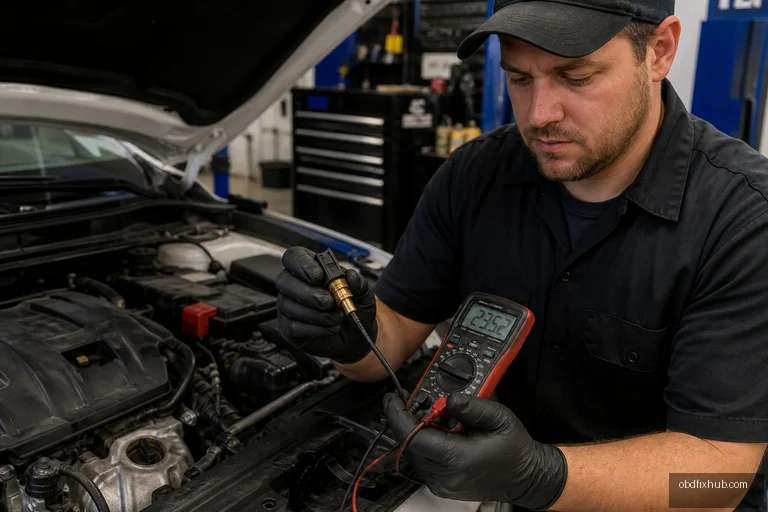
P017A means the engine computer has detected a problem in the Cylinder Head Temperature Sensor A circuit. The fault may be caused by the sensor itself, damaged wiring, a poor connector, or—less commonly—a powertrain control module issue. Because this sensor helps the ECU manage fuel delivery, ignition timing, cooling strategy, and engine protection, the code should be diagnosed rather than simply cleared.
This guide explains the meaning of the P017A cylinder head temperature sensor code, the symptoms you may notice, how to test it properly, typical repair costs, and how it differs from the frequently confused P0117 coolant temperature code.
What Does P017A Mean?
P017A is an OBD-II powertrain code associated with the Cylinder Head Temperature Sensor A Circuit. The exact wording and testing strategy can vary by manufacturer, but the core issue is the same: the engine control module is receiving an implausible, missing, or electrically incorrect signal from the cylinder head temperature sensor.
A cylinder head temperature sensor usually contains a thermistor. Its electrical resistance changes as the cylinder head heats up, allowing the ECU to estimate engine temperature. Unlike a conventional coolant temperature sensor, a CHT sensor can continue providing useful information even when coolant level is low or coolant circulation is abnormal.
P017A vs. P0117: Do Not Confuse These Codes
P017A relates to the cylinder head temperature sensor circuit. P0117 generally means “Engine Coolant Temperature Sensor 1 Circuit Low.” P0117 is usually triggered when the ECU sees a voltage that is lower than expected from the coolant temperature sensor, often because of a short to ground or a failed sensor.
The two sensors can produce similar symptoms, including hard starting, poor fuel economy, and an illuminated Check Engine Light. Always identify the exact code and locate the correct sensor before ordering parts. Replacing the coolant temperature sensor will not fix a P017A if the real problem is the cylinder head sensor or its wiring.
Common Symptoms of a P017A Code
Some vehicles set P017A with no obvious drivability problem. In other cases, the ECU enters a protective strategy and changes the way the engine runs. Typical symptoms include:
- Check Engine Light or service engine warning
- Hard starting, especially when the engine is hot
- Rough idle, hesitation, or reduced acceleration
- Rich or lean fuel mixture symptoms
- Cooling fan running continuously or switching on unexpectedly
- Reduced fuel economy
- Engine temperature data that suddenly jumps or does not change
- Fail-safe operation, reduced power, or difficulty passing an emissions test
How Do I Know If My Cylinder Head Temperature Sensor Is Bad?
A bad sensor is only one possibility. The most reliable diagnosis starts with scan-tool data, not with parts replacement. With the engine completely cold, compare the CHT reading with the intake-air temperature and outside temperature. They should be reasonably close; a reading such as -40°F, 300°F, or a value that never changes strongly suggests an open circuit, short circuit, or failed sensor.
After starting the engine, the CHT value should rise gradually. A reading that remains frozen, suddenly spikes, or drops when the wiring is moved points toward a circuit fault. A technician can also disconnect the sensor and check its resistance against the manufacturer’s temperature chart. Because thermistor resistance values differ between vehicles, universal resistance figures should not be used as a substitute for the factory specification.
Practical diagnostic checks
- Scan all stored and pending codes, including manufacturer-specific codes.
- Inspect the sensor connector for oil, coolant intrusion, corrosion, loose terminals, or broken locking tabs.
- Follow the harness around the cylinder head and exhaust area, looking for melted insulation or rubbing damage.
- Use a wiring diagram to verify reference voltage, ground, signal continuity, and short-to-ground conditions.
- Perform a gentle wiggle test while watching live data; a changing temperature reading can reveal an intermittent connection.
- Compare sensor resistance or voltage with the factory service information at two or more temperatures.
One useful workshop clue is heat soak. A vehicle may start normally when cold but develop a fault after shutdown because the cylinder head remains hot while the connector and wiring expand. If the code returns only after a hot restart, inspect the harness close to the head and exhaust manifold before condemning the sensor.
What Causes P017A?
- Failed cylinder head temperature sensor
- Broken, chafed, melted, or corroded wiring
- Loose, contaminated, or pushed-back connector terminals
- Poor sensor ground or damaged reference circuit
- Incorrectly installed aftermarket sensor
- Engine overheating or severe thermal stress
- Rarely, a fault inside the engine control module
Do not overlook recent repair work. A sensor harness can be trapped under an air-intake component, pulled tight during thermostat or cylinder-head work, or left close enough to the exhaust to melt. These installation-related faults are often cheaper to repair than replacing the sensor, but they are easy to miss during a quick visual inspection.
How to Fix P017A
The correct repair depends on the test result. Replace the cylinder head temperature sensor if its resistance or live-data response is outside specification. Repair or replace damaged wiring, clean lightly corroded terminals when appropriate, and replace terminals that no longer grip the sensor pins securely.
After the repair, clear the code and complete a drive cycle that includes a cold start, normal warm-up, steady cruising, and a hot restart. Then rescan for pending codes. If P017A returns immediately after a verified sensor and harness repair, the reference voltage, ground, and PCM circuit require further testing. A PCM should be considered only after all external causes have been proven good.
Can I Drive With a P017A or P0117 Code?
Short, gentle driving may be possible if the engine runs normally, the temperature gauge is stable, and no overheating warning is present. However, continued driving is not risk-free because incorrect temperature data can cause an overly rich mixture, poor lubrication during cold operation, cooling-fan problems, or reduced engine protection.
Stop driving and switch the engine off if you see steam, smell coolant, hear detonation, notice severe loss of power, or observe an overheating warning. A P0117 code deserves the same caution: the ECU may not know the true coolant temperature, and a dashboard gauge cannot always be trusted when the sensor circuit has failed.
How Much Does It Cost to Fix a P0117 Code?
In the United States, a straightforward P0117 repair commonly costs approximately $100 to $300, including diagnosis and a coolant temperature sensor. If the problem is a damaged connector or accessible wiring, expect roughly $150 to $450. Extensive harness damage, difficult access, or dealer-level diagnosis can push the bill beyond $500.
These are broad estimates, not a guaranteed quote. Labor rates, vehicle design, regional pricing, coolant replacement, and the difference between an independent shop and a dealership all affect the final total. A diagnostic fee may be charged separately even when the shop performs the repair.
How Much Does It Cost to Replace a Cylinder Head Temperature Sensor?
A cylinder head temperature sensor replacement often costs about $150 to $450 on vehicles with good access. The part may cost $40 to $180, while labor typically accounts for the remainder. Some models place the sensor under the intake manifold or in a difficult section of the cylinder head; those applications can reach $500 to $900 or more.
Ask whether the estimate includes diagnostic testing, a new connector pigtail, coolant top-up, code clearing, and a post-repair scan. A low parts price is not a bargain if the shop has not tested the wiring or uses a sensor with the wrong temperature curve.
Final Takeaway
P017A does not automatically mean the cylinder head temperature sensor itself is defective. Start with cold live-data comparison, inspect the connector and heat-damaged wiring, and verify the sensor against factory specifications. If your vehicle also shows P0117, diagnose the coolant temperature sensor circuit separately rather than replacing both sensors on speculation.
If the engine is overheating, running badly, or displaying an implausible temperature, arrange a professional diagnosis promptly. Correctly identifying the circuit fault can prevent unnecessary parts, protect the engine, and usually reduce the total repair bill.
Frequently Asked Questions
Is P017A the same as a bad cylinder head temperature sensor?
No. P017A identifies a problem in the sensor circuit. The sensor may be defective, but damaged wiring, a loose connector, poor ground, or a reference-voltage problem can produce the same code.
Can a low coolant level cause P017A?
It can contribute to abnormal cylinder-head temperature readings, although the code primarily concerns the electrical circuit. Check coolant level and inspect for leaks, but do not assume adding coolant alone will repair the fault.
How long can I drive with P0117?
Only drive far enough to reach a safe repair location if the engine runs normally and there are no overheating signs. Avoid towing, high speeds, and heavy loads until the coolant temperature sensor circuit is repaired.
Should I replace the sensor or the connector?
Test first. Replace the sensor when its resistance or signal is outside specification; replace the connector or repair the harness when terminals are loose, corroded, broken, or heat-damaged.




