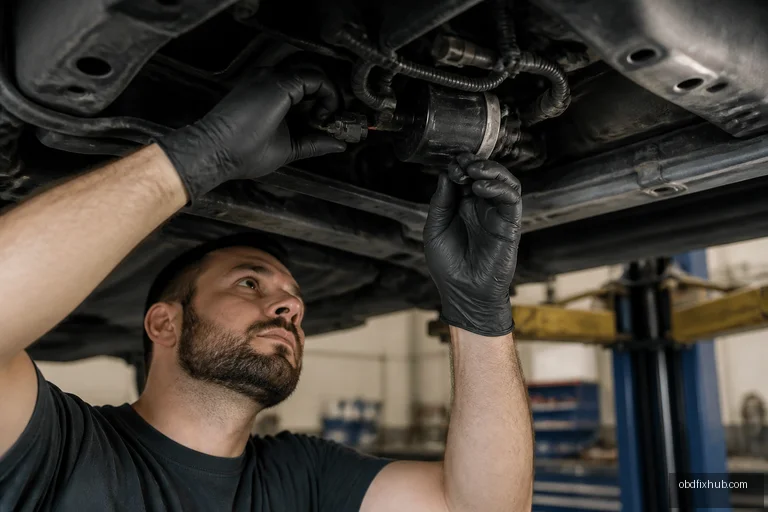
P017F EVAP System Leak Detection Pump Air Filter Restricted means the vehicle’s EVAP leak detection system cannot move or measure air correctly through its pump filter. The most common causes are a clogged or water-contaminated filter, a restricted vent hose, a failing leak detection pump, or an electrical problem. You can usually drive a short distance if the engine runs normally, but the fault should be diagnosed promptly because the check-engine light may hide a more serious emissions or fuel-vapor problem.
What Does P017F Mean?
The EVAP system stores fuel vapors from the tank and sends them into the engine to be burned instead of releasing them into the atmosphere. A leak detection pump, sometimes called an LDP, creates a small pressure or vacuum in the system so the engine computer can check whether the hoses, tank, cap, valves, and canister are sealed.
With P017F, the computer detects that the pump’s air filter or fresh-air passage is restricted. This does not automatically prove that the fuel system has a leak. In many cases, the pump is trying to perform its self-test but cannot draw clean reference air at the expected rate.
Important: OBD-II code definitions can vary by manufacturer. Before replacing any component, verify the exact description in a factory service manual or a high-quality scan tool for your specific year, make, model, and engine.
Common Causes of P017F
- Clogged EVAP pump air filter: Dust, road debris, mud, insect nests, and corrosion can block the filter element.
- Water intrusion: A filter mounted near a wheel well or underbody can become saturated after flooding, deep puddles, or pressure washing.
- Blocked vent line: A crushed hose, damaged vapor line, or contaminated charcoal canister may restrict airflow just like a dirty filter.
- Failed leak detection pump: The pump motor may be weak, seized, noisy, or unable to create the required pressure.
- Electrical or wiring fault: Corroded connectors, broken wires, a poor ground, or a blown fuse can prevent accurate pump operation.
- Incorrect previous repair: A disconnected hose, incorrectly installed filter, or aftermarket fuel-system component can create the same fault.
Symptoms of a Bad EVAP Leak Detection Pump
A restricted EVAP air filter often causes few noticeable drivability problems because the system is designed mainly for emissions control. The check-engine light is usually the first warning. Some drivers notice a faint clicking or buzzing from the rear of the vehicle after the ignition is switched off, although a normal pump may also make operating noises during a self-test.
Possible symptoms include:
- Illuminated check-engine light
- Failed emissions or inspection test
- Additional EVAP codes such as P0440, P0455, P0456, or vent-control faults
- Fuel odor near the tank or rear of the vehicle
- Longer-than-normal refueling because the pump nozzle keeps clicking off
- Intermittent warning lights after rain, washing, or driving through standing water
Hard starting, stalling, or poor acceleration is not typical of P017F alone. If those symptoms occur, check for separate fuel, ignition, intake, or purge-valve problems rather than assuming the leak detection pump is the only cause.
How to Diagnose P017F Correctly
Replacing the pump immediately is a common and expensive mistake. The restriction may be in a small filter or hose that costs far less than the complete pump module. A reliable diagnosis should follow the airflow path and confirm the pump’s electrical operation.
- Record all stored and pending codes. Freeze-frame data can show whether the fault appeared during cold weather, low fuel level, or a specific drive cycle. Related EVAP codes are valuable clues.
- Inspect the pump and filter location. Look for mud, sand, water marks, cracked housing, rodent damage, and disconnected hoses. Do not assume the filter is located beside the fuel tank; some designs place it near the rear wheel or charcoal canister.
- Check the connector and power supply. Use the wiring diagram to test power, ground, and control signals. A visual inspection alone will not find a high-resistance connection inside a corroded terminal.
- Test the pump with a scan tool. Many professional scanners can command the leak detection pump on and monitor pressure, vacuum, or switch feedback. A pump that receives power but does not respond is more likely defective.
- Check the air path before smoke testing. Remove or inspect the air filter and verify that the vent hose and canister passage are open. A smoke machine will not solve an airflow restriction and may lead to a misleading diagnosis.
- Perform a smoke test if needed. If the pump and filter work but other EVAP codes remain, smoke testing can locate cracked hoses, a loose fuel cap, a leaking canister, or a damaged tank seal.
Do not blow high-pressure shop air directly into an EVAP pump or charcoal canister. Excessive pressure can damage the pump diaphragm, dislodge charcoal pellets, or push debris deeper into the system. If the filter is a separate service part, replace it with the correct part rather than trying to wash a paper or molded filter clean.
P017F Repair Options
The correct repair depends on what the inspection finds. A dirty external filter may be replaced without removing the fuel tank. A blocked hose can sometimes be cleaned or replaced, while a contaminated charcoal canister may require replacement if loose charcoal has entered the vent circuit.
If the pump fails its commanded test or its pressure signal is outside the manufacturer’s specification, replace the leak detection pump or the complete EVAP pump module, depending on the vehicle design. After installation, inspect the hose routing carefully. A hose that is pinched during reassembly can cause the same P017F code to return.
How Much Does It Cost to Replace an EVAP Leak Detection Pump?
Replacement cost varies considerably by vehicle and by whether the pump is sold separately. A basic filter or hose repair may cost approximately $50 to $200. A leak detection pump commonly costs about $200 to $600 installed, while some vehicles require a complete EVAP or fuel-tank-related module that can push the repair beyond $700.
Labor is often between one and three hours, but access can be difficult on vehicles where the tank or rear suspension must be lowered. Ask the repair shop whether the quoted price includes diagnosis, a smoke test, the filter, and a post-repair EVAP monitor check. Replacing parts without confirming the restriction is the fastest way to increase the bill.
Can You Drive With a Faulty Leak Detection Pump?
In most cases, short-term driving is possible if the car starts, runs, and refuels normally, and there is no strong fuel smell. P017F generally does not cause immediate engine damage because it concerns vapor-system monitoring rather than the primary fuel or ignition system.
However, avoid unnecessary driving if you smell raw fuel, see liquid fuel, have trouble filling the tank, notice rough running, or the check-engine light is flashing. Fuel vapors are flammable, and a flashing light indicates a potentially damaging engine misfire that is unrelated to a simple EVAP restriction.
How Long Does an EVAP Code Take to Go Away?
After the repair, the code can be cleared with a scan tool, but the EVAP readiness monitor may need several drive cycles before it runs. Depending on the vehicle, fuel level, ambient temperature, and driving pattern, this may take one or more days and roughly 30 to 100 miles.
If the code is erased but returns immediately, the computer has detected the fault again. If it does not return but the EVAP monitor remains incomplete, continue normal mixed driving rather than repeatedly clearing the codes. Many EVAP monitors will not run when the tank is nearly full or nearly empty, so keeping the fuel level around one-quarter to three-quarters full can help the test complete.
Practical Tips That Prevent Misdiagnosis
- Do not treat P017F as proof that the fuel tank itself is leaking.
- Check for recent fuel-system work, especially a replaced fuel pump, tank, or charcoal canister.
- Inspect for water intrusion if the code appeared after heavy rain or an underbody wash.
- Use the manufacturer’s specified test values; generic assumptions about pump resistance can be wrong.
- Repair related codes together, because one blocked vent path can trigger several EVAP faults.
Summary: The Right Next Step
P017F points to restricted airflow through the EVAP leak detection pump’s air filter or reference-air circuit. Start with a code scan, visual inspection, filter and hose check, and electrical test before authorizing a complete pump replacement. Most vehicles can be driven briefly when there is no fuel odor or drivability problem, but prompt diagnosis protects emissions-system components and prevents a small restriction from becoming an expensive repair.
Frequently Asked Questions
What are the symptoms of a bad EVAP leak detection pump?
The most common symptom is a check-engine light, often with an EVAP-related trouble code. Failed emissions testing, fuel odor, refueling problems, or pump clicking and buzzing may also occur, but severe engine-performance problems are not typical of the pump alone.
Can I drive with a faulty leak detection pump?
Usually, yes, for a limited time if the vehicle runs normally and there is no fuel smell or visible leak. Repair it soon, and stop driving if raw fuel is present, refueling becomes difficult, or the check-engine light flashes.
How much does an EVAP leak detection pump replacement cost?
A typical installed replacement is about $200 to $600, although a separate filter or hose may cost only $50 to $200. Vehicles requiring a larger EVAP module can cost more than $700.
How long does it take for an EVAP code to go away?
After a successful repair, clearing the code is immediate with a scan tool, but the EVAP readiness monitor may require several drive cycles and approximately 30 to 100 miles. A returning code means the fault still exists or another EVAP problem is present.




