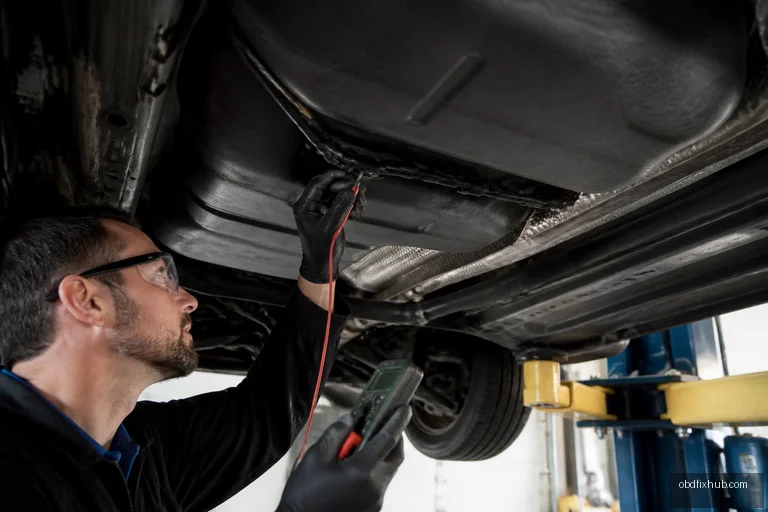
P01AA means the engine control module has detected a problem in the alternative fuel tank temperature sensor circuit. The fault may be caused by the sensor itself, damaged wiring, a poor ground, connector corrosion, or an implausible temperature signal. Because this sensor can influence fuel-pressure, range, emissions, and fuel-system safety strategies, the code should be diagnosed rather than cleared and ignored.
What Does the P01AA Alternative Fuel Tank Temperature Sensor Circuit Code Mean?
P01AA is a generic OBD-II diagnostic trouble code associated with the temperature sensor used in an alternative-fuel storage system. Depending on the vehicle, “alternative fuel” may refer to compressed natural gas (CNG), liquefied petroleum gas (LPG), hydrogen, or another fuel system that stores fuel in a dedicated tank.
The sensor usually reports the temperature of the fuel tank or the fuel surrounding a tank-mounted module. The powertrain control module uses that information to estimate fuel density, monitor pressure changes, control fuel delivery, and identify abnormal thermal conditions. In many vehicles, the sensor is an NTC thermistor: its resistance changes as temperature changes, and the control module converts that change into a temperature reading.
P01AA does not automatically mean that the tank is dangerously hot. It means the electrical signal does not match the expected range, changes too slowly, or is inconsistent with other readings. A vehicle that has been parked overnight but reports an extreme tank temperature is a typical example of an implausible signal.
Common Symptoms of P01AA
Some vehicles will drive normally when this code is stored, while others will enter a fuel-system protection strategy. The symptoms depend on the fuel type, software calibration, and whether the code is active or intermittent.
- Illuminated Check Engine Light or malfunction indicator lamp
- Reduced engine power or limited alternative-fuel operation
- Automatic switching to gasoline or another backup fuel
- Hard starting, extended cranking, or an engine that starts and stalls
- Irregular fuel-pressure control or poor acceleration
- Inaccurate fuel-range or tank-temperature information
- Difficulty filling the tank or a fuel-system warning message
- A code that returns immediately after being erased
An important diagnostic clue is when the vehicle runs correctly on conventional fuel but performs poorly or refuses to operate on its alternative fuel. That pattern points more strongly toward the alternative-fuel tank, its wiring, or the associated control module.
Most Likely Causes of P01AA
- Failed alternative fuel tank temperature sensor
- Open circuit or short circuit in the sensor wiring
- Corroded, loose, bent, or contaminated connector terminals
- Damaged harness near the tank, frame, heat shield, or mounting brackets
- Missing sensor ground or unstable reference voltage
- Fuel pump or tank module fault when the sensor is integrated into the module
- Water intrusion after pressure-washing, flooding, or underbody repair
- Incorrect replacement tank module or incompatible calibration
- Control module software or internal circuit failure
On vehicles with underbody-mounted tanks, harness damage is particularly common. Repeated vibration can pull on the connector, while road salt can wick into terminals and create high resistance. A sensor that works on a cool morning but fails after driving over rough roads often has an intermittent connection rather than a permanently defective thermistor.
How to Diagnose P01AA Correctly
Diagnosis should begin with the vehicle’s service information. Pin assignments, sensor resistance values, reference voltage, connector locations, and safe depressurization procedures are not universal. Never open a pressurized CNG, LPG, or hydrogen fuel system simply to test a sensor.
1. Check the complete code history
Use a scan tool to record all stored, pending, and manufacturer-specific codes before clearing anything. Codes relating to fuel pressure, tank valves, module communication, or reference-voltage faults may be the primary problem. Look at freeze-frame data, including reported tank temperature, ambient temperature, engine coolant temperature, and vehicle voltage.
2. Compare live data with reality
With the vehicle cold and parked for several hours, the tank-temperature reading should generally be reasonably close to the surrounding temperature. A reading such as -40 degrees or an extremely high value often indicates an open circuit or short circuit, although the exact default value varies by manufacturer.
Watch the live data while gently moving the harness and connector. A sudden temperature jump without a real change in tank temperature is strong evidence of a loose terminal, broken conductor, or connector problem.
3. Inspect the connector and harness
Disconnect the connector only according to the manufacturer’s safety procedure. Look for green corrosion, pushed-back terminals, moisture, damaged seals, melted insulation, and evidence that the harness has rubbed against the chassis. Do not rely on a visual inspection alone: a terminal can appear clean while failing under vibration or load.
4. Test the circuit, not only the sensor
With the wiring diagram in hand, check the sensor’s reference circuit, ground, and signal circuit. Many systems use a 5-volt reference, but some designs differ. Measure voltage with the connector connected when possible, because a disconnected circuit can produce misleading readings.
If the sensor is a thermistor, compare its resistance with the manufacturer’s temperature chart. Do not substitute a generic resistance value from another vehicle. A sensor may measure correctly at room temperature but fail when warmed or cooled, so an intermittent fault may require a controlled temperature test using approved procedures.
5. Confirm the repair
After repairing the wiring or replacing the sensor/module, clear the code and perform the manufacturer’s required drive cycle. Confirm that the temperature reading changes smoothly and remains plausible during refueling, operation, and heat soak. A successful repair is not proven merely because the Check Engine Light goes out immediately.
How Is P01AA Fixed?
The repair depends on the failed part. A damaged wire may require a sealed automotive splice and correctly supported harness routing. Corroded connectors should usually be repaired with the proper terminals or connector body rather than coated with grease and reconnected. Dielectric grease can help protect a sound connection, but it cannot restore a loose or corroded electrical terminal.
If testing confirms a defective sensor, the sensor may be replaceable separately, but many systems integrate it into the fuel pump, sender, valve, or tank module. Replacement of a tank-mounted module can require special tools, fuel recovery, leak testing, and post-repair calibration. On high-pressure systems, this is work for a technician trained in the specific fuel type.
Do not replace the control module first. A failed module is possible, but wiring faults and inaccurate sensor signals are considerably more common. Module replacement should follow power, ground, communication, and signal-circuit testing, plus any applicable technical service bulletin or software update.
Can You Drive With a P01AA Code?
If the vehicle runs normally and the warning light is steady, a short drive to a qualified repair shop may be possible. Avoid ignoring the code for weeks, especially if the vehicle switches fuels unexpectedly, shows a fuel-pressure warning, smells of fuel, or has reduced power.
Stop driving and move away from the vehicle if you notice a strong fuel odor, hissing near the tank, visible frost, a suspected leak, or unusual tank heating. Do not smoke, create sparks, or attempt to loosen fuel-system fittings. Alternative fuels can be flammable, pressurized, or stored under conditions that require specialized safety equipment.
Key Takeaway
P01AA identifies an electrical or plausibility problem with the alternative fuel tank temperature sensor circuit, not necessarily an overheated tank. Start with scan data and freeze-frame information, compare the reported temperature with actual conditions, then test the connector, wiring, sensor, and module in that order. Use vehicle-specific service information, and leave pressurized fuel-system repairs to a properly equipped technician.
Frequently Asked Questions About P01AA
Is P01AA a serious code?
It can be serious because the vehicle may disable alternative-fuel operation or mismanage fuel pressure. A steady light with normal operation is usually less urgent than a fuel odor, leak warning, severe drivability problem, or flashing warning light.
Can a bad connector cause P01AA?
Yes. Loose terminals, corrosion, moisture, and a broken wire near the tank are common causes. Intermittent live-data readings while moving the harness are a useful clue.
Will clearing P01AA fix the problem?
No. Clearing the code only removes the stored fault temporarily. If the electrical problem remains, the code will return, often during the next self-test or drive cycle.
Can I replace the tank temperature sensor myself?
Only if the sensor is externally accessible and the manufacturer permits that procedure. If it is part of a pressurized tank or fuel module, specialized fuel recovery, depressurization, leak testing, and safety procedures are required.
What should I check first for P01AA?
Record all codes and freeze-frame data, then compare the live tank-temperature reading with ambient temperature. Next inspect the tank harness and connector before condemning the sensor or control module.




