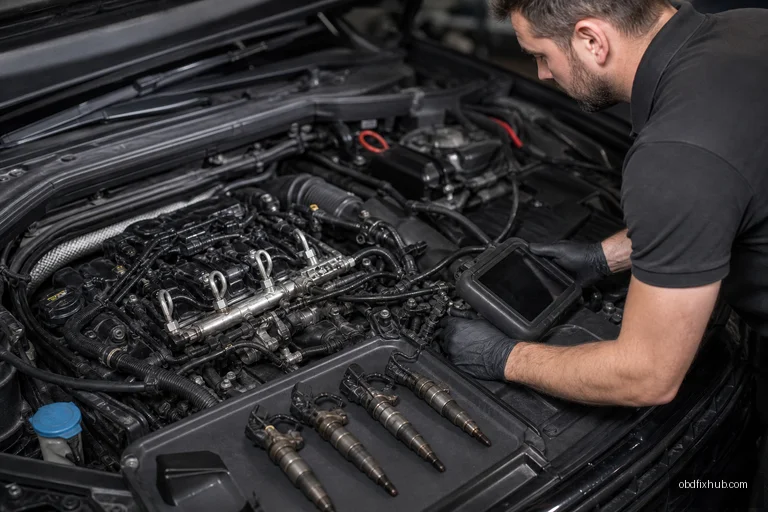
P01CB Cylinder 1 Injection Timing Performance means the engine computer has detected that the fuel injection event for cylinder 1 is not occurring within the expected crankshaft timing range. The code does not automatically prove that the injector is bad: wiring, fuel pressure, crankshaft or camshaft signals, mechanical timing, and software calibration can all create the same fault. Accurate diagnosis requires scan data and testing rather than simply replacing the cylinder 1 injector.
What Does P01CB Mean?
P01CB is a powertrain diagnostic trouble code related to cylinder 1 injection timing performance. The engine control module calculates when cylinder 1 should receive fuel and compares that target with crankshaft position, camshaft position, injection feedback, and other operating data.
If the measured injection event is too early, too late, unstable, or outside the permitted correction range, the ECM may store P01CB. The exact monitoring strategy varies by manufacturer, so the factory service information for the specific vehicle is important. On some diesel applications, the code may involve high-pressure injection control; on others, it can be closely related to cam/crank synchronization or injector response.
P01CB Symptoms to Watch For
Some vehicles will drive almost normally when the fault is intermittent. Others will show clear drivability problems, especially during cold starts, acceleration, or high engine load.
- Check Engine Light or flashing malfunction indicator
- Long cranking, difficult starting, or a no-start condition
- Rough idle, shaking, or a noticeable cylinder misfire
- Reduced acceleration and poor engine performance
- Increased fuel consumption or excessive exhaust smoke
- Diesel knock, combustion noise, or irregular engine sound
- Engine limp mode and limited RPM
- Additional injector, fuel-pressure, camshaft, or crankshaft codes
A useful practical clue is when the engine runs better after warming up but struggles during the first start of the day. That pattern can point toward fuel drain-back, excessive injector leak-off, low cranking speed, or an electrical connection that changes resistance with temperature.
Common Causes of P01CB
1. A restricted, sticking, or electrically faulty injector
Injector 1 may be contaminated, mechanically stuck, internally leaking, or unable to respond quickly enough to the commanded pulse. A failed injector does not always produce a simple injector circuit code; the ECM may instead identify the resulting injection timing or combustion performance problem.
2. Injector wiring or connector damage
Oil contamination, loose terminals, corrosion, chafed wiring, and poor ground connections can interrupt injector control. Inspect the harness while performing a wiggle test, but do not rely on visual inspection alone. A terminal can look clean and still lose contact under vibration.
3. Incorrect fuel pressure
Low supply pressure, a restricted filter, a weak lift pump, air entering the fuel system, or unstable common-rail pressure can delay or distort the injection event. Compare commanded and actual rail pressure during cranking, idle, and acceleration. A pressure reading that looks acceptable at idle may collapse during starting or load.
4. Camshaft or crankshaft signal problems
The ECM needs accurate position signals to schedule injection. A weak crankshaft position sensor, damaged reluctor wheel, incorrect air gap, poor cam sensor signal, or intermittent wiring fault can make injection appear mistimed even when the injector itself is healthy.
5. Mechanical timing that has shifted
A stretched timing chain, worn tensioner, damaged sprocket, or incorrectly installed belt can move the relationship between the crankshaft and camshaft. If P01CB appears with cam/crank correlation codes, rattling on startup, or a sudden loss of power, verify mechanical timing before replacing expensive fuel components.
6. Calibration or control-module issues
After injector replacement, some vehicles require injector coding, flow-rate entry, or a pilot-injection relearn. Incorrect programming can produce a performance code even when the replacement injector is good. A software update may also be required if the manufacturer has issued revised diagnostic logic.
How to Diagnose P01CB Correctly
- Record freeze-frame data. Note engine temperature, RPM, battery voltage, fuel pressure, load, and vehicle speed when the code was set.
- Scan for companion codes. P01CB combined with P0335, P0340, fuel-pressure codes, or cylinder misfire codes changes the diagnostic direction.
- Check battery voltage and cranking speed. A weak battery can make a diesel crank too slowly to build pressure and synchronize injection.
- Inspect cylinder 1 wiring and connectors. Check power supply, control circuits, terminal tension, continuity, and short-to-ground or short-to-power conditions.
- Compare injector data. Use injector balance, correction values, cut-out testing, and leak-off testing where supported. One abnormal cylinder is more meaningful than a generic “injector test passed” result.
- Verify fuel pressure under the conditions that set the code. Test during cold cranking and acceleration, not only at warm idle.
- Check cam/crank synchronization. A scope test is often more reliable than a basic scan-tool reading when the fault is intermittent.
- Confirm mechanical timing if needed. If synchronization is incorrect, inspect the chain, belt, tensioner, guides, and timing marks according to the manufacturer’s procedure.
Do not clear the code repeatedly without recording data. Clearing it erases valuable freeze-frame information and can make an intermittent fault much harder to reproduce.
How to Fix P01CB
The repair depends on the failed test. Possible fixes include repairing the injector harness, replacing a damaged connector, replacing and coding injector 1, correcting fuel-supply restrictions, repairing a high-pressure pump or pressure-control component, replacing a faulty camshaft or crankshaft sensor, or restoring mechanical timing.
When replacing an injector, use the correct part number and enter its calibration code if the vehicle requires it. After installation, prime the fuel system, check for leaks, perform the required injector or pilot-injection relearn, and confirm that correction values improve during a road test.
If the timing chain has jumped, avoid extended driving. Continued operation can lead to valve-to-piston contact on interference engines, turning a timing repair into a major engine repair.
P01CB vs. P0012: Do Not Confuse These Codes
P01CB concerns cylinder 1 injection timing performance. P0012, in contrast, generally means “A” camshaft position timing is over-retarded on Bank 1, usually referring to the intake camshaft. Although both faults can involve timing data, they are not the same code and should not be diagnosed with the same parts-swapping approach.
A P0012 diagnosis commonly involves low or dirty engine oil, a sticking variable valve timing solenoid, a blocked oil passage, a failed camshaft actuator, a stretched timing chain, or incorrect cam timing. Checking oil level and condition is sensible, but replacing the VVT solenoid without checking oil pressure and cam-angle data can waste money.
How to Fix Camshaft Position Over-Retarded
For P0012, start with the engine oil level, viscosity, and service history. Then inspect the VVT control solenoid and its screen, test the solenoid electrically, monitor commanded versus actual cam angle, and verify oil pressure. If the commanded angle is correct but the cam remains retarded, inspect the actuator, timing chain, tensioner, and mechanical alignment.
A camshaft over-retarded condition may be safe for a short trip if the engine is quiet, oil pressure is normal, and the vehicle has no severe loss of power. However, avoid driving when there is chain rattling, a flashing Check Engine Light, hard starting, stalling, or suspected low oil pressure. Those symptoms can indicate damage that worsens quickly.
How Long Can You Drive With a P0012?
There is no reliable mileage limit. A vehicle with a mild, intermittent P0012 may reach a repair shop, but prolonged driving can increase fuel consumption, cause misfires, damage the catalytic converter, or allow a failing timing component to jump further. Drive only the minimum distance needed for diagnosis, keep engine speed and load low, and stop immediately if the engine rattles, stalls, or loses oil pressure.
How Much Does It Cost to Fix P01CB or P0012?
Repair costs vary widely by engine design and the failed component. A diagnostic session may cost approximately $80–$180, while a wiring repair or sensor replacement may range from $150–$500. Injector replacement can commonly reach $400–$1,500 or more per cylinder, especially on modern diesel engines that require coding and high-pressure system work.
For P0012, an oil service or VVT solenoid repair may cost about $150–$600. A timing-chain, camshaft actuator, or related mechanical repair can range from $1,000 to more than $3,500. These are general estimates, not a quote; labor rates, access to the timing system, parts quality, and engine damage determine the final price.
Final Takeaway
P01CB is a performance fault, not a guaranteed injector verdict. Begin with freeze-frame data, companion codes, wiring, battery condition, fuel pressure, and cam/crank synchronization before authorizing parts. If your scan tool actually reports P0012, follow the separate over-retarded camshaft diagnosis and check oil, VVT operation, and mechanical timing promptly.
Best next step: obtain the vehicle’s year, engine, stored codes, freeze-frame data, and live fuel-pressure or cam-angle readings. That information usually turns an expensive guessing exercise into a focused repair.
Frequently Asked Questions
What does P01CB Cylinder 1 Injection Timing Performance mean?
It means the ECM believes the cylinder 1 fuel injection event is not occurring within its expected timing or performance range. The cause may be an injector, wiring, fuel pressure, position sensor, mechanical timing, or calibration issue.
Can a bad injector cause P01CB?
Yes, a sticking, leaking, restricted, or slow-responding injector can trigger P01CB. Test injector correction or balance, electrical control, and leak-off before replacing it.
How much does it cost to fix intake camshaft position timing?
Minor repairs such as oil service or a VVT solenoid may cost roughly $150–$600. Timing-chain or camshaft actuator repairs commonly cost $1,000–$3,500 or more, depending on the vehicle.
Can low oil cause a P0012 code?
Yes. Low, degraded, or incorrect-viscosity oil can prevent the variable valve timing actuator from reaching its commanded position. Always verify oil level and pressure before replacing timing components.
Should I keep driving with P01CB?
Only for the shortest trip to a repair facility if the engine runs smoothly and the warning light is steady. Do not continue driving with severe misfires, hard starting, smoke, loud timing noise, a flashing warning light, or low oil pressure.




