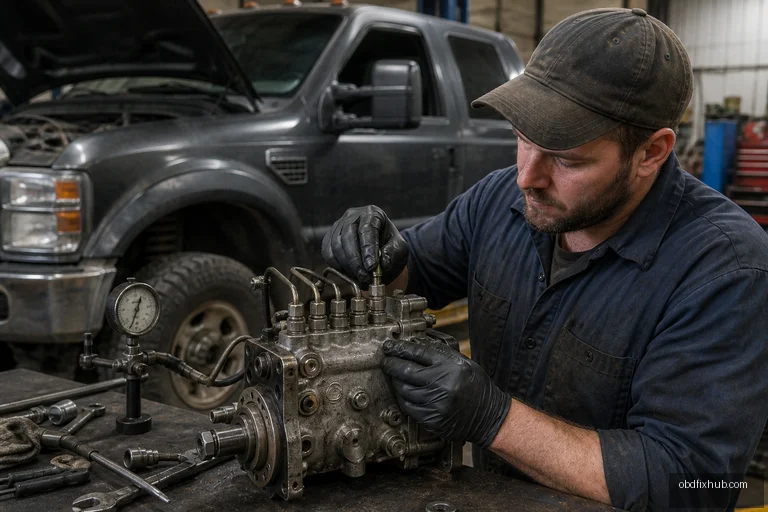
Search intent: Informational and diagnostic. The P0251 fault code means the engine control module has detected a problem with the fuel metering control circuit of the injection pump, commonly called Injection Pump Fuel Metering Control A. It does not automatically prove that the entire high-pressure fuel pump has failed. Wiring, a metering valve, low fuel pressure, contaminated diesel, or a faulty pump driver can produce the same code.
What Does the P0251 Fault Code Mean?
P0251 is a generic OBD-II powertrain code used mainly on diesel vehicles with electronically controlled injection or high-pressure common-rail fuel systems. The engine control module, or ECM, compares the commanded fuel quantity with the fuel pressure or delivery response it actually sees. When that response is implausible for a calibrated period, it stores P0251 and usually turns on the check engine light.
The term Fuel Metering Control A normally refers to the fuel quantity control valve mounted on or near the high-pressure pump. Depending on the manufacturer, this component may be called a fuel metering valve, inlet metering valve, suction control valve, fuel quantity regulator, or pump regulator. The exact name and test values vary by engine, so a generic parts replacement strategy is risky.
P0251 Symptoms You May Notice
The vehicle may still start and drive normally when the fault is intermittent. In other cases, the code appears after hard acceleration, cold starting, towing, or extended highway driving when the fuel system is under greater demand.
- Hard starting, extended cranking, or a no-start condition
- Engine hesitation, surging, or reduced throttle response
- Rough idle or an engine that stalls when coming to a stop
- Reduced power or limp-home mode
- Unusually low or fluctuating common-rail pressure
- Excessive smoke, poor fuel economy, or louder diesel operation
- Additional fuel pressure, rail pressure, or injector-related codes
A useful practical clue is the difference between a code that appears only under load and one that returns immediately after clearing. A load-related P0251 often points toward restricted fuel supply, a weak pump, or pressure loss. A code that returns as soon as the ignition is switched on is more suspicious for an electrical fault, shorted valve, damaged wiring, or a failed driver circuit.
Common Causes of P0251
- Defective fuel metering control valve or suction control valve
- Open, shorted, corroded, or chafed wiring in the metering valve circuit
- Loose electrical terminals or water contamination at the pump connector
- Clogged fuel filter, restricted pickup, collapsed fuel line, or air entering the supply side
- Contaminated fuel containing water, gasoline, rust, or microbial debris
- Low fuel supply pressure caused by a failing lift pump
- Worn high-pressure injection pump or excessive internal leakage
- Fuel rail pressure sensor inaccuracies or related circuit problems
- Incorrect battery voltage, poor grounds, or a charging-system fault
- Rarely, an ECM calibration or internal driver problem
How to Diagnose P0251 Correctly
Begin with a complete scan, not just the code shown on a basic reader. Record all stored, pending, and manufacturer-specific codes, along with freeze-frame data such as engine speed, fuel pressure, temperature, and commanded fuel quantity. A P0251 accompanied by a rail-pressure code provides a very different diagnostic direction from an isolated P0251.
- Inspect the fuel supply. Check the fuel filter service history, drain the water separator if fitted, and inspect the fuel for water or dark contamination. On many diesel systems, a restricted filter can imitate a failed injection pump.
- Perform a visual wiring inspection. Follow the harness from the pump connector toward the engine loom. Look for insulation rubbed through by brackets, oil-soaked connectors, green corrosion, and terminals that have lost tension.
- Test power, ground, and continuity. Use a wiring diagram and a multimeter. Do not assume that battery voltage at the connector proves the circuit is healthy; a voltage-drop test under load can reveal high resistance that an open-circuit check misses.
- Compare commanded and actual data. With a capable scan tool, monitor fuel metering valve duty cycle, desired rail pressure, actual rail pressure, and engine speed during cranking and acceleration. The expected values are engine-specific.
- Check low-pressure fuel delivery. Measure supply pressure and vacuum at the pump inlet where the manufacturer provides test specifications. Air bubbles in a transparent test line, if the system permits one, can expose a suction-side leak.
- Evaluate the high-pressure system. If the electrical circuit and fuel supply pass inspection but rail pressure remains low, test injector return flow and pump performance using the manufacturer’s procedure. Never loosen high-pressure diesel lines while the engine is running.
How to Fix P0251 Fault Code
The correct repair depends on the failed part, but common solutions include replacing a blocked fuel filter, repairing the pump harness, cleaning or replacing corroded terminals, fixing a leaking fuel line, or replacing the fuel metering control valve. If contaminated fuel has reached the high-pressure system, the tank, lines, filter, and sometimes the injectors and pump may require professional cleaning or replacement.
Do not replace the injection pump solely because P0251 is present. Before condemning an expensive pump, verify fuel quality, supply pressure, electrical integrity, metering valve operation, and injector return flow. A pump can be damaged by metal debris from a failing component; installing a new pump without cleaning the system may cause the replacement to fail again.
After the repair, clear the codes and perform the vehicle’s required fuel-system relearn or pump calibration if specified. Road-test the vehicle while recording actual and commanded rail pressure. A successful repair should eliminate the code and restore stable pressure during starting, idle, acceleration, and high-load operation.
What Happens When a Fuel Injection Pump Fails?
A failing injection pump may not stop the vehicle immediately. Early symptoms can include hard starting, intermittent power loss, unstable rail pressure, or stalling when the engine demands more fuel. As wear progresses, the pump may produce insufficient pressure for the injectors, resulting in a no-start condition.
In severe cases, internal pump wear creates fine metal particles that circulate through the high-pressure fuel system. This is a major failure because the injectors, rail, lines, and fuel tank may all need inspection or replacement. If a diesel suddenly loses power and metal is found in the fuel filter, avoid repeated cranking and arrange a proper contamination assessment.
What Does Ford P0251 Mean?
On Ford diesel models, P0251 generally identifies a fault involving the fuel injection pump metering control circuit or the pump quantity-control function. Ford may publish additional manufacturer-specific codes that narrow the problem to circuit voltage, fuel pressure performance, or pump operation. The engine family matters: a Power Stroke and a Ford diesel sourced from another manufacturer may use different valves, connectors, and test procedures.
Ford diagnosis should therefore include a scan with a tool capable of reading Ford-specific data, not only generic OBD parameters. Inspect the fuel filter and pump connector first, then compare commanded versus actual fuel pressure during cranking and under load.
What Does Dodge Code P0251 Mean?
On Dodge and Ram diesel vehicles, P0251 usually indicates that the ECM cannot control or verify fuel quantity through the injection pump metering circuit. The exact component may be described as a fuel control actuator, FCA, or an inlet metering valve, depending on the engine and model year.
On common-rail Cummins applications, low supply pressure, a restricted filter, air intrusion, a failing metering valve, wiring damage, and excessive injector return flow are all worth checking. Use the service information for the specific engine before applying a pressure value or resistance specification from another Dodge model.
Can You Drive With P0251?
Short-distance driving may be possible if the engine runs smoothly and maintains normal power, but it is not a code to ignore. The vehicle can enter limp mode, stall in traffic, or fail to restart. Stop driving and seek immediate diagnosis if there is severe power loss, a no-start condition, fuel contamination, unusual pump noise, or evidence of metal in the filter.
Frequently Asked Questions
Is P0251 always caused by a bad injection pump?
No. A metering valve, damaged wiring, restricted fuel filter, low supply pressure, air leak, or faulty pressure sensor can all set P0251. The pump should be condemned only after these possibilities are tested.
Can a clogged fuel filter cause P0251?
Yes. A restricted filter can starve the high-pressure pump and make actual fuel pressure fall below the commanded value. Replacing the filter and checking for contaminated fuel is often an appropriate first step, but the code should be cleared and verified afterward.
How serious is the P0251 code?
It ranges from a wiring issue to a major high-pressure fuel-system failure. Because the engine may stall or fail to start, prompt diagnosis is recommended. Metal contamination or severe pressure loss makes the situation urgent.
Will replacing the fuel metering valve fix P0251?
It will fix the code only if the valve is the actual cause. Check its power supply, control signal, connector, fuel pressure response, and related fuel restrictions before installing a replacement.
Bottom line: P0251 identifies a fuel metering control problem, not a guaranteed pump failure. Start with fuel quality, filter condition, wiring, supply pressure, and scan-tool data. A disciplined diagnosis prevents unnecessary pump replacement and helps protect the rest of the diesel fuel system.




