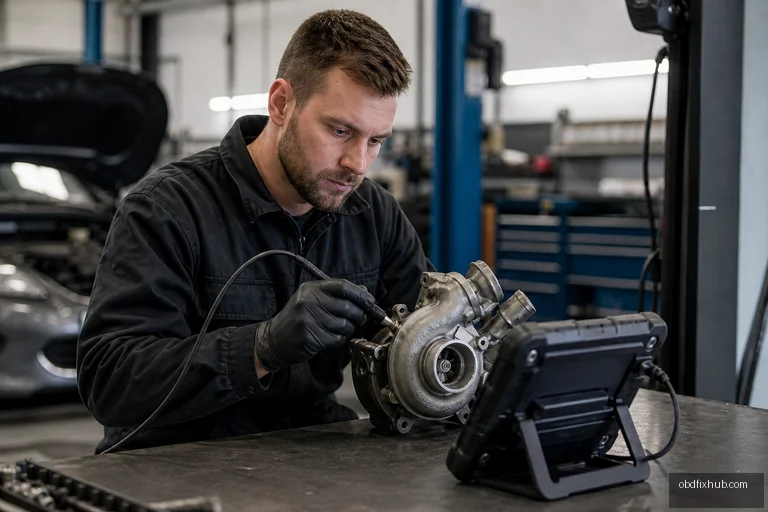
The P0234 overboost code means the engine computer detected turbocharger or supercharger boost pressure higher than the calibrated limit. In practical terms, the engine is receiving more intake pressure than the ECU expects, often because the wastegate or variable-geometry turbo cannot reduce boost quickly enough. Do not treat this code as a simple sensor warning: sustained overboost can damage the turbocharger, head gasket, pistons, or catalytic converter.
What Does P0234 Mean?
P0234 is a generic OBD-II diagnostic trouble code defined as “Turbocharger/Supercharger A Overboost Condition.” The word “A” identifies the boost-control system monitored by the vehicle manufacturer; it does not necessarily mean there are multiple turbochargers. The ECU compares requested boost with measured pressure from the MAP or boost sensor and sets P0234 when actual pressure remains too high or rises beyond a safety threshold.
The exact pressure limit varies by engine, software calibration, altitude, and operating conditions. A gasoline engine, modern diesel, and twin-turbo vehicle can all set P0234 for different reasons, so replacing parts based only on the code is a common and expensive mistake.
P0234 Symptoms You May Notice
Many vehicles enter reduced-power or “limp” mode as soon as the ECU detects dangerous boost pressure. Some drivers experience the problem only during hard acceleration, while others notice poor performance after the engine warms up.
- Check Engine Light or flashing glow-plug warning on some diesels
- Sudden loss of power and limited engine speed
- Surging or hesitation under load
- Higher-than-normal turbo whistle or an unusual siren-like noise
- Black smoke from a diesel engine caused by incorrect air-fuel control
- Engine shutdown or difficulty restarting after an overboost event
- Intermittent limp mode that temporarily disappears after cycling the ignition
A vehicle that feels normal after a restart is not necessarily fixed. Cycling the ignition may reset limp mode, but the underlying boost-control fault can return during the next hill climb or full-throttle acceleration.
Common Causes of the P0234 Overboost Code
1. Sticking wastegate or actuator
The wastegate diverts exhaust gas away from the turbine to control boost. Rust, carbon, heat damage, or a seized actuator rod can leave the wastegate closed, allowing boost pressure to continue rising. On many turbochargers, the actuator should move smoothly through its full range; a rod that moves only with excessive force is a strong clue.
2. Variable-geometry turbocharger vanes are restricted
Diesel engines commonly use VGT or VNT turbochargers. Soot and carbon can restrict the movable vanes, especially on vehicles used mainly for short urban trips. The turbo may create excessive boost at low or mid-range rpm because the vanes remain too closed instead of opening as commanded.
3. Faulty boost control solenoid or vacuum system
A boost control solenoid regulates vacuum or pressure sent to the turbo actuator. A failed solenoid, incorrectly routed vacuum hose, cracked line, blocked filter, or weak vacuum pump can prevent correct actuator movement. Inspect hose routing against the factory diagram rather than assuming every small hose is interchangeable.
4. Incorrect or modified engine calibration
Aftermarket tuning, an incorrectly installed performance controller, or a software update mismatch can command more boost than the hardware can safely control. P0234 appearing immediately after a tune, turbo replacement, or ECU programming event deserves special attention before any sensor is replaced.
5. Inaccurate MAP or boost pressure sensor
A contaminated, damaged, or poorly connected MAP sensor can report pressure that is higher than reality. However, a sensor code is not always present. Compare the sensor reading with a trusted mechanical boost gauge or scan-tool data and check whether key-on, engine-off pressure is close to local atmospheric pressure.
6. Intake or exhaust restrictions
A severely restricted air filter, collapsed intake hose, blocked intercooler passage, or restricted exhaust can disturb turbocharger control. A plugged diesel particulate filter may also increase exhaust backpressure and affect turbo operation. These problems are less obvious than a loose vacuum hose but can produce the same overboost behavior.
How to Diagnose P0234 Correctly
A professional diagnosis starts with evidence from the moment the code was set, not with a parts cannon. Record freeze-frame data, including engine speed, load, throttle position, calculated boost, and vehicle speed. Also scan for related codes such as MAP sensor, actuator position, turbo control, EGR, DPF, or mass-airflow faults.
- Compare requested and actual boost. Use live scan data during a controlled road test. If actual boost rises above commanded boost, the control mechanism is likely failing. If both values are implausibly high, question the sensor or calibration.
- Inspect the complete air path. Check the air filter, turbo inlet, charge pipes, intercooler, clamps, and intake manifold for collapse, blockage, or previous repair errors.
- Test the actuator. Apply the specified vacuum or electrical command and verify that the actuator moves smoothly and reaches its stop. Never apply uncontrolled compressed air to a vacuum actuator unless the service procedure specifically permits it.
- Check the control solenoid. Test power supply, ground, resistance, connector condition, and commanded duty cycle. A solenoid may click during a basic test yet fail under heat or load.
- Verify sensor plausibility. With the engine off, MAP pressure should generally be near atmospheric pressure, adjusted for altitude. A reading that is already implausibly high points toward wiring, sensor, or reference-voltage problems.
- Inspect turbocharger movement and condition. Excessive shaft play, damaged compressor blades, oil pooling, or a seized mechanism requires turbocharger-specific repair rather than a code reset.
One useful workshop clue is the shape of the boost trace. A sharp boost spike followed by limp mode often suggests a sticky wastegate or VGT mechanism. A steady, incorrect reading that does not respond to throttle changes is more consistent with a sensor or wiring fault.
How to Fix P0234
The correct repair depends on the failed component. Replace damaged vacuum hoses, repair wiring, clean or replace a contaminated MAP sensor, or replace a defective boost-control solenoid when testing confirms the fault. If the actuator linkage is seized, the turbocharger may need professional cleaning, actuator replacement, or complete replacement depending on wear and manufacturer specifications.
Do not adjust the wastegate rod by guesswork. Changing its length can alter base boost and cause a more serious overboost condition, even if the vehicle initially feels faster. Likewise, deleting the code without repairing the cause only hides the warning until the next high-load event.
After the repair, clear the code, perform the manufacturer’s actuator relearn if required, and repeat a road test while monitoring commanded and actual boost. Confirm that the pressure rises smoothly, follows the requested value, and does not spike during gear changes or uphill acceleration.
Can You Drive With P0234?
Short, gentle driving to a repair facility may be possible if the engine is running normally and no severe noises, smoke, or overheating are present. Avoid towing, hard acceleration, high rpm, and long uphill drives. Stop driving if the turbo makes a siren or grinding noise, the engine begins racing on its own, oil smoke appears, or power changes suddenly.
A diesel engine that begins revving uncontrollably can be experiencing a turbo oil-seal failure. In that situation, switching off the ignition may not stop the engine because it can burn engine oil as fuel. Treat that symptom as an emergency rather than as an ordinary P0234 event.
Final Takeaway
P0234 identifies excessive turbocharger or supercharger boost, but the code alone does not identify the failed part. The most reliable approach is to compare commanded and actual boost, test the actuator and control system, verify MAP sensor plausibility, and inspect for mechanical restriction. Repair the root cause before clearing the code, then confirm the fix with live data under load.
Frequently Asked Questions
Is P0234 dangerous?
It can be. Excessive boost raises cylinder pressure and turbocharger speed, potentially causing engine or turbo damage. Avoid heavy load until the cause has been diagnosed.
Can a bad MAP sensor cause P0234?
Yes. A MAP sensor that reports artificially high pressure can trigger P0234, although mechanical overboost must be ruled out first by comparing scan data with a verified pressure measurement.
Will a boost leak cause P0234?
Usually, a boost leak causes underboost rather than overboost. However, an intake restriction, incorrectly routed hose, or control-system problem associated with a leak can produce confusing boost readings, so the entire intake and control system should be inspected.
How do I fix P0234 on a diesel?
Begin by checking vacuum supply, the boost-control solenoid, actuator travel, and VGT vane movement. Carbon-restricted vanes are common on diesels, but sensor and DPF-related faults should also be tested before replacing the turbocharger.
Can clearing the code fix P0234?
No. Clearing the code may temporarily remove limp mode, but it does not correct a seized actuator, faulty sensor, wiring problem, or incorrect calibration. The code will normally return when the engine again reaches the conditions that caused overboost.




