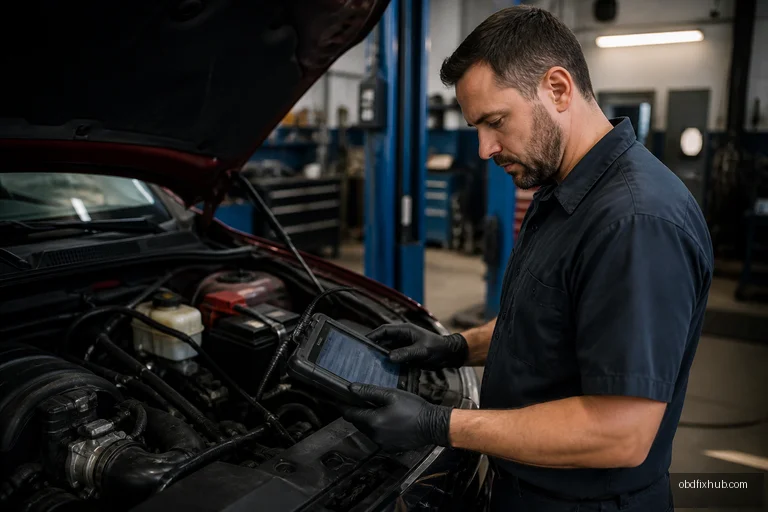
P0315 Crankshaft Position System Variation Not Learned means the engine control module has not successfully learned the normal relationship between the crankshaft position sensor signal and actual crankshaft rotation. In many vehicles, the repair is a crankshaft position variation relearn performed with a capable scan tool—not automatic replacement of the crankshaft sensor. However, a failed relearn can also point to misfires, incorrect timing, reluctor wheel damage, wiring faults, or an engine mechanical problem.
What Does P0315 Mean?
The crankshaft position sensor tells the PCM or ECM where the crankshaft is and how fast it is turning. The computer uses this information to control ignition timing, fuel injection, variable valve timing, and misfire detection. During a variation relearn, the module measures tiny changes in crankshaft speed as each cylinder fires and stores a reference pattern.
That pattern is important because no crankshaft, reluctor wheel, or sensor produces a perfectly uniform signal. P0315 is set when the module cannot complete or trust this calibration. The exact wording and relearn procedure vary by manufacturer; GM commonly refers to this operation as a CASE relearn, while other manufacturers may call it crankshaft position variation learning or a crankshaft relearn.
Common Causes of P0315
- The crankshaft variation relearn was never performed after an engine, PCM, or crankshaft-related repair.
- A replacement crankshaft position sensor has been installed without completing the required relearn.
- The engine has an active misfire, unstable idle, low compression, or fuel delivery problem that prevents a clean calibration.
- The crankshaft reluctor wheel is damaged, loose, bent, incorrectly positioned, or installed with the wrong indexing.
- Incorrect valve timing caused by a stretched, jumped, or incorrectly installed timing chain or belt.
- Crankshaft position sensor wiring is open, shorted, poorly routed, contaminated with oil, or affected by a weak ground.
- Low battery voltage or a charging-system problem interrupts the relearn procedure.
- The wrong crankshaft sensor, incompatible PCM software, or an incorrectly programmed control module is installed.
- Less commonly, excessive crankshaft end play, a damaged harmonic balancer, or a mechanical engine fault changes the expected signal.
P0315 Symptoms to Watch For
Some vehicles store P0315 without an obvious drivability complaint, especially when the code is set immediately after service. Others may exhibit symptoms because the underlying problem affects engine speed or timing. Typical signs include:
- Check Engine Light illumination
- Hard starting, extended cranking, or an engine that will not start
- Rough idle, hesitation, stumble, or reduced acceleration
- Engine misfire codes such as P0300 or cylinder-specific P0301–P0308 codes
- Stalling when coming to a stop or during warm-up
- Reduced power or limp-home operation
- Intermittent tachometer movement or an engine-speed signal that drops out
A useful diagnostic clue is timing. If P0315 appeared directly after timing-chain work, an engine replacement, PCM replacement, or crankshaft sensor installation, an incomplete relearn is more likely than a randomly failed component. If the code returns after a correct relearn, treat it as a fault that needs testing.
How to Diagnose P0315 Correctly
1. Scan for related codes first
Use a professional scan tool to record all stored, pending, and history codes. Do not focus on P0315 alone. Misfire, camshaft correlation, crankshaft sensor circuit, low-voltage, fuel-pressure, or timing codes may identify the real reason the variation pattern cannot be learned.
2. Check the repair history and live data
Ask whether the engine, PCM, crankshaft sensor, harmonic balancer, or timing components were recently removed. Inspect engine RPM while cranking and compare crankshaft and camshaft synchronization data if the scan tool provides it. A zero or erratic RPM reading during cranking strongly suggests a sensor, wiring, power, ground, or reluctor problem rather than a simple relearn issue.
3. Inspect the sensor circuit and mechanical trigger
Look for damaged wiring near the crankshaft pulley, oil-soaked connectors, bent terminals, poor grounds, and wiring routed too close to ignition components. Remove the sensor only when necessary and inspect its mounting area for metal debris or an incorrect air gap. If symptoms began after crankshaft or timing work, verify the reluctor wheel and timing marks instead of assuming the new sensor is defective.
4. Confirm battery and engine condition
A crankshaft relearn often requires several controlled high-RPM accelerations. A weak battery, poor alternator output, overheating, unstable idle, or an active misfire can cause the process to abort. The engine should start easily, reach normal operating temperature, and run smoothly before attempting the procedure.
How to Fix P0315
When no mechanical or electrical fault is found, connect a scan tool that supports the vehicle-specific crankshaft position variation relearn. Follow the manufacturer’s conditions precisely. Depending on the vehicle, the procedure may require the transmission to be in Park or Neutral, the engine to be warm, the brake pedal applied, and the throttle released before accelerating to a specified RPM.
- Repair any crankshaft sensor, camshaft correlation, misfire, fuel, or voltage problems first.
- Warm the engine and verify that the battery and charging voltage are stable.
- Use the scan tool’s crankshaft variation relearn or CASE relearn function.
- Perform the commanded acceleration only in a safe, controlled environment and within the manufacturer’s RPM limits.
- Allow the engine to return to idle, clear the code, and complete a road test.
- Rescan the vehicle and confirm that P0315 does not return as a pending or confirmed code.
Do not attempt the relearn in traffic, on a public road without proper control, or with the drive wheels unsecured. On some vehicles, the procedure is performed with the vehicle stationary; on others, the service information specifies different conditions. Always use the exact instructions for the vehicle’s year, engine, and transmission.
Can You Drive With P0315?
Short trips may be possible if the engine starts normally and runs smoothly, but driving should not be treated as a permanent solution. A failed crankshaft variation calibration can interfere with misfire detection and may accompany a timing or sensor problem. Stop driving if the Check Engine Light flashes, the engine stalls, there is severe loss of power, or strong misfires are present, because catalytic-converter damage can occur.
What Not to Replace First
The most common expensive mistake is replacing the crankshaft position sensor solely because P0315 contains the word crankshaft. This code does not automatically prove that the sensor is defective. Confirm the signal, wiring, mechanical timing, and relearn requirements before buying parts; a new sensor will not correct a jumped timing chain or a damaged reluctor wheel.
Final Takeaway
P0315 usually indicates a missing or unsuccessful crankshaft position variation calibration, but the correct fix depends on why the relearn failed. Check related codes, verify sensor and engine-speed data, inspect timing and reluctor components, then perform the manufacturer-approved relearn with a capable scan tool. If the code returns, stop repeating the relearn and diagnose the underlying electrical or mechanical fault.
Frequently Asked Questions
Can a bad crankshaft sensor cause P0315?
Yes, a faulty sensor or damaged sensor circuit can prevent the PCM from receiving a reliable signal. However, P0315 can also be caused by a missing relearn, misfire, incorrect timing, or reluctor wheel damage, so sensor replacement should be based on testing.
Will disconnecting the battery fix P0315?
No. Disconnecting the battery may clear some temporary data, but it does not repair a wiring, timing, sensor, or mechanical problem. On many vehicles, it also does not erase the stored crankshaft variation data in the same way a control-module replacement can.
Does P0315 require a special scan tool?
Usually, yes. A basic code reader can display P0315 but commonly cannot initiate the crankshaft variation relearn. A manufacturer-level or advanced bidirectional scan tool is normally required.
Why does P0315 return after a relearn?
It may return because the engine has an active misfire, unstable RPM, incorrect valve timing, a bad reluctor wheel, a poor crankshaft sensor signal, or a control-module software issue. Repeating the relearn without checking these areas usually wastes time.
Can P0315 cause a no-start condition?
It can, particularly when the crankshaft signal is missing or the PCM cannot synchronize crankshaft and camshaft position. A vehicle with a no-start condition should be tested for engine RPM during cranking, sensor power and ground, signal integrity, fuel pressure, and ignition output.




