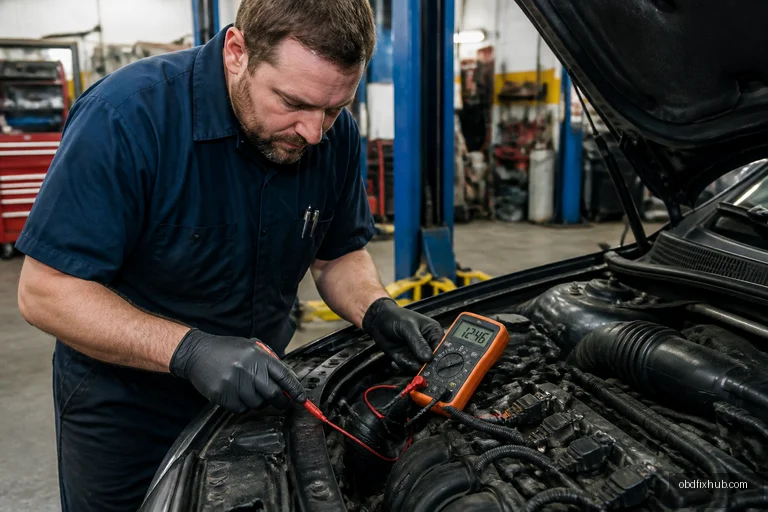
P030A Ignition A Control Signal Circuit/Open means the engine computer has detected a missing, interrupted, or electrically incorrect control signal in part of the ignition system. The fault may involve an ignition coil, wiring, connector, ignition control module, power supply, ground, or the ECU’s internal coil driver. Do not replace the ignition module immediately: the same code can be caused by a broken wire or a coil that has shorted and damaged the driver circuit.
What Does P030A Mean?
The wording of P030A is not interpreted identically on every vehicle. Some manufacturers use it for an ignition control circuit associated with a particular cylinder, while others use “Ignition A” as a circuit or coil designation. Before testing, verify the exact definition in a manufacturer service manual or a scan tool with enhanced vehicle coverage.
On a conventional ignition system, the ECU or ignition control module switches the coil’s primary circuit on and off. That switching creates the high voltage needed at the spark plug. An “open” fault means the expected electrical path or control signal is absent; it does not necessarily mean the circuit is visibly broken.
Common Causes of P030A
- Broken, stretched, or corroded wiring between the ECU, ignition module, and coil
- A loose connector terminal, backed-out pin, water intrusion, or damaged coil plug
- Failed ignition coil or an internally shorted coil
- Missing ignition power caused by a blown fuse, relay, or poor power connection
- Bad engine ground or excessive voltage drop in the module ground circuit
- Defective ignition control module, where the vehicle uses a separate module
- An ECU coil-driver failure, sometimes caused by a shorted coil or incorrect jump-start connection
- Previous repair work that left a harness pinched, pulled, or incorrectly spliced
A useful field clue is the timing of the fault. If P030A appeared immediately after a jump start, engine wash, coil replacement, or collision repair, inspect the related wiring and power supply before buying expensive electronic parts.
Symptoms You May Notice
The most common symptom is a misfire, because the affected cylinder or ignition channel is not receiving a reliable spark. The engine may start poorly, run roughly, or hesitate under load. Some drivers notice the problem only when accelerating, when vibration and harness movement expose an intermittent connection.
- Check Engine Light, sometimes flashing during a severe misfire
- Rough idle, stumbling, hesitation, or loss of power
- Long cranking or a no-start condition
- Fuel smell from unburned fuel in the exhaust
- Reduced fuel economy and poor throttle response
- Additional misfire or coil primary-circuit codes
A flashing Check Engine Light should be treated as urgent. Continued driving with a dead ignition channel can send raw fuel into the catalytic converter and overheat or destroy it.
How to Diagnose P030A Correctly
1. Confirm the code and freeze-frame data
Record every stored and pending code, engine temperature, RPM, and load when the fault occurred. Check technical service bulletins for the exact vehicle. A generic code description can be misleading, particularly when “Ignition A” does not clearly identify a cylinder.
2. Inspect the coil and connector first
Look for cracked coil insulation, oil inside a spark-plug well, melted plastic, green corrosion, and terminals pushed backward in the connector. With the engine idling, gently move the harness near the coil and module. If the engine stumbles, you have valuable evidence of an intermittent wiring fault—but repair the damaged section rather than simply securing it with tape.
3. Check power and ground under load
Do not rely only on a continuity test. A wire can show continuity with no load and still fail when the coil draws current. Verify ignition voltage at the coil connector with the circuit active, then perform a voltage-drop test between the module ground and battery negative while cranking or running. A reading noticeably above about 0.1–0.2 volts on a critical ground deserves investigation, although the exact specification depends on the manufacturer.
4. Test the control signal safely
A test light, LED logic probe, oscilloscope, or suitable automotive scope can reveal whether the ECU or ignition module is commanding the coil. The expected waveform and voltage vary widely, so compare it with a known-good cylinder or follow the wiring diagram. Never connect a conventional incandescent test light to an ECU control wire unless the service procedure explicitly permits it; the extra load can damage a sensitive driver.
5. Swap components only when the system allows it
If the vehicle has interchangeable coil-on-plug units, move the suspected coil to another cylinder and clear the codes. If the fault follows the coil, the coil is a strong suspect. If the code remains on the original circuit, focus on wiring, the driver signal, power, ground, or the module. This test is more dependable than condemning a coil from resistance readings alone.
How to Fix an Ignition Coil A Primary Control Circuit Open
Once testing identifies the failure, the repair is usually straightforward:
- Repair or replace damaged wiring using the correct wire size, sealed crimp connections, or solder and heat-shrink where approved by the manufacturer.
- Replace loose terminals and repair connector locks; cleaning corrosion without restoring terminal tension will not provide a lasting repair.
- Replace a failed ignition coil, spark plug, or coil boot, and correct oil or water contamination in the plug well.
- Replace a blown fuse or relay only after finding why it failed. Installing a larger fuse can cause harness damage or fire.
- Replace the ignition control module only after confirming its power, ground, input, and output circuits.
- If the ECU driver is proven defective, have the ECU professionally repaired or replaced and programmed as required.
After the repair, clear the code, perform the vehicle’s required relearn procedure, and road-test it under the conditions shown in the freeze-frame data. Recheck for pending codes rather than assuming the repair succeeded because the warning light stayed off for one short trip.
Signs of a Bad Ignition Control Module
A failing ignition control module may cause an intermittent no-start, stalling after the engine warms up, weak or absent spark, multiple-cylinder misfires, or a loss of the coil trigger signal. Heat-related failure is common: the engine may run normally when cold and stop after ten to twenty minutes, then restart after cooling.
However, these symptoms do not prove the module is bad. A failing crankshaft position sensor, poor ground, ignition relay, or damaged harness can produce nearly identical behavior. Confirm that the module receives the correct supply voltage and ground and that its input signal is present before replacing it.
What Burns Out an Ignition Control Module?
The most common causes are excessive heat, voltage spikes, reversed jump-start polarity, an incorrectly connected battery charger, water intrusion, and a coil with an internal short. A poor ground can also force the module to handle abnormal current and generate damaging heat. Repeatedly installing a new module without testing the coil and wiring often causes the replacement to fail again.
Some modules can be repaired at component level, but most modern units are sealed, potted, or integrated into the ECU. A specialist may repair a failed driver board, yet replacement and programming are often more reliable when the unit has extensive internal damage. The practical answer to “Can you fix an ignition control module?” is: sometimes, but only after testing confirms the module itself is the failed component.
Bottom Line
P030A is an electrical ignition-control fault, not an automatic instruction to replace the ignition module. Start with the exact vehicle-specific code definition, then verify the coil, connector, power supply, ground, wiring, and control waveform in that order. Repair the root cause, clear the code, and confirm the fix with a complete road test—especially if the Check Engine Light is flashing.
Frequently Asked Questions
Can I drive with P030A?
Only for the shortest distance needed for diagnosis if the engine is running smoothly. Do not continue driving with a flashing Check Engine Light, severe shaking, or a strong fuel smell because catalytic-converter damage may occur.
Does P030A always mean the ignition coil is bad?
No. The coil is one possibility, but an open wire, loose connector, missing power, weak ground, ignition module, or ECU driver can produce the same code.
How do I fix an open ignition coil control circuit?
Find the open or high-resistance section with a wiring diagram and voltage-drop testing, then repair the harness or terminal. If the circuit and power supply test correctly, test or replace the coil and control module according to the vehicle’s service procedure.
What are the signs that my ignition control module is bad?
Typical signs include intermittent stalling, a hot no-start, loss of spark, missing coil trigger signals, and recurring ignition-control codes. These symptoms must be confirmed with power, ground, input, and output tests.
Can an ignition control module be repaired?
Some electronic repair specialists can rebuild certain modules, but sealed or ECU-integrated units are commonly replaced and programmed. Always identify the root cause—especially a shorted coil or voltage spike—before installing another module.




