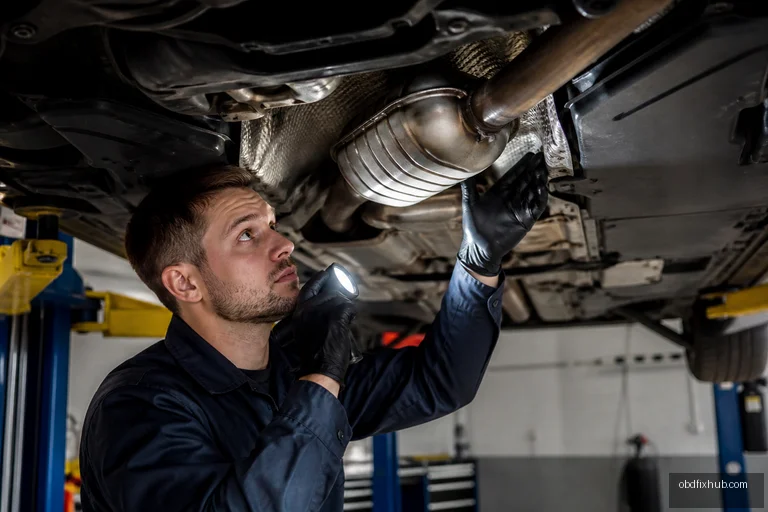
P0424 means the engine control module has detected that the heated catalytic converter on Bank 1 is not reaching its expected operating temperature quickly enough. This is usually a cold-start emissions problem, not an immediate engine failure, but it should not be ignored. The underlying cause may be a weak catalytic converter, an exhaust leak, faulty oxygen sensor data, incorrect fuel mixture, low coolant temperature, or a problem in the catalyst-heating strategy.
What Does the P0424 Code Mean?
The diagnostic trouble code P0424 is defined as Heated Catalyst Temperature Below Threshold, Bank 1. Bank 1 is the side of the engine containing cylinder number one. On an inline four-cylinder engine there is only one bank, while V6 and V8 engines have Bank 1 and Bank 2.
The word heated does not always mean that the vehicle has a separate electric heater inside the catalytic converter. In many gasoline vehicles, the catalyst is heated by deliberately changing ignition timing and fueling during the first seconds after startup. The ECM then estimates catalyst temperature by comparing oxygen sensor behavior with coolant temperature, airflow, engine load, and exhaust conditions.
That distinction matters during diagnosis. A P0424 does not automatically prove that the catalytic converter itself is defective, and replacing the converter before checking the inputs that control the test is a common and expensive mistake.
Common Symptoms of P0424
Many vehicles with P0424 drive almost normally because the fault is detected during the catalyst warm-up phase. The check engine light may be the only obvious symptom. However, a careful owner may notice changes during cold operation.
- Check engine light or malfunction indicator lamp
- Longer cold-start emissions warm-up period
- Rough or unusually high idle for the first minute
- Reduced fuel economy, especially on short trips
- Exhaust smell resembling sulfur or unburned fuel
- Sluggish acceleration if the converter is restricted
- Failed emissions or inspection testing
- Additional oxygen sensor, fuel-trim, misfire, or coolant-temperature codes
If the vehicle has severe loss of power, a glowing red catalytic converter, repeated misfire codes, or loud rattling from the exhaust, stop driving except to move the vehicle safely. Those signs can indicate overheating or a collapsing substrate, which can cause further engine and exhaust damage.
What Causes P0424?
1. Aged or contaminated catalytic converter
A catalyst loses its ability to store oxygen and promote chemical reactions as the washcoat wears out. Oil consumption, coolant entering the combustion chamber, silicone contamination, prolonged rich running, and repeated misfires can poison or melt the catalyst. In this situation, the converter may genuinely warm too slowly even when every sensor is working correctly.
2. Exhaust leak before the catalytic converter
A small leak at the exhaust manifold, manifold gasket, flex pipe, or upstream oxygen sensor threads can draw outside air into the exhaust stream. That extra oxygen distorts the sensor signal and may cause the ECM to calculate an abnormally low catalyst temperature. Look for black soot marks, ticking noises during a cold start, or a leak that becomes quieter as the metal expands.
3. Faulty oxygen or air-fuel ratio sensor
The ECM relies heavily on upstream and downstream sensor feedback when evaluating catalyst performance. A slow upstream air-fuel sensor, a biased rear oxygen sensor, damaged wiring, or a contaminated connector can make a healthy converter appear too cold. Sensor-related trouble codes and abnormal live-data readings should be addressed before condemning the catalyst.
4. Engine running too rich or too lean
Incorrect fuel pressure, leaking injectors, a dirty mass airflow sensor, vacuum leaks, purge-valve problems, or ignition faults can prevent the catalyst from reaching the intended temperature. A rich mixture can overheat and damage the converter, while a lean mixture may produce insufficient exhaust heat during warm-up. Misfire codes such as P0300 through P030x are especially important because unburned fuel can rapidly destroy the catalyst.
5. Engine coolant temperature problem
A thermostat stuck open or an engine coolant temperature sensor that reports an artificially warm or cold engine can disrupt catalyst heating. If the ECM thinks the engine has already warmed up, it may skip or shorten the catalyst warm-up strategy. Compare the coolant temperature after an overnight cold soak with ambient temperature; they should be close before the engine starts.
6. Ignition, software, or wiring faults
Incorrect ignition timing, weak ignition components, damaged harnesses, poor grounds, and outdated engine-control software can all affect the P0424 monitor. Some manufacturers have issued software updates for false catalyst-temperature complaints, so checking technical service bulletins by VIN is worthwhile before buying parts.
How to Diagnose P0424 Correctly
Use a scan tool capable of displaying live data and freeze-frame information. The freeze-frame shows the exact conditions when the code set, including coolant temperature, engine speed, load, fuel trims, and vehicle speed. A code that appears only at -10°C during a short idle period points toward a different problem than one that returns after every fully warmed highway drive.
- Record all stored and pending codes. Diagnose misfires, fuel-trim faults, coolant-temperature codes, and oxygen-sensor codes first. P0424 may be a secondary result rather than the primary failure.
- Inspect the exhaust cold. Check the manifold, gaskets, flex section, oxygen sensor ports, and converter seams for soot, cracks, or ticking noises. An approved smoke machine or low-pressure exhaust leak test is more reliable than simply listening.
- Check cold-start data. Coolant temperature and intake-air temperature should be reasonably close to ambient after the vehicle sits overnight. An implausible temperature reading can derail the catalyst monitor.
- Evaluate fuel trims and sensor response. Large positive trims suggest a lean condition or unmetered air; large negative trims suggest excessive fuel. Confirm that the upstream sensor responds quickly and that the downstream signal behaves consistently once the converter is hot.
- Verify engine temperature and warm-up. A scan tool should show the engine reaching its normal operating range within a reasonable drive. A thermostat that remains open can keep the engine and catalyst below the expected temperature.
- Test for restriction if power is low. Excessive backpressure or a vacuum gauge that drops under load can reveal a melted or collapsed converter. Do not continue driving a vehicle with a restricted converter.
- Check manufacturer-specific information. Catalyst-monitor enable conditions and repair procedures vary. Follow the service manual for the exact make, model, engine, and model year.
One practical diagnostic tip is to compare the same cold-start data on a known-good vehicle of the same model when possible. Generic oxygen-sensor voltage values can be misleading because some vehicles use wideband air-fuel sensors whose readings do not behave like conventional narrowband sensors.
How to Fix P0424
The correct repair depends on the test results, not simply on the presence of the code. Possible fixes include:
- Repairing an exhaust manifold, gasket, flex-pipe, or oxygen-sensor leak
- Replacing a failed coolant-temperature sensor or thermostat
- Repairing oxygen-sensor wiring or replacing a sensor that fails response testing
- Cleaning or replacing a contaminated mass airflow sensor where appropriate
- Correcting injector, fuel-pressure, vacuum-leak, purge, or ignition problems
- Installing the correct catalytic converter after confirming the original unit is degraded or restricted
- Applying a manufacturer software update when a known calibration issue exists
Do not install a cheap universal converter solely to clear the warning light. The replacement must meet the vehicle’s emissions specification and be installed without leaks. If an engine is burning oil or misfiring, repair that condition first; otherwise, the new converter may fail again within a short time.
Can You Drive With P0424?
Short-distance driving is often possible when the vehicle has only a steady check engine light and no drivability symptoms. Nevertheless, continued driving can worsen catalyst damage and may leave you with a failed emissions test. Avoid long trips and heavy loads until the cause is identified, particularly if the exhaust smells strongly of fuel or the converter becomes unusually hot.
A flashing check engine light is a different situation. It usually indicates an active misfire capable of damaging the catalytic converter, so reduce engine load and have the vehicle inspected immediately.
Repair Cost Expectations
Costs vary widely by vehicle. A loose exhaust connection, damaged wire, or thermostat may be a relatively modest repair, while a catalyst replacement can be one of the more expensive exhaust-system jobs. Oxygen sensors, fuel-system faults, and diagnostic labor also vary by engine design and accessibility.
Ask the repair shop for the test results that justify the repair. A trustworthy estimate should explain whether the converter was proven inefficient or restricted, whether exhaust leaks were ruled out, and whether the engine is free of misfires and abnormal fuel trims.
Final Takeaway
P0424 indicates that Bank 1’s catalytic converter is not reaching the expected temperature during the monitored warm-up period. The converter may be worn out, but exhaust leaks, sensor errors, incorrect fuel mixture, thermostat problems, misfires, and software issues are equally important possibilities. Start with freeze-frame data, cold-start inspection, exhaust-leak testing, temperature verification, and fuel-trim analysis before replacing the catalyst.
If the light is steady, schedule a proper diagnosis soon. If it is flashing or the vehicle has severe power loss, overheating, or active misfires, stop driving and arrange professional service.
Frequently Asked Questions
Is P0424 the same as P0420?
No. P0420 generally indicates catalyst efficiency below threshold for Bank 1, while P0424 specifically concerns the catalyst not reaching the expected temperature during warm-up. The two codes can share causes, but they require different diagnostic emphasis.
Does P0424 always mean I need a new catalytic converter?
No. An exhaust leak, faulty oxygen sensor, thermostat, coolant-temperature sensor, fuel problem, misfire, or calibration issue can trigger P0424. The converter should be replaced only after these possibilities have been tested.
Can a bad thermostat cause P0424?
Yes. If the thermostat is stuck open, the engine may warm too slowly and the catalyst may not reach the temperature expected by the ECM. Compare cold-soak temperature readings and monitor coolant temperature during a road test.
Will clearing P0424 fix the problem?
Clearing the code only erases the warning temporarily. If the fault remains, the catalyst monitor will run again and the code will return, often after several cold starts or drive cycles.




